
AI-Native vs. Traditional Supply Chain Planning System Implementation: Why It Takes Weeks, Not 18+ Months
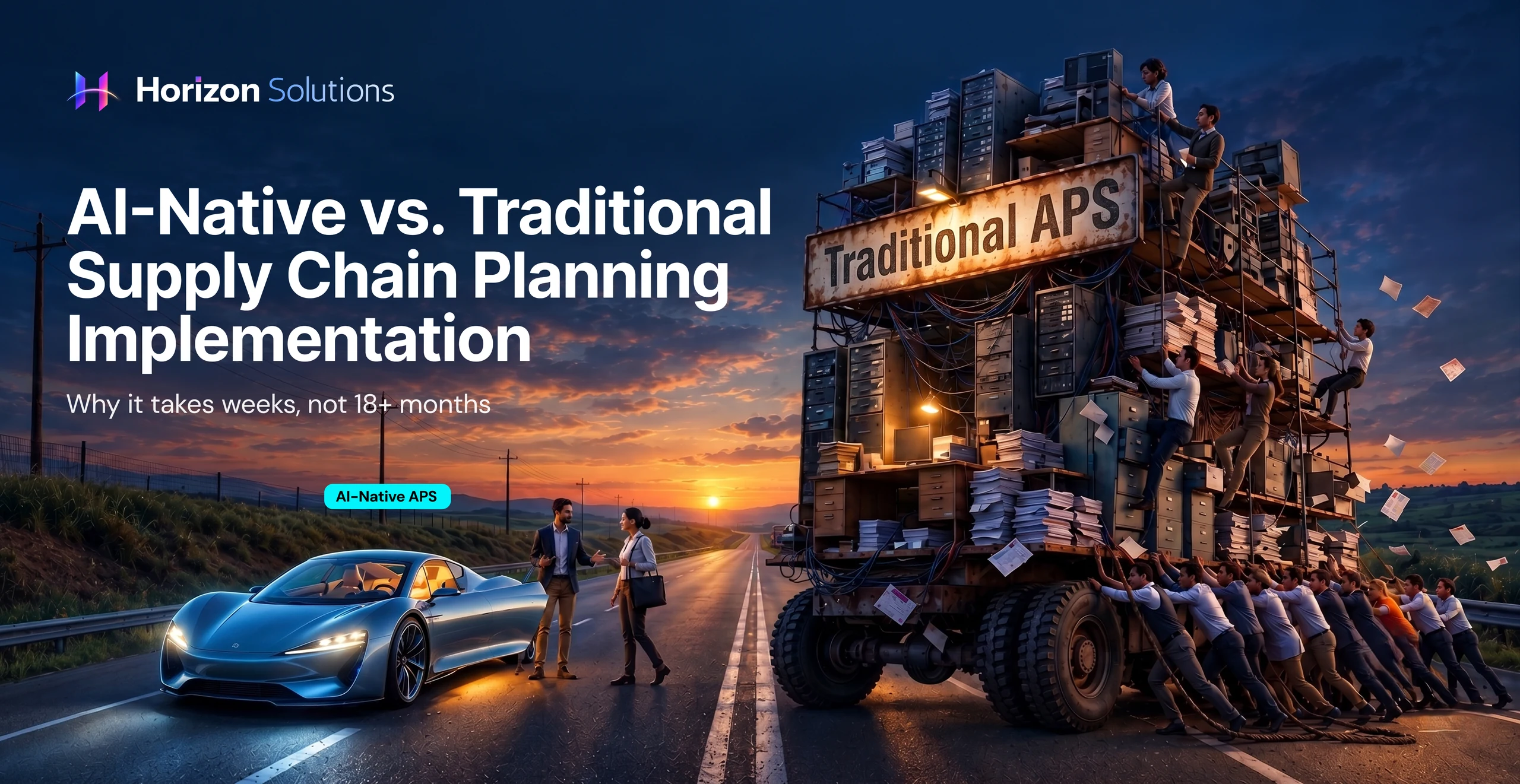
TL;DR: A planning system implementation has two phases: data transformation, configuration, and model setup, then user testing and change management. Horizon compresses the first phase from months to under 24 hours, so most customers go live within weeks, the time it takes to test and adopt a new system. Traditional planning systems can take months on the first phase alone, before a user even has access, and then bill separately for every change request afterward, which is what stretches a traditional rollout past 18 months. The technical part of that timeline is becoming obsolete. The change-management part isn't, and won't be.
If you're evaluating supply chain planning software, one of the more consequential supply chain management decisions you'll make this year, you've probably been quoted 18+ months for implementation and told that's just how long it takes. Part of that is true: testing a new system with real users and managing the change a rollout requires takes real time, and AI doesn't shortcut it. But most of an 18+ month quote isn't change management. It's data transformation, configuration, and model setup, the work that used to need a room of consultants and now takes under a day.
The two phases of a supply chain planning implementation
Every implementation, AI-native or traditional, has to get through the same two phases before a planning system is actually in use.
The first is technical: transforming raw ERP and operational data into a usable model, configuring the system to match how the business plans, and selecting or tuning the right forecasting and optimisation models for the data. None of this involves a single end user yet. It's infrastructure work.
The second is human: putting the system in front of planners, testing it against real decisions, training people to use it, and managing the organizational change that comes with replacing a process people have run manually, or on spreadsheets, for years. This phase doesn't get faster because the underlying software got smarter. It gets faster when people have time to learn a new system and reasons to trust it.
Large enterprise APS (Advanced Planning & Scheduling) platforms have historically bundled both phases into one long, billable engagement, which is a big part of why "18 months" became the default answer to "how long will this take." What's changed is phase one. What hasn't is phase two, and it shouldn't.
Phase one: data transformation, configuration, and model setup
As Horizon co-founder Ben, explained in what AI really means in supply chain planning, it breaks down into a few distinct things: machine learning for forecasting, optimisation for supply decisions, and, critically for implementation speed, LLMs for exactly the kind of grunt work that used to require a room of consultants: identifying column types and mapping data structures, generating the SQL or Python needed to clean and transform ERP exports, and translating messy client data into a usable model.
That's the gap AI-native architecture actually closes: Horizon customers have a usable environment, with their own data mapped, cleaned, and modeled, in under 24 hours. That's day zero, not go-live: it's the first leg of the journey, not a second, competing claim. Full implementation, phase two included, still takes under four weeks.
Add model selection to that. Horizon doesn't make a planner pick a forecasting algorithm and hope it's right: the platform evaluates and selects the right model for the data automatically, accounting for demand variability and supply risk, and keeps re-evaluating as the business changes. Pre-built connectors for SAP, NetSuite, Microsoft Dynamics 365, and Infor activate in 1-2 days. For everything else, Bring Your Data in Any Format lets AI-guided transformation handle the mapping and cleanup that used to be a consulting deliverable.
Change requests work the same way. The same underlying LLM and automation layer that maps your data can generalise a change request that the vast majority of customers eventually ask for: a new inventory rule, a different exception view, a WhatsApp-based update flow. Ship it once, to everyone, instead of quoting it site by site as custom services work. What used to be a billable event at every location becomes a release note. And because every site runs on the same data model and the same integration, a multi-site rollout isn't twelve sequential projects. It's the same rollout, run in parallel.
None of this requires a user to have touched the system yet. It's the setup, and it's now measured in hours, not months.
Phase two: user testing and change management
Horizon customers go live in under four weeks, with single-module deployments in as little as 2-3 weeks. But here's the part worth being honest about: a fast technical setup doesn't make user testing and change management faster. A planner who's run demand planning in spreadsheets for ten years doesn't trust a new system on day one because the data loaded quickly. A global rollout across dozens of sites still means dozens of teams learning a new process, in their own time zones, languages, and working patterns.
That's why go-live takes weeks, not hours. The gap between "environment ready" and "go-live" is phase two: testing, training, and adoption, done at the pace people need, not the pace the software allows.
This is also where a global, multi-site rollout earns some real time. Training and change management across many sites and regions is legitimate work. It doesn't disappear because AI got faster, and no platform, AI-native or not, should claim otherwise.
Why traditional supply chain planning implementations still take 18+ months
Most large enterprise planning platforms are sold on two revenue lines: a license and implementation, the services needed to make the software run in the business. The license is usually a fixed, negotiated number. The implementation is where the real, ongoing revenue sits, and it's typically billed by time and materials or by milestone, delivered by a systems integrator or the vendor's own consulting arm. None of that shows up as a license line item, but it's real total cost of ownership, and it's worth asking for upfront.
That structure means phase one, the technical setup, gets billed the same way as phase two, even though only phase two requires time to pass. In Horizon co-founder Ben Van Delm's look back at six decades of planning software history, this is one of the things that hasn't moved in sixty years: “Access to a usable environment still often takes months, and full rollouts still take years, especially in large organisations.” The clouds got cheaper. Compute got cheaper. Implementation timelines didn't, because “Total cost of ownership for customers did not come down in the same way. Dependencies on and shortage of consultants, high cost of change, and long-running projects are almost still expected by companies.”
Now layer on a global rollout. Instead of one implementation, you have one per plant, one per region, one per business unit, each treated as its own project with its own statement of work, even though the underlying software, data model, and configuration logic are identical every time. Every one of those sites becomes a fresh phase-one clock, even though phase one doesn't need to run again. And once a handful of sites are live, the same pattern repeats through change requests: a tweak to a planning rule, a new report, a process that doesn't quite match what was scoped a year earlier. Those get quoted individually, billed individually, and rolled out site by site, even when the same change has already been built, tested, and billed for the site next door.
None of this is a secret. It's what happens when phase one and phase two get billed the same way, and the model has no incentive to tell them apart.
Traditional vs. AI-native supply chain planning: what's different, what isn't
Phase two is the same row on both sides on purpose. AI didn't make change management faster, and a platform that claims it did isn't being honest with you.
| Traditional planning system | AI-native (Horizon) | |
|---|---|---|
| Phase one: data transformation, configuration, model setup | Manual, by a consulting team: weeks to months, billed by time and materials | AI-guided, automatic: under 24 hours |
| Change requests | Custom-quoted and billed per client, often repeated per site | Common requests productized once, shipped to all customers |
| Per-site rollout | Each site scoped, billed, and delivered as its own project | One data model and integration, deployed to every site in parallel |
| Phase two: testing, training, change management | Real, necessary, and takes weeks to months, same as any new system | Real, necessary, and takes weeks, same as any new system |
| Typical time to go live | 18+ months, often longer with multi-site rollout and change requests | Under 4 weeks; 2-3 weeks for a single module |
What a fast & successful supply chain planning implementation requires
Whichever platform you choose, it's worth asking what's driving your quoted timeline, not to catch anyone out, but because the two phases should be priced and scheduled differently.
Ask how long phase one takes on your own data, separate from training and rollout. A vendor that can answer this precisely has clearly separated the two already. Ask whether each site in a multi-site rollout needs its own phase one, or whether one data model and integration can serve every site in parallel. And find out how common change requests get handled, built once and shipped as a feature, or quoted and billed per client every time, plus how much of the quoted timeline is phase two: testing, training, and change management. That part is legitimate, and no platform should promise to skip it.
You don't have to accept the traditional pace as inevitable, and you don't have to take a vendor's word for why it's necessary. The technology to compress phase one exists and is already in production. Separating the two phases is the fastest way to find out whether your quoted timeline reflects real change-management work, or just an unseparated bill.
Frequently asked questions
1. Why do supply chain planning implementations typically take 18+ months?
Because phase one, data transformation, configuration, and model setup, and phase two, testing and change management, get bundled into one long, billed engagement. On a traditional platform, phase one alone can take months before a single user has access, and change requests keep billing throughout the rollout, which is what pushes a multi-site, global implementation to 18 months or more.
2. Does AI eliminate the need for training and change management?
No. AI compresses phase one, the technical setup, from months to under a day. It doesn't change phase two. Testing a system with real users and managing organizational change still takes real time, and that's true for any platform, AI-native or not.
3. Why do change requests get billed per site instead of built once?
In a services-led model, each change request is typically scoped and quoted for the specific client and site asking, even when other customers have requested something functionally identical. An AI-native, productized platform can generalize common requests and ship them as features to every customer, instead of re-billing the same work repeatedly.
4. How fast can an AI-native supply chain planning platform go live?
Horizon customers have a usable environment in under 24 hours, for data transformation and initial configuration, phase one. That's not the same claim as go-live: full implementation, including the testing and change management of phase two, typically takes under four weeks, with single-module deployments in as little as 2-3 weeks.
5. Does a faster technical setup mean a shallower implementation?
No. Horizon runs demand planning, production and capacity planning, inventory optimization, including safety stock calculations, procurement planning, distribution planning, and S&OP/IBP on one shared data model and integration, which is what makes phase one fast in the first place, not a shortcut around it.
The bottom line
An 18+ month planning system implementation was never one single block of necessary time. It's two different things billed as one: a technical setup AI has made fast, and a change-management process that hasn't changed and shouldn't be rushed. Separating the two is the fastest way to find out what your own rollout requires, and what any vendor, including us, should be able to show you.
See it on your own data. Book a demo and we'll show you how fast your environment could be ready, and what your own rollout timeline would look like →
