
Gartner Supply Chain Planning Summit 2026: everyone talks decisions, few read the signals
Here are my takeaways from the Gartner Supply Chain Planning Summit 2026 in Denver last week.
Since last year, I still haven't cloned myself, so I couldn't attend every session at once. This is what I saw, heard and think about it all.
(Apologies for the (potato) quality of my pictures - will maybe get a better phone by next year.)
So, everyone talks about decisions now
Gartner's main theme this year: not making plans, but making the right decisions. A plan is just a means to an end.
That sounds obvious, but it changes what you measure.
Decision velocity, decision quality and adoption kept coming back as the measures that count. Not how many plans you produce or how detailed they are.
A few concepts I found useful:
- Decision maps with triggers, instead of static workflows. This makes a lot of sense. Triggers for when somebody should look at something, with the right context, rather than everyone working through the same steps every week.
- The question for companies is how to put this into practice with AI (hint: Horizon).
- "Just enough governance". A good concept. Enough control to trust the decision, not so much that nothing moves.
- Dashboards are about visibility first. Their job isn't to create more decisions, but to show what's going on. So better dashboards alone won't be the solution for making better decisions.
2) Everyone suddenly has become AI-native. Really? I don't think so.
Last year, "agentic" was slapped onto everything. This year, it's "AI native". Almost every vendor talks about AI, agents and decisions, and soon every vendor will claim all three.
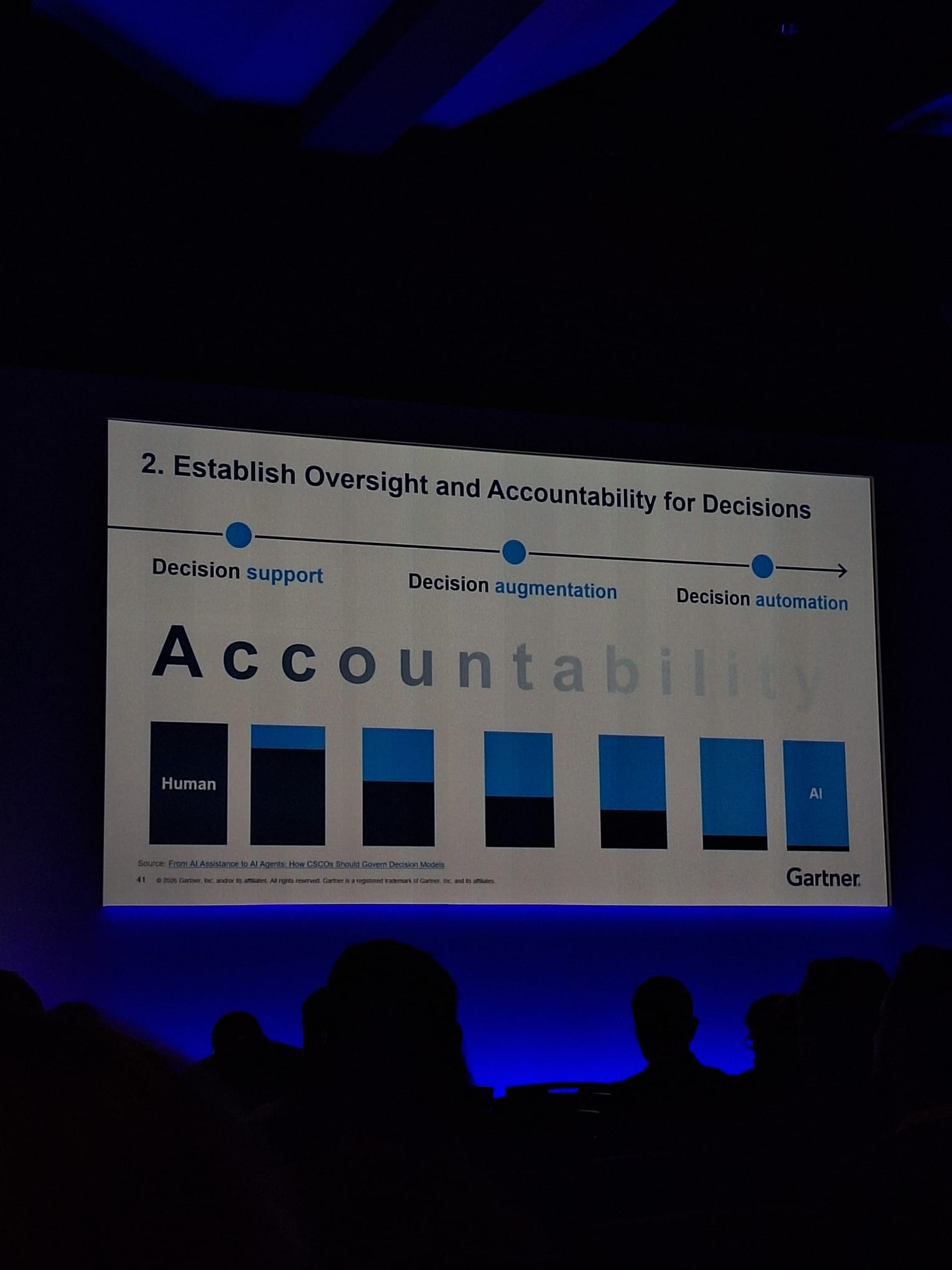
Gartner did make a point I found important: as you move from decision support to augmentation to automation, accountability decreases at each step. So senior roles will need to oversee the AI agents.
One session did stand out. I came in sceptical, but what they explained was very true: AI in every layer, foundation models already outperforming other models in demand planning, an agent that reasons through the full picture, custom screens for exactly what a planner needs to review, and software written for specific cases. The impact of AI and language models on what's possible is immense.
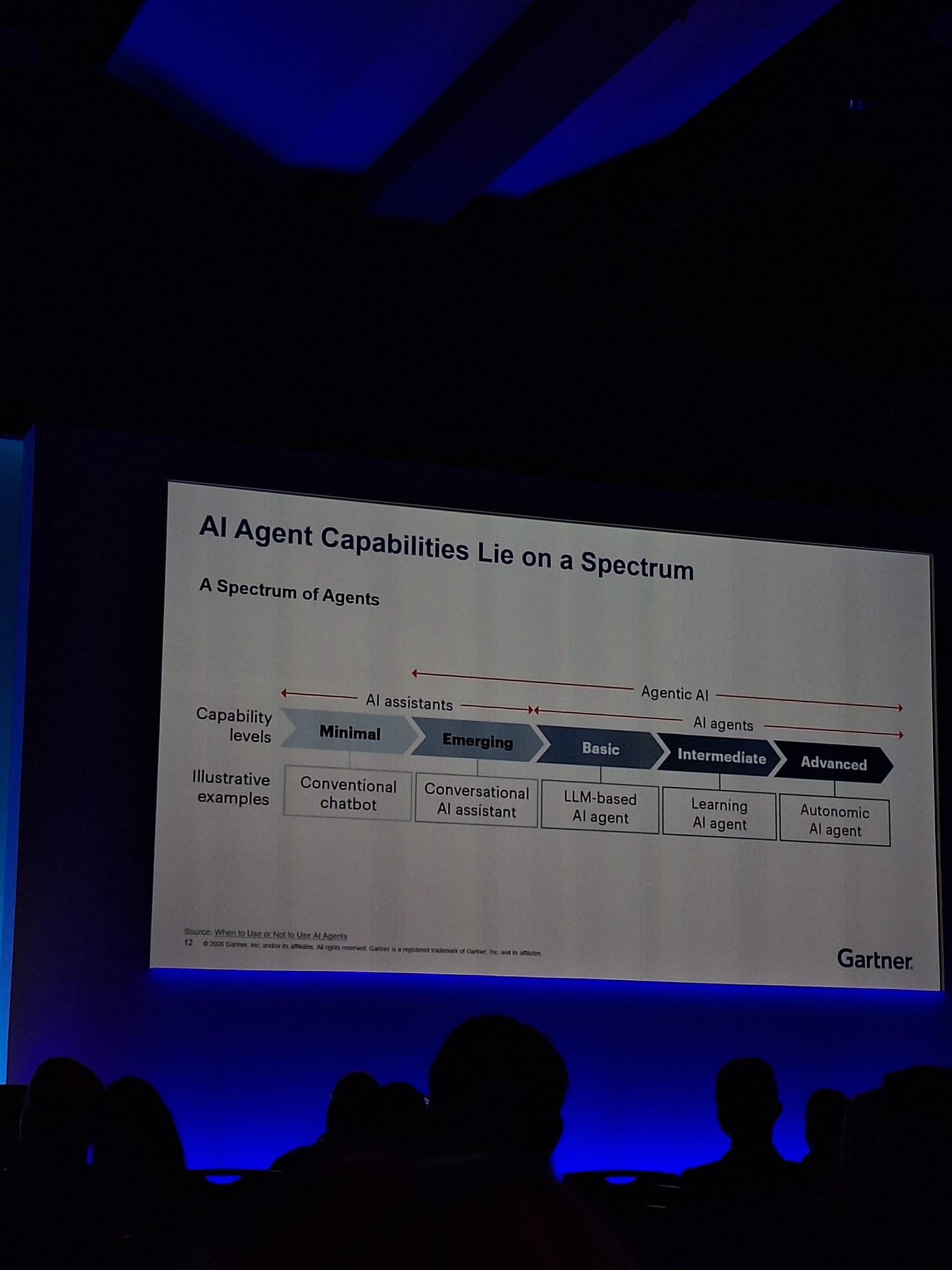
This is something legacy vendors don't have, because they don't have the architecture, the flexibility or the business model for it.
My take: AI native will become obvious for any new planning tool. Everyone already claims AI native and a focus on decisions. It's up to the buyer to look deeper and see which of these are only claims.
3) Vibe coding raises expectations… and possibly costs
Pia (Gartner) on vibe coding: many more companies will start building things themselves. Gartner made a point here that I agree with: companies will need the flexibility to build on top of their planning system, and to vibe code on top of it in the future.
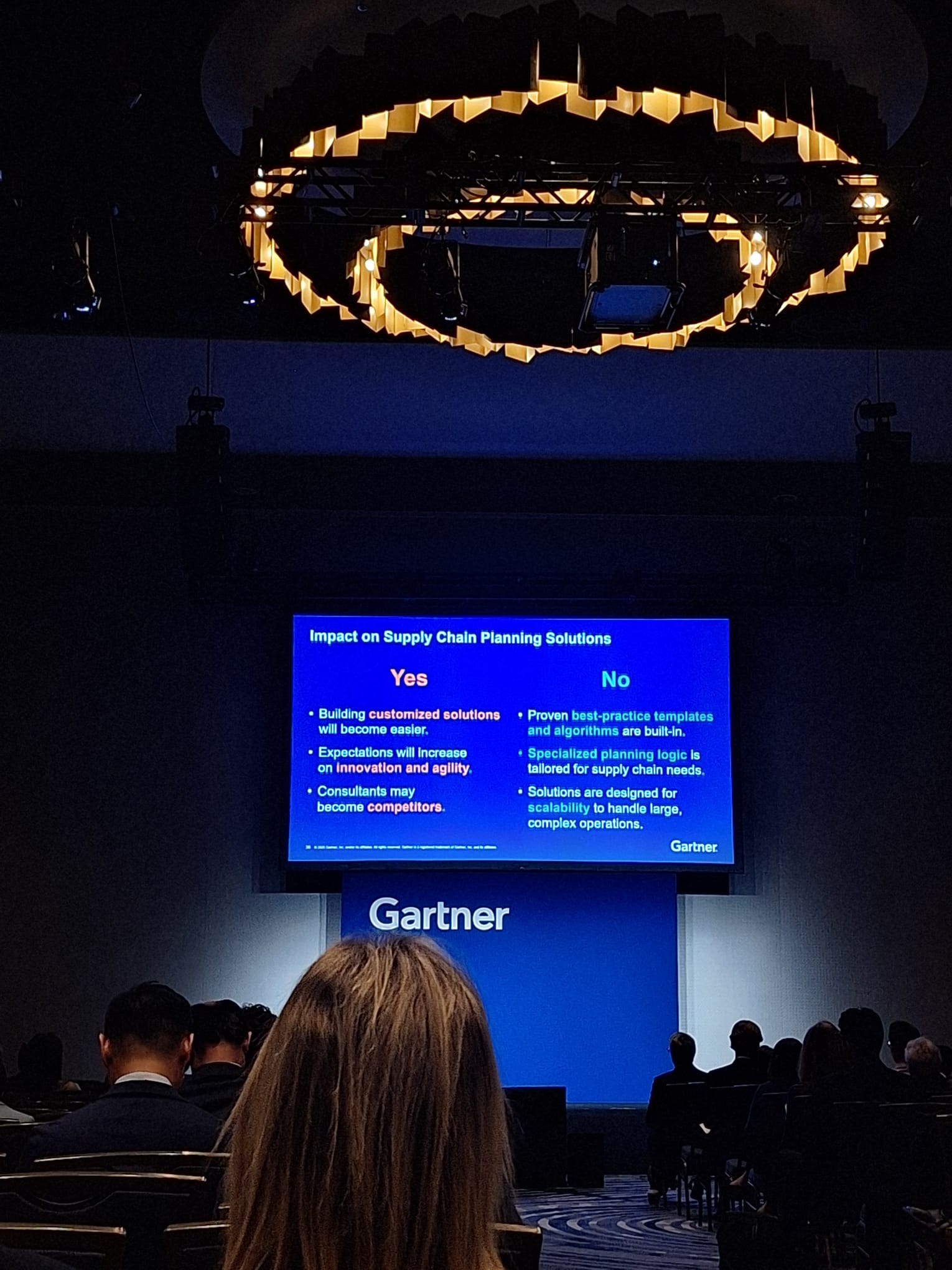
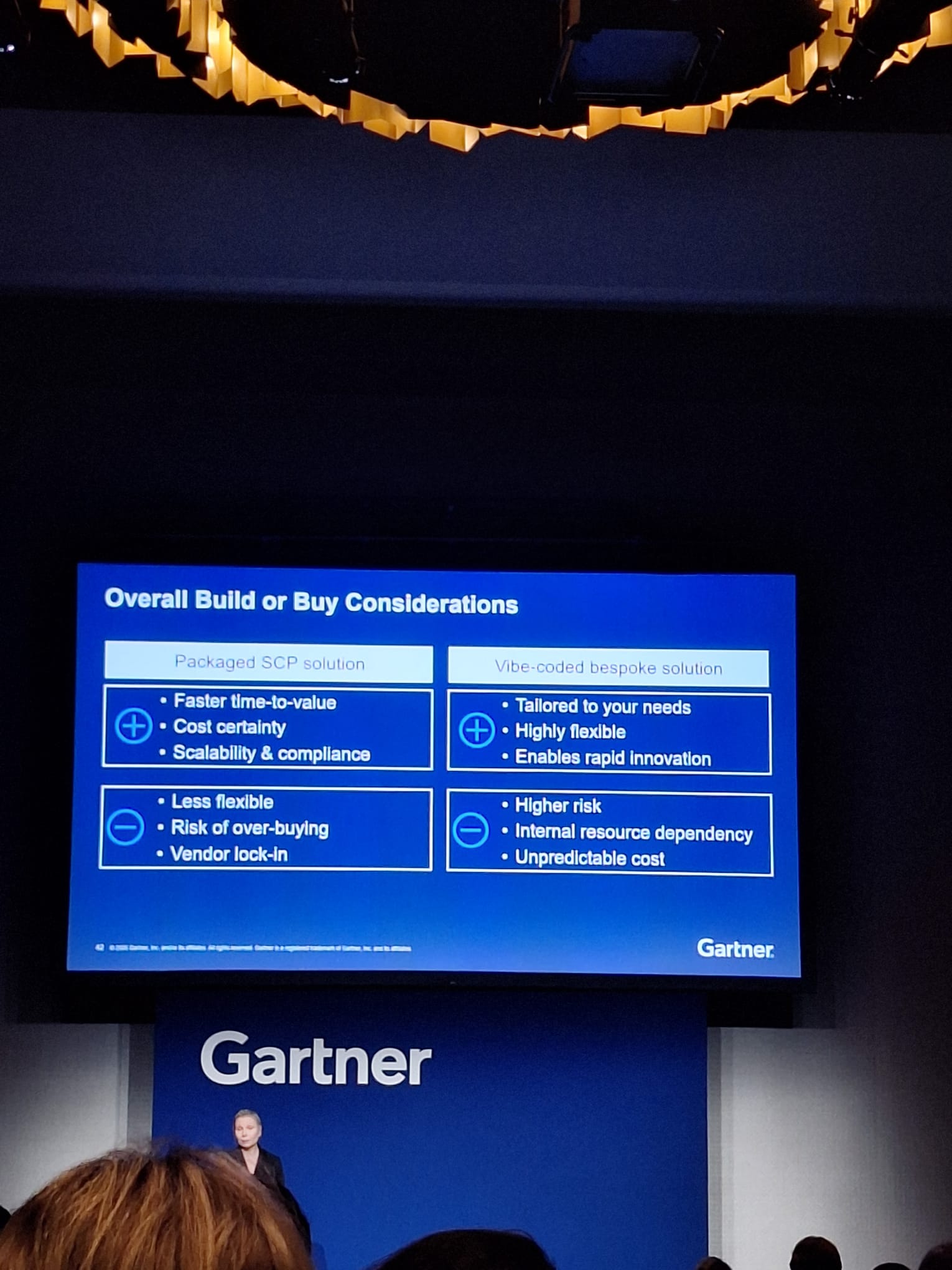
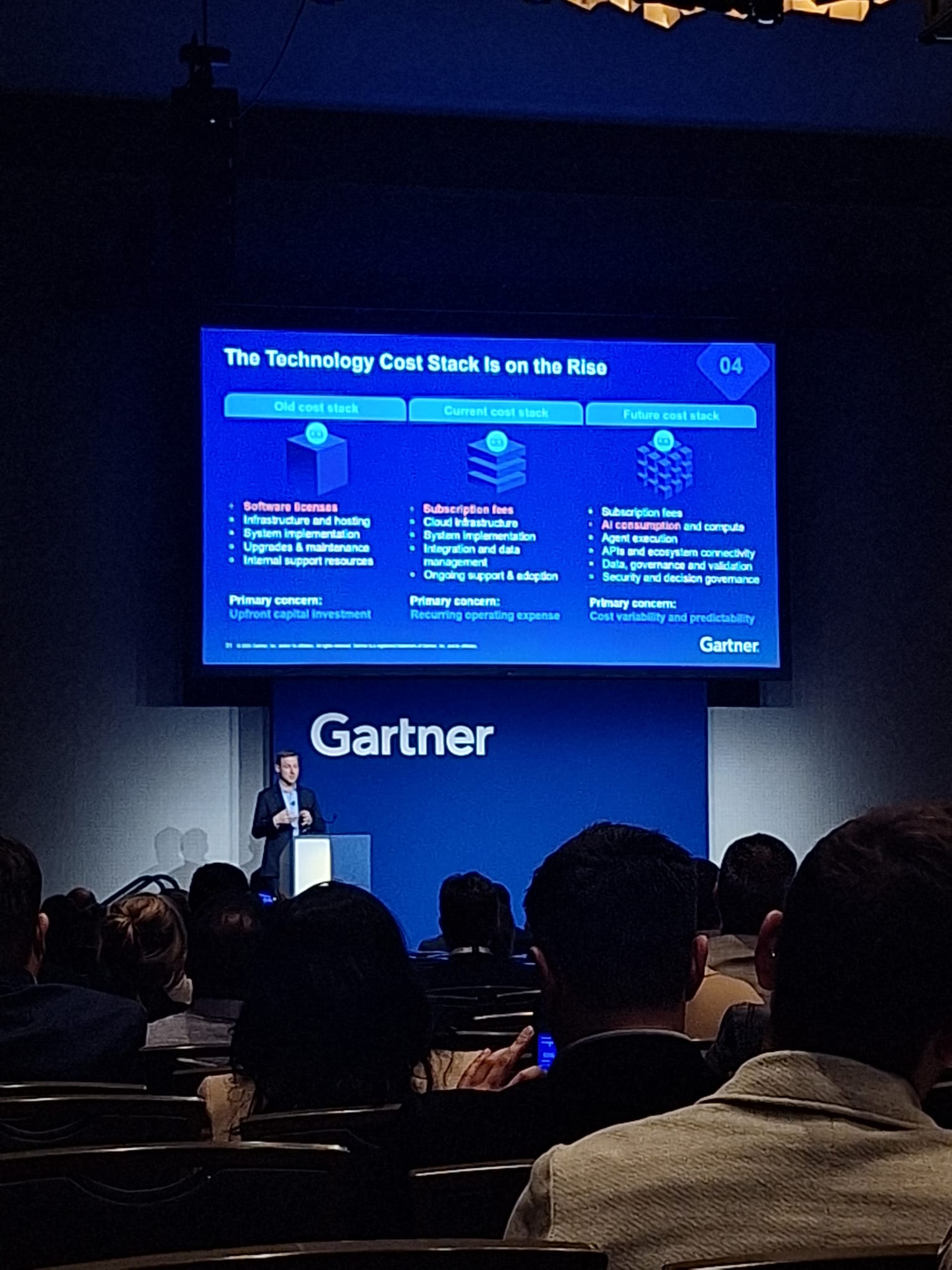
That raises expectations: faster, more flexible, more customised. The flip side is cost. SaaS costs are expected to rise sharply, and AI consumption adds a whole new cost layer on top of licences. When a provider runs on AI, its customers will feel that in their bill.
My take: you don't solve this by having every company build everything from scratch. Infrastructure and data still matter a lot. You need solid infrastructure with specific parts on top, and the freedom to vibe code on top of that.
4) Jan Snoeckx (Gartner): five things to watch
His five points:
1. Talent. Planners will get more recommendations and need new skills. Not number crunchers, but not coders either. Many companies don't understand this yet, and people need to know how their role will change. In many companies this isn't clear at all yet, so how can planners adapt if they don't know what to adapt to?
2. Autonomy. Less than expected in the short term. Use a decision delegation framework to decide what to hand over.
3. Cybersecurity. The more decisions are automated, the bigger the impact when something goes wrong.
4. Economics. Higher technology costs for supply chain. More market consolidation, more vendor lock-in, and a new cost stack: AI consumption on top of licences.
5. AI reliability. AI doesn't always reproduce identical outcomes. The toolbox keeps expanding, so pick machine learning, statistics, optimisation or generative AI based on the problem.
5) The end-to-end planner
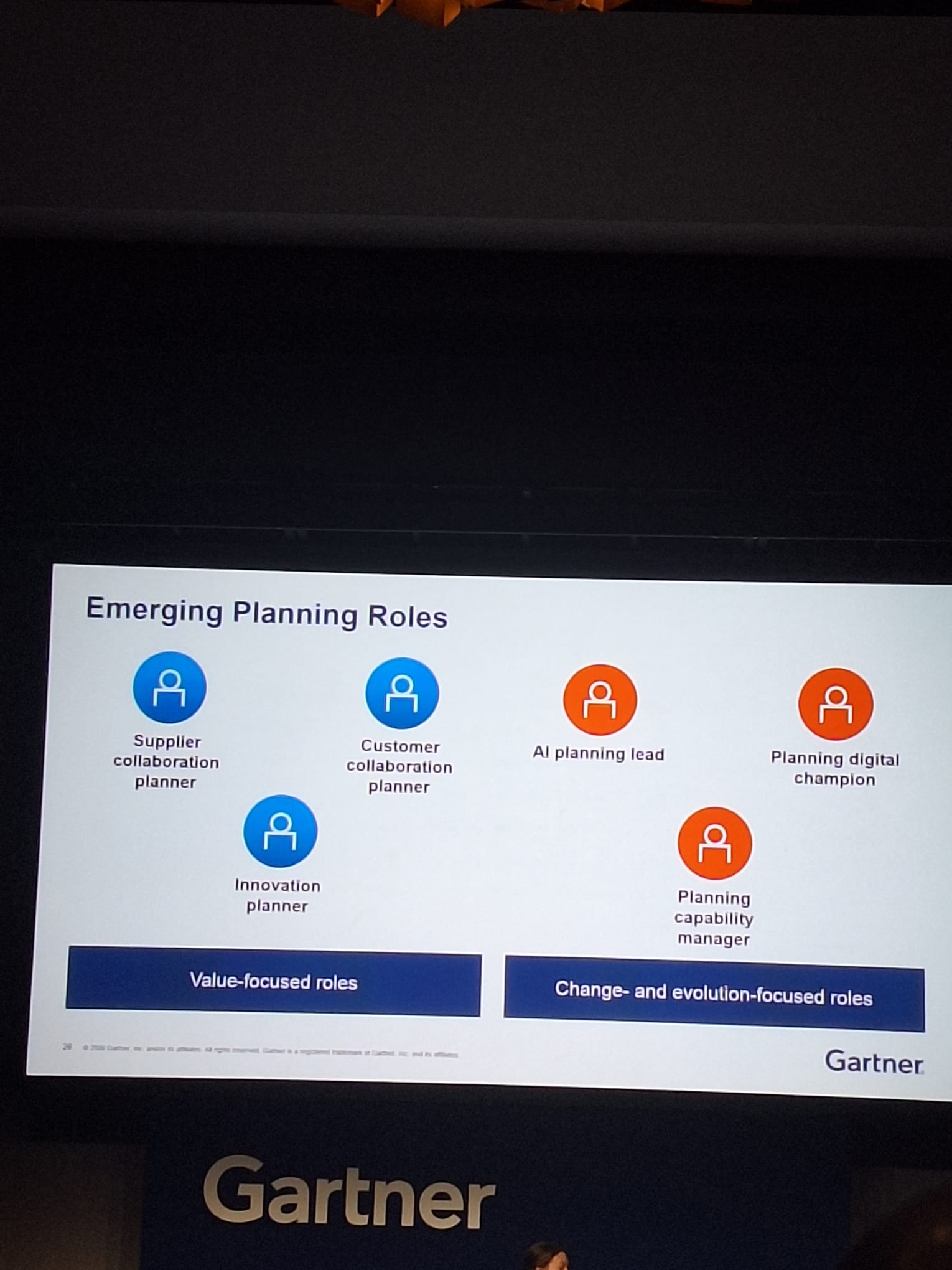
A session on the role of the planner, end to end. AI lets people combine parts of the process and expand their scope end to end. Will planning become fully autonomous, or will planners get a different role? The answer in the room: a combination.
The customer collaboration planner for demand planning is a very good example in my opinion. Building the baseline by hand has no point anymore, so the time goes to working with customers and sales on what's really coming. Roles become value-focused instead of task-based, once the right tool is in place.
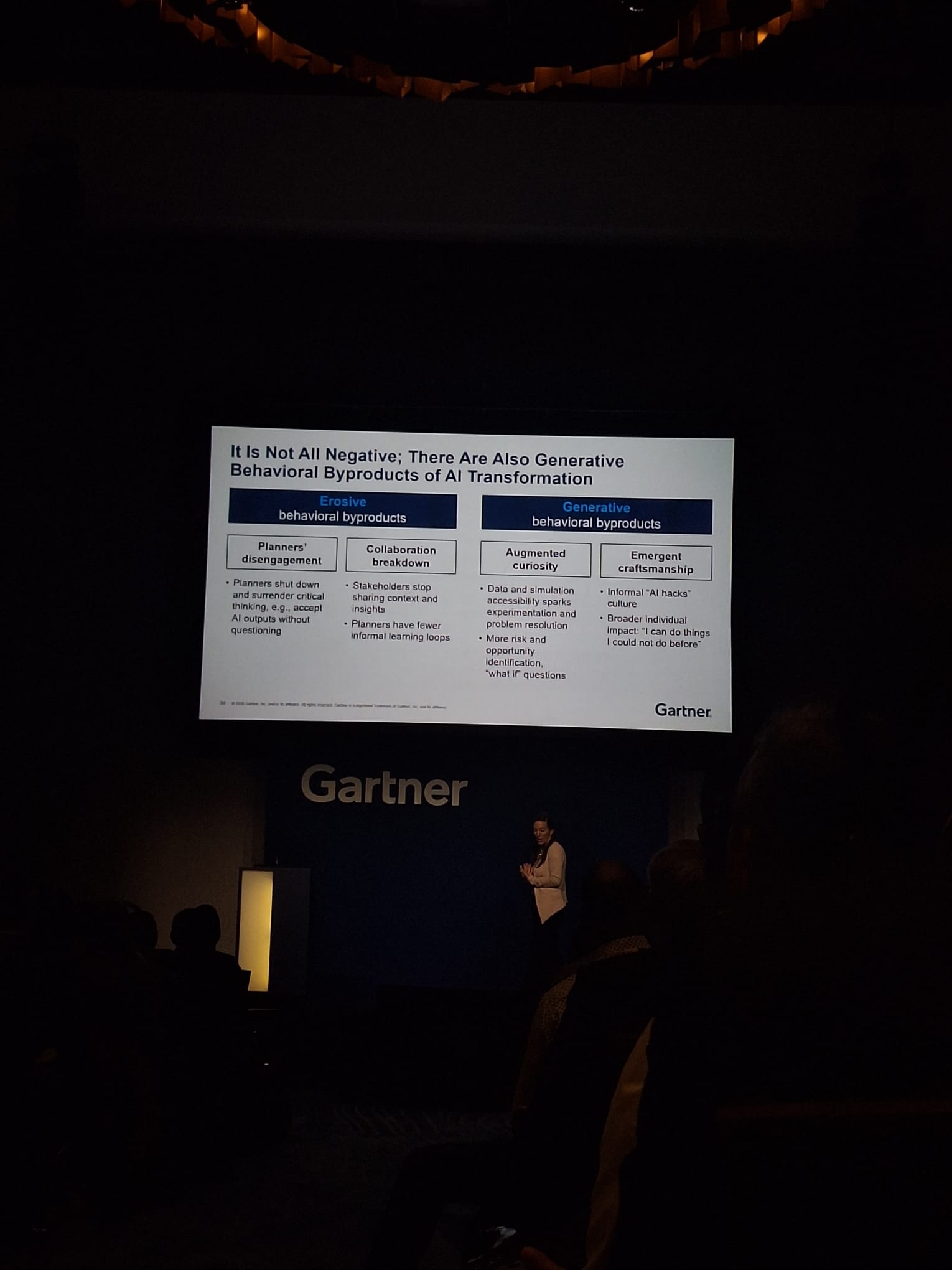
There's a risk too: disengagement versus curiosity. Some planners will lean in, others will switch off. That's why the point on talent above matters so much.
6) What's still missing: reading the information, and reasoning on it
Everyone talks about decisions and AI. But no system really takes in all the information and reasons on it properly, immediately.
Without that, planners can't make the right decisions, however good the dashboard or the workflow.
And it's not a feature you just add. It needs a change in infrastructure, the right models, and a system that flags what matters proactively.
Compare it with the usual way:
- Signals. Usually: sales history, orders and maybe a few fixed inputs, and every new signal becomes a data project with a correlation analysis. What's needed: any signal, structured and unstructured, taken in out of the box and monitored continuously. CRM notes, customer emails, Excels, sales chats, tenders, material prices information,…
- Models. Usually: one forecast engine with an AI chatbot on top. What's needed: scalable models for the baseline, plus reasoning and explainability on the signals where they add value, such as competitor moves, promotions and new products.
- Planners. Usually: fixed screens and a chatbot. What's needed: the key decisions for each planner, plus flexible views they can shape themselves.
So decisions yes, vibe coding yes, but the signals and the reasoning on them need to come out of the box. And all of that at low cost, ideally.
7) My stance, and what we built
That's exactly why we built Deep Sensing. Three key things:
- Every signal read: internal and external, structured and unstructured, automatically.
- Every impact modelled, with proprietary and best-in-class forecasting models.
- Your priorities ranked: planners only see the key decisions, on the impact map, and see which signals and decisions added value.
AI native matters most where it makes this possible: reading unstructured information and reasoning on it. Language models read. The engines decide the numbers. Planners own the calls.
Planners are rightly sceptical of grand claims, so start small: with Horizon Instant, you're up and running in less than 24 hours, and you add Deep Sensing and Ori when you're ready.
