Demand and supply planning in project-driven industries


Demand in building materials, ceramics and other project-driven industries moves with interest rates, government incentives and construction cycles, and every market wants its own variant of the product. In this webinar replay, Guilherme Pereira, who led global IBP and AI-based planning at Knauf, and Jogy Babu, general manager of sales and operations at RAK Ceramics, compare how they plan it: 50–60 causal factors in the demand model and where that data comes from, seasonality from Ramadan to Chinese New Year, how to stop SKU proliferation before it reaches the forecast, make-to-order versus make-to-stock by service level and channel, planning inventory at network level, and what it took to move from Excel to IBP, including the business case and the first AI use cases. Sabitavo Das (Holcim) was announced but could not join on the day.
Who spoke
Guilherme Pereira led global IBP processes and technology implementation at Knauf, after global supply chain and planning roles at Nordex, Allnex and Baker Hughes, and has since moved to a new role.
Jogy Babu is general manager of sales and operations at RAK Ceramics, overseeing demand, supply and fulfilment planning, with more than 25 years in production and supply chain.
Moderated by Ben Van Delm, co-founder of Horizon.
In this webinar
- 03:29 Causal factors in the demand plan: interest rates, incentives and 50–60 drivers, with third-party data for the country-specific ones
- 06:30 Short term versus long term: incentives and trade barriers matter most for capacity decisions
- 07:56 Seasonality by region: summer renovations in Europe, Ramadan in the GCC, Chinese New Year in Asia
- 11:01 SKU complexity in tiles: lifestyle products, colour and design variants, and pushing one SKU into two or three markets
- 13:55 Master data as the foundation: a rebuilt item-code structure the whole company follows
- 14:56 Variants, packaging and why forecasting at the lowest level with messy master data goes wrong
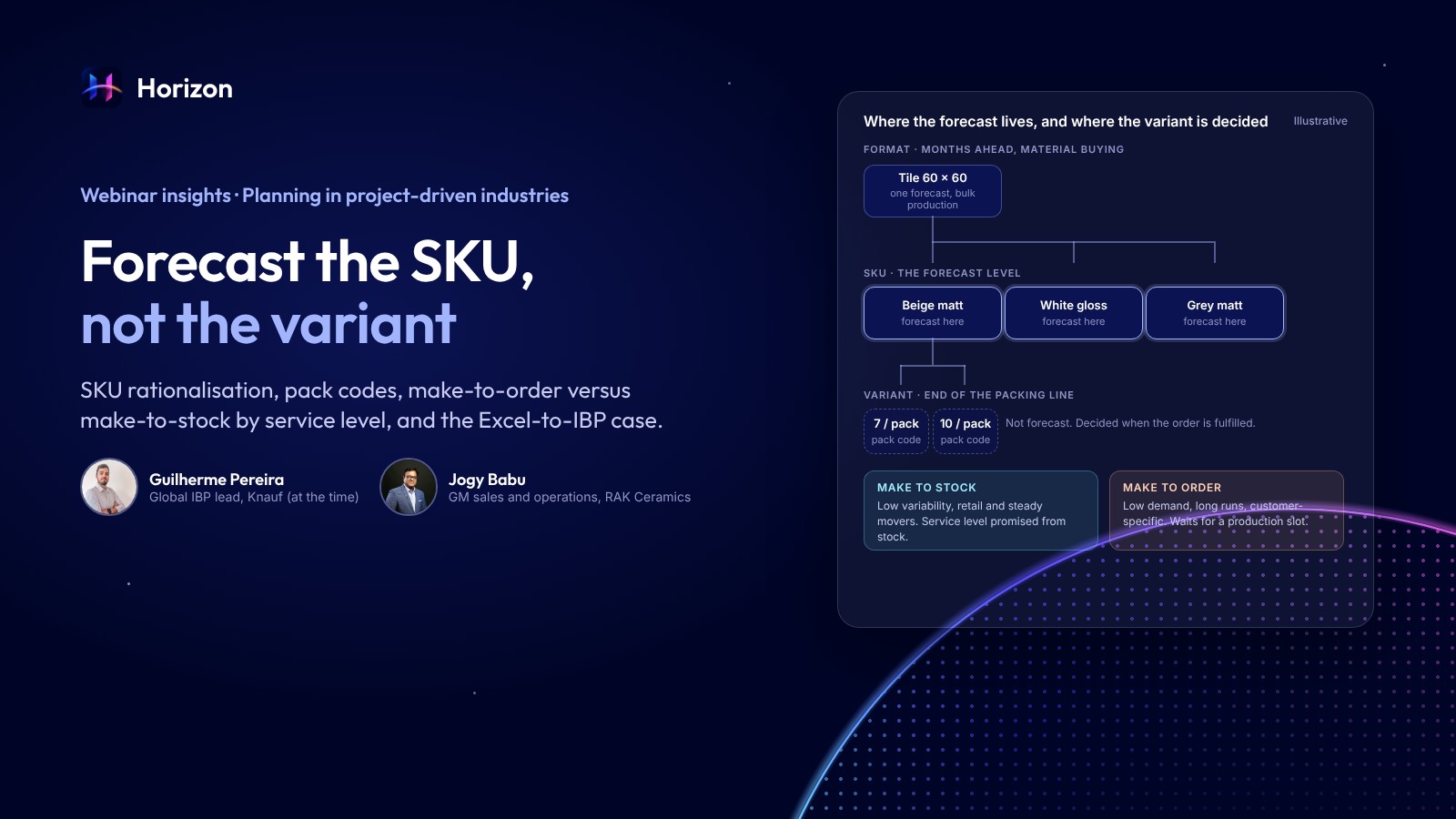
- 16:56 Pack codes: forecast the SKU, manage the variant at the end of the packing line
- 20:30 Make-to-order versus make-to-stock, by forecast variability, channel and promised service level
- 26:35 CO2 and energy constraints: in planning as regional capacity limits, and in logistics as load design
- 29:25 Planning at network level: ownership for stock in transit and on the ground, and the two aged-inventory hubs that saved almost $10 million
- 35:25 From Excel to IBP: change management, implementation, and master data first
- 38:08 Why IBP: breaking silos, one picture of demand and supply, working capital and revenue
- 40:34 Building the business case: define the problem, quantify working capital and lost sales from CRM data, estimate measurable gains, compare cost and ROI
- 47:37 AI now: agents on the manufacturing sites, a demand planner agent, collaboration with customers, guardrails against hallucination
- 53:21 Q&A: supplier capacity in planning, product lifecycle metrics, third-party data sources, and the AI tools each company allows
Three things they said
“The tricky part is when you start wrong with the master data. If you have messy master data, you are going to have messy IBP in the end.” (Guilherme Pereira)
“We don't forecast the variants, we forecast the SKU. The packing is managed at the end of the packing line through pack codes.” (Jogy Babu)
“The biggest constraint is always the human being. The planner has done this in his Excel for twenty years, with his VLOOKUPs and formulas. It is about change management.” (Guilherme Pereira)
Questions this webinar answers
- Which external signals move demand in construction-related industries, and where do you get the data?
- How do you keep SKU variants from making the forecast unmanageable?
- How do you decide what is make-to-order and what is make-to-stock?
- How do you plan inventory across a global network of plants and warehouses?
- What goes wrong when you move from Excel to IBP, and how do you build the business case?
- Which AI use cases are real in these companies today?
Resources
- Companion article: SKU rationalisation and make-to-order versus make-to-stock: planning in project-driven industries
- Podcast: Jochen Bansemir on Knauf's global S&OP rollout, and the article Global S&OP rollout: Knauf's five steps
- Guilherme offered to share the third-party data sources he trusts for incentives and interest-rate data; contact him on LinkedIn
Related Articles