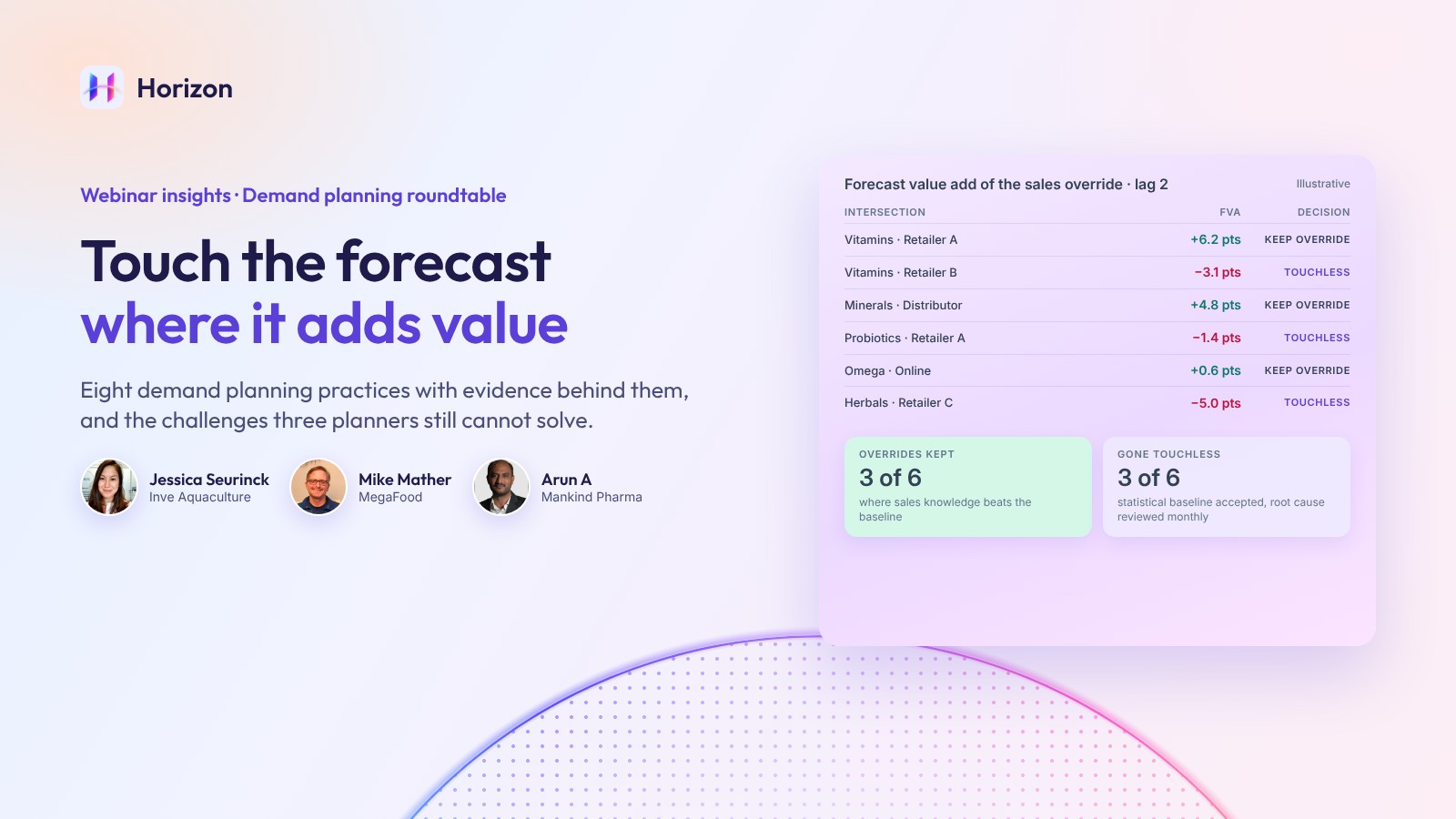
Demand planning experts roundtable: insights across industries


Three demand planners, three continents, three industries: a biotech supplier to fish and shrimp farmers in Belgium, a premium vitamin and supplement manufacturer in the United States, and a large pharmaceutical company in India. In this roundtable replay, Jessica Seurinck, S&OP manager at Inve Aquaculture, Mike Mather, demand planning manager at MegaFood, and Arun A, head of demand planning at Mankind Pharma, with earlier planning transformations at AB InBev and Mondelēz International, share what has worked in demand planning and what is still unsolved: product lifecycle management as a feedback loop into the demand plan, when a statistical forecast beats a collaborative one, why point-of-sale data is not always the best signal, people and process before the system, getting distributors and sales to share data and to own forecast accuracy, new product launches that are pushed too fast or forecast too low, the black box objection to a statistical baseline and the forecast value add answer to it, which drivers to try first, S&OP frequency and horizon, choosing a planning system, and where machine learning adds the most value.
Who spoke
Jessica Seurinck (Belgium), S&OP manager at Inve Aquaculture, eight years in S&OP, running the forecasting process with sales and the demand planners that drives replenishment from two factories to affiliates and warehouses worldwide.
Mike Mather (United States), more than twenty years in demand planning, management, process and system implementation roles in consumer goods, now at MegaFood, a premium vitamin and supplement manufacturer, where he owns the process and plans about twenty accounts and 250 SKUs with eight account managers.
Arun A (India), leads a team of eight demand planners at Mankind Pharma, after large-scale planning transformations at AB InBev and Mondelēz International, with more than nine years in demand and supply planning.
Moderated by Ben Van Delm, co-founder of Horizon.
In this webinar
- What has worked: integrating product lifecycle management into the demand review, so new products, launches and phase-outs reach the planners in time (Jessica); the statistical forecast winning where the company cannot shape demand, and the collaborative one where it can (Mike); people and process first, the system six to twelve months later, end users involved from the start, data cleansing and segmentation before any model (Arun)
- Point of sale against orders: why buyers do not buy the POS, from open-to-buy and year-end constraints to personal habits, and why a statistical model often captures buyer behaviour better
- Collaborative forecasting: incentives for distributors to share inventory data, forecast accuracy in the sales team’s bonus at 5–10% weighting, extra margin for key accounts that share sell-out data
- New products: pressure from above to launch before the product is ready, launch volumes underestimated by cautious salespeople, intra-account placements and delistings that nobody communicates, a 15–20% success rate for launches and a year of nurturing each new SKU
- The baseline and the black box: when accuracy measurements show the statistical model beating the account plan and the account’s own forecast, and people still keep their number; forecast value add by intersection, touchless where overrides destroy value, root cause analysis where the model underperforms
- Adoption: two to three months of hand-holding and in-person sessions for the sales team; explaining promotion, price and weather effects that remain partly a black box
- Drivers: internal first (promotions, pricing, seasonality, field force), then external (weather, GDP, demographics, customer inventory, inflation); test correlation outside the system before loading thirty variables into it; the lockdown example that forecast store sales from predicted freeway miles
- S&OP in a small industry: monthly cycle, a 12-month horizon limited by biological variability and the maturity of the process, lead times stretched by the Red Sea and the Panama Canal, safety stock and safety time, and the executive sponsorship that made the incentive possible
- Monthly before weekly: an 18-month statistical horizon and the inventory potential unlocked by moving to weekly planning once the organisation is mature
- Choosing a system: ease of use, implementation resources, accuracy in the pilot, optimiser capabilities, the right amount of customisation, the ROI case for the CFO, and whether the vendor’s people have “supply chain grease on their hands”
- Machine learning: baseline and lift, forecasting new products by analogy, driver impact, and why you do not jump from a moving average in Excel to machine learning
- Closing: full-load data in every test, never a partial pilot
Three things they said
“First bring people and process, then bring the tool. Once the weekly and monthly reviews are stable for six months to a year, then bring in any statistical tool. Bring the tool first and everything collapses.” (Arun A)
“You can show the accuracy, and the statistical model is consistently beating the account plan, a naive model, even the forecast from the account itself. And at the end of the day people think, well, it’s from a black box, so I’m going to stick with my forecast.” (Mike Mather)
“S&OP is also a soft skill. It is an educating role in the organisation: we have a common goal of getting the right product in the right place at the right time for our customers, and there will always be challenges balancing supply and demand.” (Jessica Seurinck)
Questions this webinar answers
- When does a statistical or machine learning forecast beat a collaborative forecast?
- How do you get distributors, key accounts and the sales team to share data and own forecast accuracy?
- How do you plan new product launches without history, and keep them from being over- or under-forecast?
- How do you get people to accept a statistical baseline they call a black box?
- Which demand drivers should a planner try first, and how do you keep noise out of the model?
- What should you look for when choosing a demand planning system?
Resources
- Companion article: Demand planning best practices and the challenges still unsolved: three planners compare notes
- Article: Forecast accuracy, bias and forecast value add
- Webinar: Global demand planning: AI/ML and causal planning, centre of excellence, roles and process
- Case study: How Inve plans with Horizon
Related Articles