
Network design in supply chain
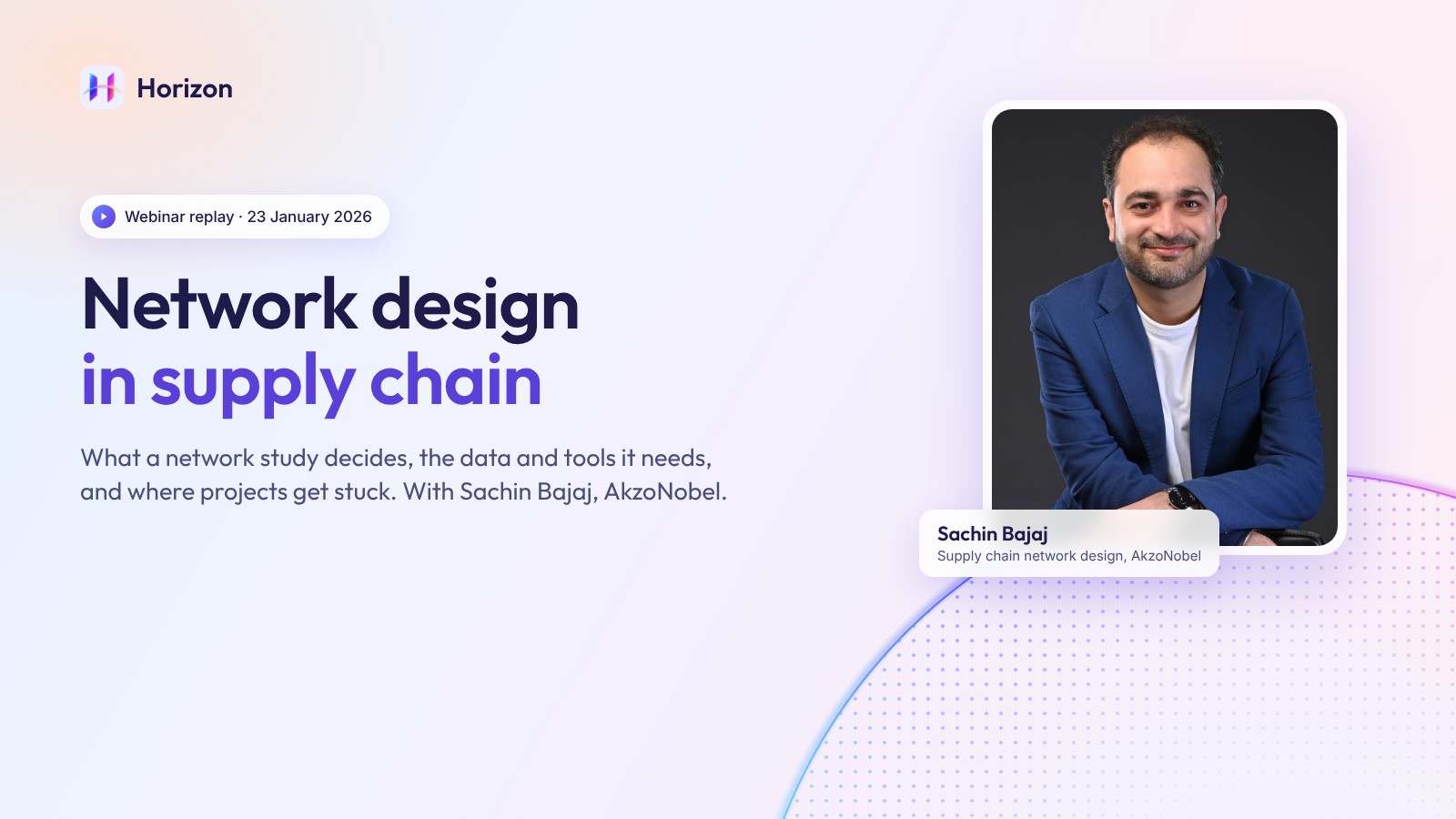

Network design is the science behind the big footprint decisions: where to produce, where to hold stock, which plant serves which customer, and what a merger, a divestment or a new tariff does to all of it. In this webinar replay, Sachin Bajaj, who leads supply chain network design at AkzoNobel after network design and optimisation work at Amazon and Accenture, walks through how a network study is run in practice: the questions it answers at strategic, tactical and operational level, the data it needs (and why data collection is 60–65% of the work), the tools, the project phases, where projects get stuck, and how savings are tracked until they land in the P&L. Ashish Thomas was announced for this session but could not join on the day.
Who spoke
Sachin Bajaj, business process manager for supply chain network design at AkzoNobel. Fifteen years of network design and optimisation projects across AkzoNobel, Amazon and Accenture, covering strategy, modelling, data and implementation.
Moderated by Ben Van Delm, co-founder of Horizon.
In this webinar
- 03:11 What network design is: the science behind footprint decisions, from relocation and consolidation to new plants and stores
- 04:31 Strategic, tactical and operational: mergers and divestments, tariffs and alternative sourcing, transport routes and fleet sizing
- 07:07 Why nearly every network design problem is a mixed-integer linear programme
- 09:22 Where the questions come from: top-down from the business, bottom-up from regional supply chain directors, and the team's own benchmarking
- 11:14 The link with planning: network design output feeds the planners, and a warehouse at 85–90% utilisation feeds the next study
- 15:18 The data a model needs: locations, product attributes, transport costs, production and warehousing costs split fixed and variable, validated by finance, planning and commercial
- 18:35 Data collection and the baseline take 60–65% of the effort
- 21:02 Tools: planning suites with a network module, dedicated network design software, free evaluation licences, and data preparation with Alteryx or Databricks
- 26:14 What comes pre-built, and where multi-objective problems need customisation
- 28:53 The project phases: charter and governance, data collection and validation, baseline, scenarios, results and handover
- 32:28 How projects are prioritised with the operations directors twice a year
- 34:51 Where projects get stuck: data across SAP instances, and scenarios that ignore the commercial side
- 37:36 Modelled savings, implementable savings, and tracking them month by month for twelve months
- 39:53 Q&A: the skills for a network design role, whether smaller companies can use it, digital twins, AI and natural-language scenario building, and where to learn
Three things Sachin said
“Data collection and the baseline generally take 60 to 65% of the effort and time. Once you have a baseline, the interesting piece of running the scenarios and comparing them starts.”
“Sometimes we fail to speak to our commercial colleagues. They have lead-time requirements and customer SLAs they have promised. Thinking not only from the cost angle but about the overall value we can deliver makes so much more sense.”
“What is the modelled saving, what is the implementable saving, and then we lock the aligned number into the system as the target for the next twelve months and track it month over month until it lands in the P&L.”
Questions this webinar answers
- What is supply chain network design, and which decisions does it support?
- What data does a network model need, and who validates it?
- Which tools are used, and are there free ways to try one?
- How is a network design project structured, and where does it get stuck?
- How do you know whether the promised savings were realised?
- Does network design make sense for a smaller or growing company?
Resources
- Companion article: Supply chain network design: when to use it, what it needs, and why the baseline is most of the work
- Earlier webinar: Supply planning and optimisation roundtable
- Sachin mentioned free evaluation licences for network design software and a vendor's online university as a way to learn the concepts, which transfer between tools
Related Articles

