Why your supply chain transformation needs health, not just performance
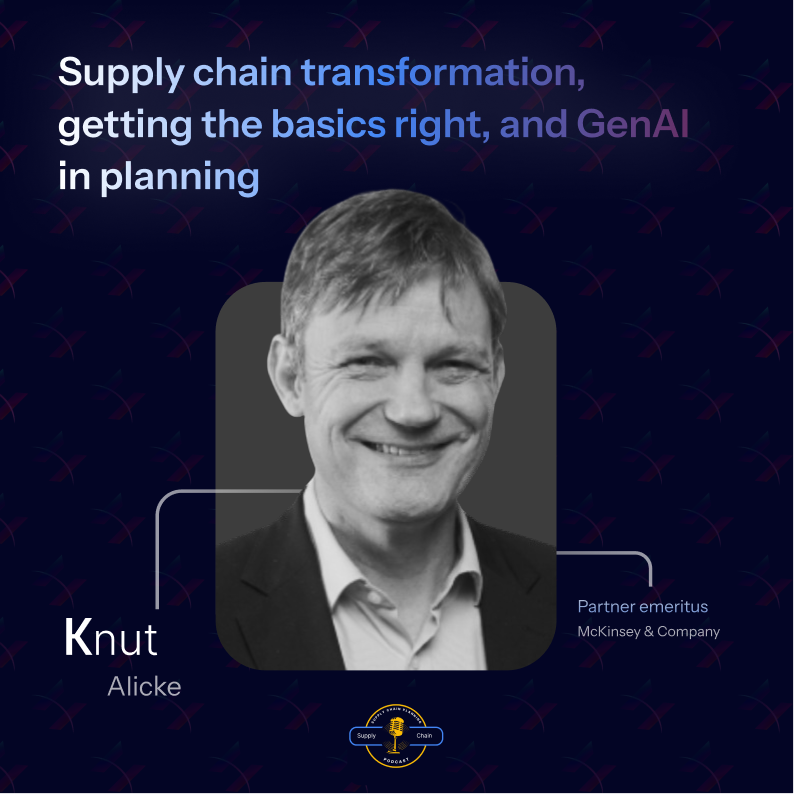
About Knut Alicke
Supply chain transformation expert with 30 years in the field across research, software (Icon/E2Open), and 20+ years as a partner at McKinsey & Company. Also, a professor at the University of Cologne, author of "Source to Sold," featuring 26 supply chain leaders. Knut specializes in helping companies move from project-focused transformations to continuous improvement of cultures.
The 70% failure rate nobody talks about
Here's a stunning statistic: only 30% of supply chain transformations succeed. The other 70% either take longer than planned, deliver less than promised, or go nowhere. And this number stays constant year after year.
Knut learned these by analyzing transformations across McKinsey's portfolio. The culprit isn't complicated algorithms or expensive systems. It's simpler and sadder: companies focus obsessively on performance (reducing inventory, cutting costs, boosting EBITDA) while completely ignoring health (people, capabilities, leadership, and culture).
"If you only focus on performance, what often happens is that you have a short kind of success phase, where you increase the performance, but then, midterm and long term, you go back to the old habits," Knut explains. You get a temporary win, then drift back toward dysfunction.
A successful 30% do both. They chase performance metrics while building the organizational capability to sustain improvement. That's the difference between a one-time project and actual transformation.
If you're planning inventory optimization, this matters immediately. You can implement the perfect policy and see it fail within months because people don't understand it, don't trust it, or leadership doesn't support it.
Master data is unsexy, so nobody does it.
Every supply chain leader knows master data quality matters. Nobody actually fixes it.
"The most sexy topic ever," Knut says sarcastically. "And the reason is exactly this, that it's the most unsexy topic of the world. No one addresses it." There's no prize for cleaning up your part numbers. No promotion for fixing location codes. So, it stays broken.
But broken master data ruins everything downstream. Feed garbage data into a machine learning algorithm? You get garbage out, and then people blame the algorithm instead of the data.
"If you want to move more to algorithmic planning and your master data is crap, then the result is crap," Knut explains. Companies then decide algorithms don't work and go back to manual Excel planning, never realizing the foundation was rotten.
The solution sounds boring because it is: do the unsexy work first. Audit your master data. Fix the obvious errors (lead times that don't match reality, SKUs listed twice, and locations that don't exist). Then, and only then, layer in better algorithms.
"It's not rocket science, right? So, you just need to do it," Knut says. Yet most companies skip this entirely.
Three "brilliant basics" that replace 80% of complexity
Knut uses simple scatter plots to uncover inventory problems without fancy analytics. The first one: plot days of inventory coverage against measured lead time.
If you find an SKU with 50 days of coverage but only 10 days of lead time, something's broken. Maybe there's a minimum lot size. Maybe demand spikes in one season. But you immediately know that SKU needs investigation.
"If you then go one level more in detail, it might be that there's an AOQ model, so lot size and so on, but that gives you the first idea of what's going on, right?" This one plot often surfaces 80% of your inventory problems without needing advanced modeling.
The second: plot OTIF (on-time-in-full delivery) against customer importance or revenue.
Knut found companies serving small customers with a 95% fill rate while big customers got 85%. "You have important customers and you have not-so-important customers... but you also have this loudest shout to be served principle, which contradicts a bit the strategy," he says. A simple visualization reveals this immediately.
The third: map service level targets against customer segments.
Platinum customers should get higher service than gold. A plot showing this relationship immediately reveals where reality conflicts with strategy.
"So all, sometimes I feel that we forget with all of the AI stuff; we forget this super basic analysis. Basics." Knut watches companies skip these fundamentals, chase sexy AI projects, and then fail because they didn't understand their actual problems first.
Transform once, then transform again incrementally.
Companies think transformation is a big event: launch a project, six months of chaos, then done. Knut argues that's backward.
"It doesn't make sense to aim for a big step and then stay there. It rather makes sense to do it in small baby steps, and with this kind of approach, take the organization with you," he explains. This comes from lean manufacturing wisdom, but supply chain leaders forget it constantly.
The danger with big-bang changes: you crash morale. People panic. The organization pushes back. You get to your shiny new state, declare victory, and then people revert to old habits because they never internalize the change.
"We have a lot of clients where we, after the implementation, talk to them, and we're like, 'Yeah, we are not so happy... they had seven users to use the system, seven.'" Out of potentially thousands. Everyone else used workarounds; the system failed because change management was ignored.
Small incremental improvements let people absorb each change, master it, and build confidence before the next one. You take the organization with you instead of dragging it.
You can't AI your way out of fundamentals.
Everyone now pitches projects as "AI initiatives" to get board approval. Knut pushes back: start with the vision (be digital, be smart), but execute the boring work first.
"You enter with the vision, hey, we need to really be digital. And then you realize, oh, you still use fax machines. Let's start working on the basics, right? Let's start cleaning up the master data first." Paint the inspiring picture. Execute the boring reality.
The danger of skipping AI: "Worst case, automate a crappy process, and then you have an automated crappy process. And that's clearly not best practice."
Gen AI helps experienced planners analyze data faster. But it can't replace understanding your business. A Gen AI system analyzing your inventory will propose mathematically correct answers that ignore your specific peak season, your minimum lot sizes, and your customer contracts. You need a human in the loop who knows the business.
Knut uses Gen AI for root cause analysis, asking why a delivery was missed and drilling into data fast. But he still provides business context to the algorithm: "Hey, these two weeks you have demands, and you burn down your inventory... so that just did not consider this. And so I had to explain it, and then it did calculate it correctly."
Your next steps
If your inventory is out of control and you're considering optimization:
- Do one brilliant basics analysis this week. Plot days of coverage vs. lead time or service level vs. customer importance. Spend 30 minutes. You'll find problems hiding in plain sight.
- Audit your master data for the top 20% of SKUs. Check: Do listed lead times match actual lead times? Do the customer groupings make sense? Fix obvious errors first, then layer in algorithms.
- Plan your improvement in quarters, not years. One small change per month beats one big change every two years. Give people time to adjust, master the change, then move forward.
- Have an honest conversation: Is leadership bought in? If your CFO sees the supply chain as a cost center, your transformation will fail. Don't start until you have C-level support for improving availability and revenue, not just cutting costs.
- Create a "control tower" for execution separate from planning. Don't let today's inventory shortage crash your 12-month plan. Use one meeting for strategy and another for firefighting.
Inventory problems feel complex because they are. But they're usually caused by basics: bad master data, no strategy alignment, lack of sustained commitment, and people ignoring new processes. Simulation helps you validate solutions. But it can't fix the fundamentals.
Fix the fundamentals first. The algorithms come after.
Related Podcast
Related Webinar