

Plan Smarter in Simple Steps
Replace endless discussions with clear decisions.
How It Works
S&OP with Horizon
Replace endless discussions with clear decisions.

Single source of truth

Unify demand, supply, and finance in one shared, consistent view.

Scenario & assumption tracking
Compare what-if plans instantly and track underlying assumptions.

Structured S&OP process
Define steps, owners, and approval flows for every cycle.

Task & workflow management
Assign actions, track progress, and follow up directly in the platform.

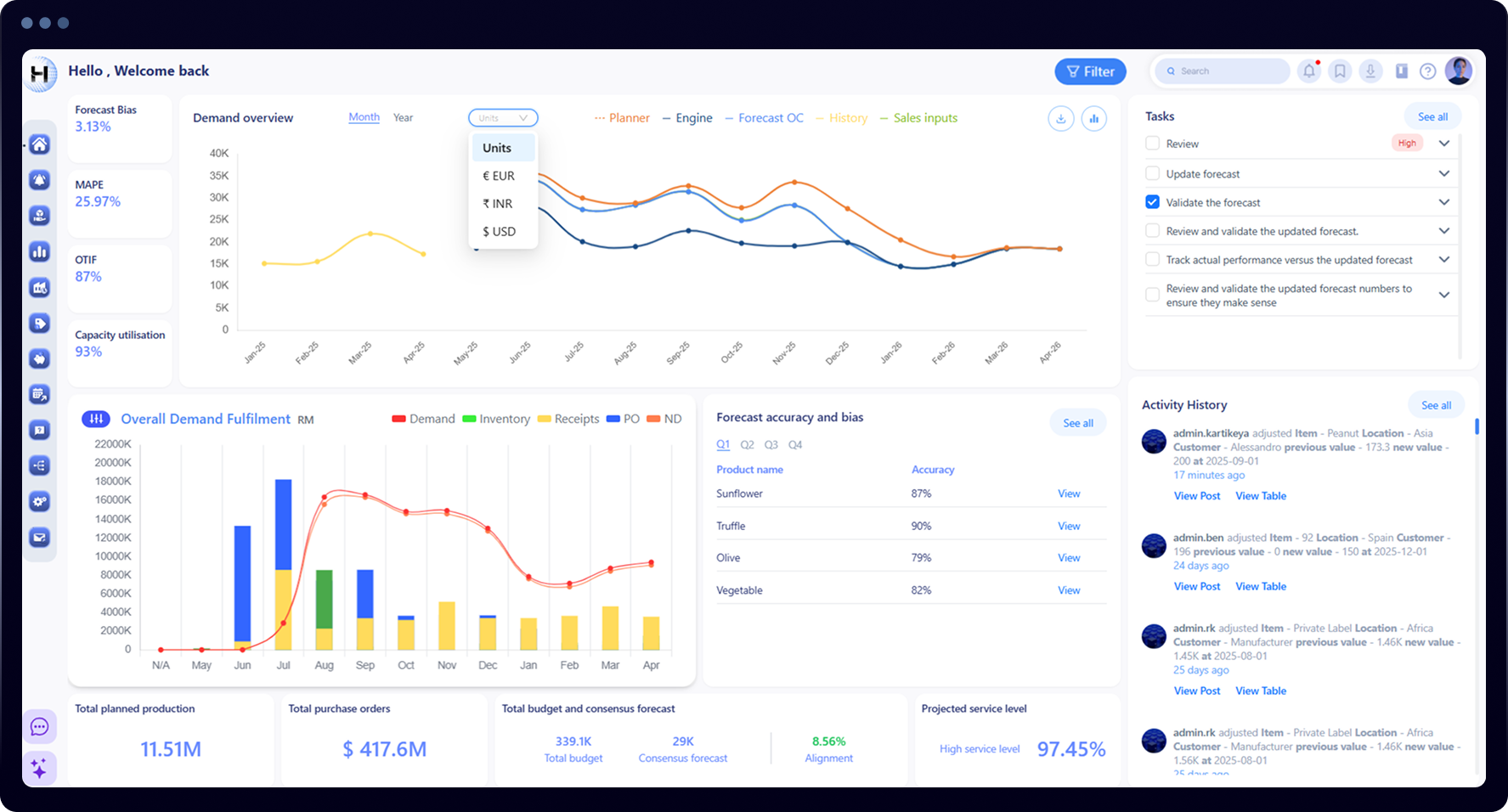
Decision dashboards
See KPIs, gaps, and trade-offs in one clear view.

GenAI meeting assistant
Generate summaries, reports, and insights automatically through text or voice.
Next-Gen Planning
Smarter Tools, Built for Planners
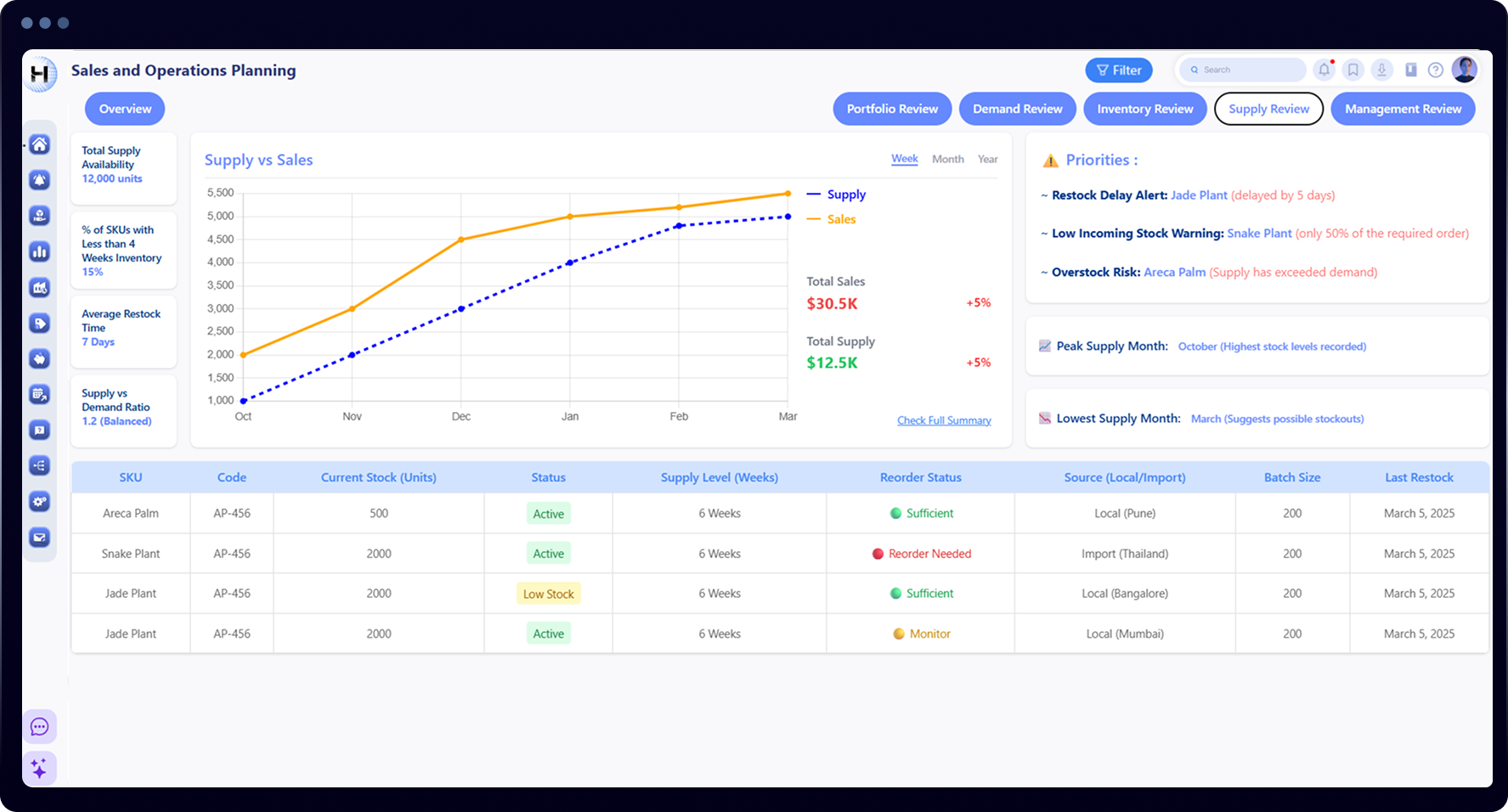
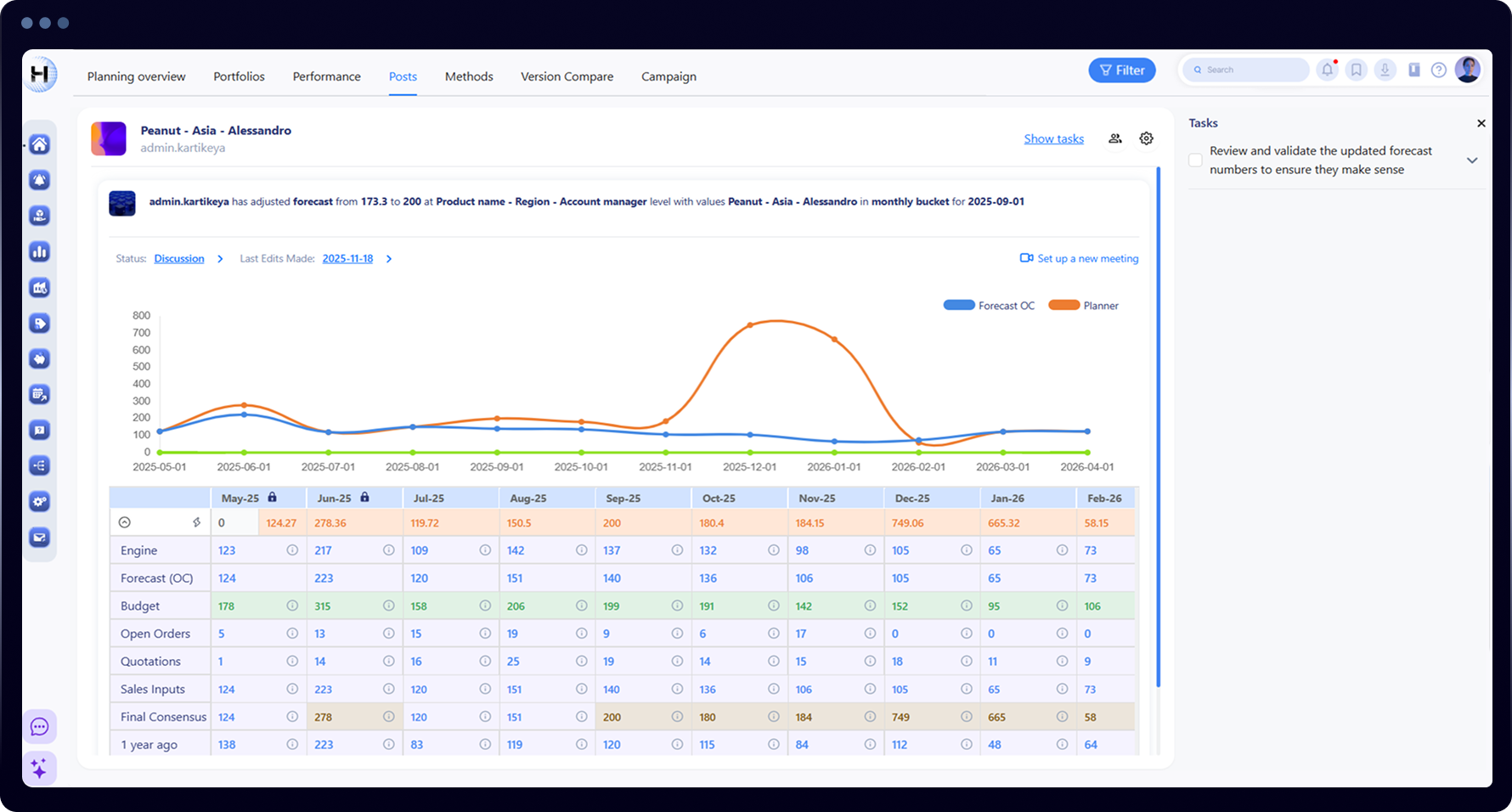
Detailed S&OP/IBP review pages



Planner's Voices
What planning leaders say
Real experiences from planners and leaders.
"Impressed by the knowledge and fast results of Horizon.
Together we turned plans into action in no time."
Together we turned plans into action in no time."

Olivier Van Hoef –
Supply chain manager at Ahrend
Supply chain manager at Ahrend
"After 40+ years of implementing different planning tools, Horizon is by far the easiest to set up and adapt. It combines strong models with a flexibility we haven’t seen elsewhere."

Alex Young –
Director at Demand Integration
Director at Demand Integration
“What stood out was how quickly our team could use Horizon and how easily it was integrated with our current systems: the planning team saw the impact on their day-to-day immediately, and it improved collaboration and decision-making from a management perspective.”

Siddhant Bhalinge –
CEO at Ugaoo
CEO at Ugaoo
FAQ
Frequently Asked Questions
Find quick answers to the most common questions about our trading dashboard.
How does Integrated Business Planning (IBP) help companies make better decisions?

Integrated Business Planning (IBP) is a unified approach that brings together sales, supply chain, operations, and finance under one planning process.
Instead of each department working in silos, IBP ensures that every plan from production to budgeting aligns with long-term business goals.
With IBP, companies can:
Balance profitability and service levels in real time.
Connect strategy to execution, ensuring operational plans support financial objectives.
Optimize working capital and resource allocation through data-driven decisions.
In short, IBP transforms planning from a departmental task into a strategic growth enabler helping leadership see the full picture before acting.
Instead of each department working in silos, IBP ensures that every plan from production to budgeting aligns with long-term business goals.
With IBP, companies can:
Balance profitability and service levels in real time.
Connect strategy to execution, ensuring operational plans support financial objectives.
Optimize working capital and resource allocation through data-driven decisions.
In short, IBP transforms planning from a departmental task into a strategic growth enabler helping leadership see the full picture before acting.
What is Sales & Operations Planning (S&OP), and why is it important?
Sales & Operations Planning (S&OP) is the bridge between short-term demand and mid-term supply planning.
It ensures that production, inventory, and sales forecasts stay aligned over the next few months keeping operations efficient and customers satisfied.
An effective S&OP process helps teams:
Spot capacity or material constraints early and adjust plans before disruptions occur.
Keep sales, supply, and operations teams working toward one common plan.
Maintain consistent service levels while optimizing costs. While S&OP focuses on the near to mid-term horizon, IBP extends this alignment to financial and strategic planning helping leaders plan for growth, not just fulfillment.
It ensures that production, inventory, and sales forecasts stay aligned over the next few months keeping operations efficient and customers satisfied.
An effective S&OP process helps teams:
Spot capacity or material constraints early and adjust plans before disruptions occur.
Keep sales, supply, and operations teams working toward one common plan.
Maintain consistent service levels while optimizing costs. While S&OP focuses on the near to mid-term horizon, IBP extends this alignment to financial and strategic planning helping leaders plan for growth, not just fulfillment.
What’s the difference between S&OP and IBP?
S&OP (Sales and Operations Planning) focuses on aligning sales forecasts with supply and operations for the next few months, ensuring smooth day-to-day execution. IBP (Integrated Business Planning) goes a step further it connects sales, supply, finance, and leadership to align operational plans with long-term financial and strategic goals. In short, S&OP manages the present, while IBP shapes the future.
How does AI and machine learning support Integrated Business Planning (IBP)?
AI plays an increasingly powerful role in making IBP more responsive and insight-driven.
While optimization and statistical modeling still drive core planning, AI adds intelligence and automation across the process.
Here’s where it helps:
Smarter forecasting: AI refines demand projections and highlights anomalies automatically.
Scenario analysis: Machine learning models evaluate “what-if” scenarios to support strategic choices
Automated insights: AI can summarize planning outcomes and generate reports tailored for different departments.
Rather than replacing planners, AI acts as a co-pilot accelerating analysis, enhancing accuracy, and enabling faster decision-making.
While optimization and statistical modeling still drive core planning, AI adds intelligence and automation across the process.
Here’s where it helps:
Smarter forecasting: AI refines demand projections and highlights anomalies automatically.
Scenario analysis: Machine learning models evaluate “what-if” scenarios to support strategic choices
Automated insights: AI can summarize planning outcomes and generate reports tailored for different departments.
Rather than replacing planners, AI acts as a co-pilot accelerating analysis, enhancing accuracy, and enabling faster decision-making.
How does Horizon simplify and strengthen Integrated Business Planning (IBP)?
Horizon is a next generation planning platform built to connect sales, supply chain, and finance in one intelligent ecosystem.
Here’s how Horizon supports true integrated planning:
End-to-end integration: Unites demand, supply, and financial planning into a single connected workflow.
Modular flexibility: Use it as a standalone S&OP tool or a complete IBP suite, depending on business maturity.
AI-driven decision support: Offers intelligent recommendations, automated scenario planning, and KPI-driven insights.
Customizable dashboards: Track financial, operational, and demand metrics through real-time, role-based views.
Agentic AI assistance: Guides planners in analyzing trends, tracking performance, and identifying opportunities.
With Horizon, businesses can transform their planning process from reactive to strategic, ensuring every decision supports long-term growth and profitability.
Here’s how Horizon supports true integrated planning:
End-to-end integration: Unites demand, supply, and financial planning into a single connected workflow.
Modular flexibility: Use it as a standalone S&OP tool or a complete IBP suite, depending on business maturity.
AI-driven decision support: Offers intelligent recommendations, automated scenario planning, and KPI-driven insights.
Customizable dashboards: Track financial, operational, and demand metrics through real-time, role-based views.
Agentic AI assistance: Guides planners in analyzing trends, tracking performance, and identifying opportunities.
With Horizon, businesses can transform their planning process from reactive to strategic, ensuring every decision supports long-term growth and profitability.
Learn more about S&OP and IBP
Best Supply Chain Planning Software for Manufacturers
Excel vs Supply Chain Planning Software
What Should Manufacturers Look for in Supply Chain Planning Software?
How Can Manufacturers Improve Forecast Accuracy?
What Is Supply Chain Planning Software?
IBP Software Buyer Guide
What Is Integrated Business Planning?
IBP vs S&OP: What Is the Difference?

Horizon Solutions empowers you to plan smarter, stay in control, and drive confident supply-chain decisions.



© 2026 Horizon Solutions. All rights reserved.