
Aris Economopoulos - Channel complexity in planning, AI explainability, and the evolving demand planner
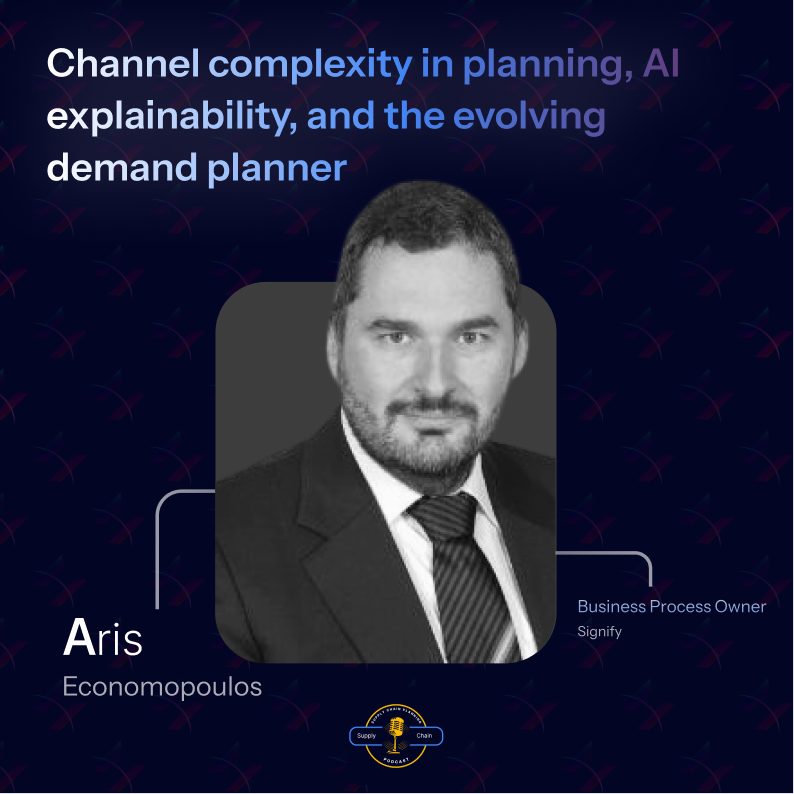

In this episode, Ben and Wim speak with Aris Economopoulos, Business Process Owner for Supply Chain at Signify, with 19 years of experience in the lighting industry across Philips and Signify.
Aris walks us through why lighting is one of the most complex industries to plan for, from multi-channel complexity and SKU proliferation to massive technology shifts from incandescent to LED to smart lighting. He explains how Signify handles capacity allocation across business verticals, why service levels should differ by channel by design, and how their S&OP process resolves prioritization conflicts.
We also explore the role of AI in planning, where Aris sees real value in explainability and building planner trust, versus the hype of autonomous AI agents. He shares his pragmatic approach to piloting new technology using a mode one / mode two framework, and why he believes planners won't be replaced by AI, but by people who can use AI.
The conversation wraps up with a great discussion on the evolving demand planner role, why splitting technical and business-facing planning skills matters, and how junior planners can grow by rotating through operational roles.
Key topics covered include:
- Why the lighting industry is uniquely complex for planning
- Multi-channel complexity: contractors, retail, e-commerce, government, OEM
- Capacity allocation and prioritization in S&OP when supply is constrained
- Technology tsunamis: from incandescent to CFL to LED to smart lighting
- Supply chain resilience through diversification and digital supplier collaboration
- AI in planning: the vision, reality, and the useful middle ground
- Joule and AI assistants for explainability and planner trust
- Forecast consumption and order-based vs time-series planning
- Eliminating Excel dependency with SAP IBP
- Mode one / mode two: piloting new tech before scaling
- The evolving demand planner role: technical COE vs business-adjacent planners
- Why junior planners should rotate through operational roles
Key timestamps:
- (01:08) – Aris's career: from IT and computer science to supply chain leadership
- (03:08) – Why lighting is one of the most complex industries to plan for
- (04:50) – Channel setup: how Signify organizes by business verticals
- (05:50) – Capacity allocation and prioritization across channels
- (07:08) – S&OP as the decision point for channel conflict resolution
- (08:06) – Technology shifts: incandescent to CFL to LED to smart lighting
- (09:08) – Resilience strategy: diversification and digital supplier integration
- (10:32) – Building an end-to-end digital supply chain with vendor collaboration
- (11:51) – AI in planning: vision vs reality vs useful middle ground
- (13:44) – Where AI adds real value: explainability and planner trust
- (15:14) – Reducing Excel usage with SAP IBP
- (16:03) – Order-based vs time-series planning: two planning brains
- (17:37) – Forecast consumption logic and handling over- or under-consumption
- (19:52) – Will AI replace planners? Aris's firm answer
- (22:20) – How the demand planner role is evolving and splitting
- (25:11) – AI policy and the mode one / mode two pilot approach
- (27:27) – The demand planner as junior vs senior role
- (29:04) – Why planners should rotate through operational roles
- (31:15) – Book recommendations: Vandeput, Cecere, Taleb
Related Articles
