Lora Cecere - Outside-in planning, the orchestrator role, and don't AI stupid
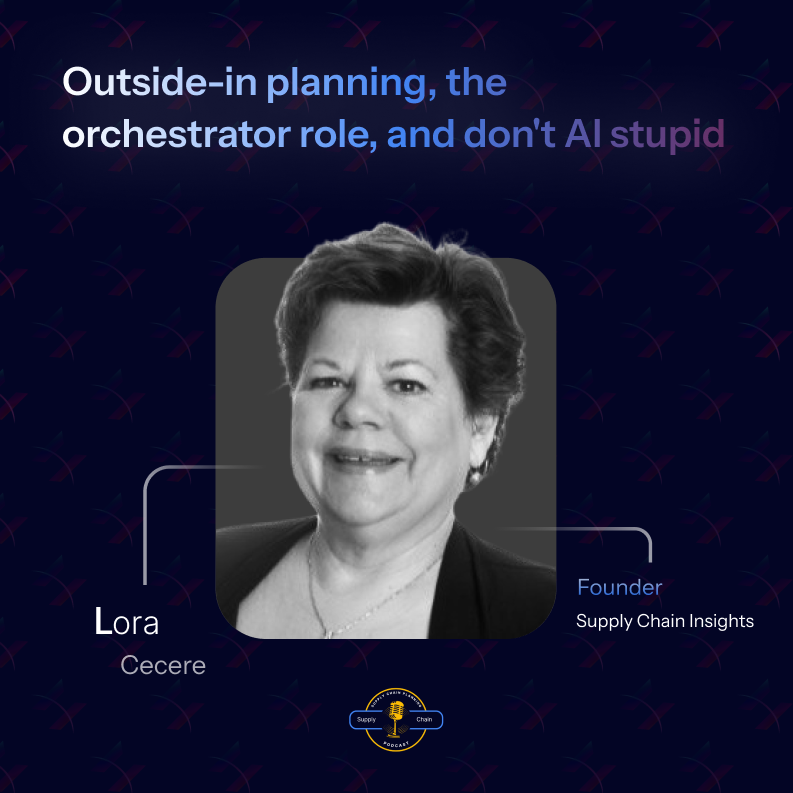

In this episode, Ben and Wim talk to Lora Cecere, founder of Supply Chain Insights and one of the most-read independent voices in supply chain research. Over four decades she has run plants for Procter & Gamble, Kraft, Clorox and Nestlé, worked for Manugistics, Gartner and AMR Research, and published hundreds of reports on why supply chains underperform.
Lora explains outside-in planning: using the data that surrounds the supply chain, not just the transactions inside it. She defines demand latency, separates demand sensing from demand planning, shows why functional metrics throw a supply chain out of balance, and explains what she means by "don't AI stupid".
In this episode
- (00:48) From chemical engineer to analyst: how Lora got into supply chain
- (02:35) Outside-in planning: the five things it makes possible, from cutting demand latency to planning by flow
- (06:35) The balanced scorecard: growth, operating margin, inventory turns and return on capital employed
- (10:39) Why optimising a functional metric throws the system out of balance
- (12:55) Demand sensing vs demand planning: why they belong to different horizons
- (16:01) Bidirectional orchestration: what S&OP misses when it only matches demand to supply
- (21:21) You don't need a data science team, you need customer intimacy
- (23:56) Companies have more data than they think, and don't use it
- (25:31) The planner as orchestrator, and why work design comes before process and technology
- (35:38) "Don't AI stupid": agents on top of old architectures versus an AI-enabled stack
- (42:16) The semantic layer: why DRP and transport planning can't talk to each other
- (45:11) "It's not just data cleaning, it's definitions cleaning"
- (50:06) Buy versus build, and why domain knowledge is the scarce resource
- (53:28) What Lora would tell her 30-year-old self
Three quotes
"Eighty percent of the data that surrounds the supply chain is not used."
"Demand latency is at least three weeks and is often three to four months."
"It's not just data cleaning. It's definitions cleaning."
Questions this episode answers
What is outside-in planning? Planning that starts from market data (point of sale, channel inventory, weather, reviews, supplier data) and works back to the enterprise, instead of starting from orders and shipment history. Lora Cecere coined the term.
What is demand latency? The time between a purchase decision in the market and the moment the supply chain sees the order. Lora puts it at three weeks at minimum and often three to four months.
Is outside-in planning the same as demand sensing? No. Demand sensing works inside lead time, in the operational horizon. Outside-in planning covers the tactical horizon too, and changes which data the plan is built on.
Resources Lora mentions: Supply Chains to Admire (Supply Chain Insights) · Supply Chain Metrics That Matter · "Staple Yourself to an Order", Harvard Business Review · the "What Would I Tell My 25-Year-Old Self" series · IBF on forecast value add · Lora's books.
Read the companion article: Outside-in planning, explained by Lora Cecere.
Related Articles