Anaplan is one of the strongest connected planning platforms for finance-led planning organizations. The Hyperblock calculation engine handles real-time multi-dimensional modeling well, the model-building flexibility is genuine, and the platform integrates finance, supply chain, sales, and corporate planning more tightly than most alternatives. For companies where finance owns the planning rhythm — including S&OP and IBP — Anaplan often fits better than supply-chain-native platforms.
Anaplan fits less well in several common cases: supply-chain-led planning where operational depth matters more than financial integration, companies needing native demand sensing, inventory optimization, or production scheduling capability, mid-market manufacturers wanting integrated operational planning rather than connected modeling, and companies wanting modern architecture for demand forecasting and decision execution.
This page is for buyers in those categories — particularly the common pattern of supply chain leaders who inherited Anaplan from a finance-led initiative and find it doesn't deliver operational depth their team needs.
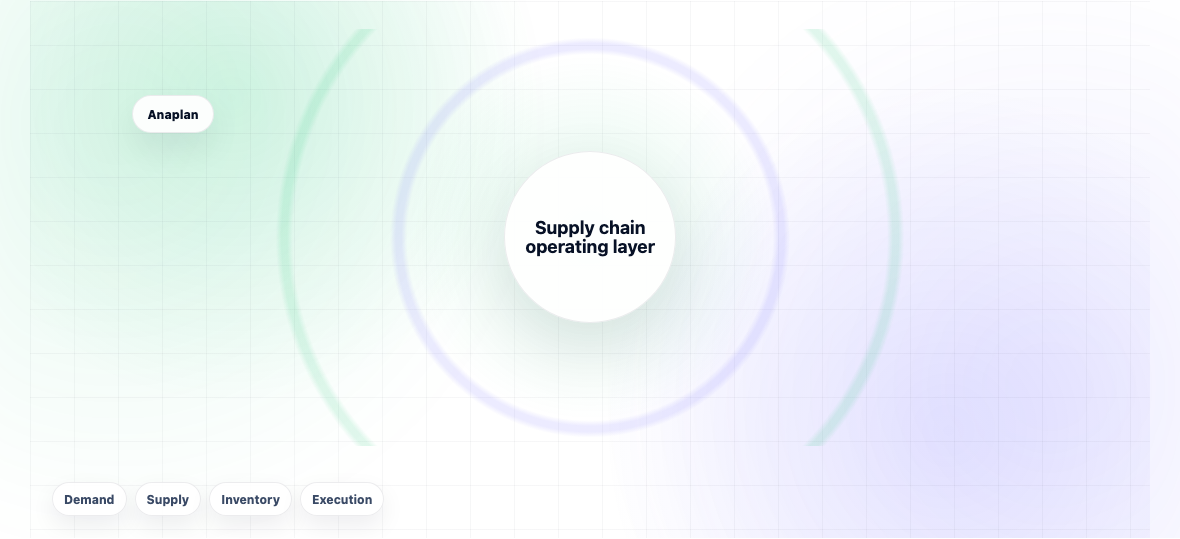
Horizon is positioned for supply-chain-led mid-market manufacturers ($100M-$3B revenue) who are either evaluating Anaplan or who have inherited Anaplan and find it lacks operational supply chain depth. For these companies, Horizon offers a different value proposition: operational depth in supply chain rather than connected modeling across all functions.
What Horizon delivers that Anaplan doesn't: native demand forecasting with ensemble methods and automatic per-SKU model selection (Anaplan can model forecasting logic but doesn't provide it native), multi-echelon inventory optimization with stochastic service-level evaluation, finite capacity production scheduling with sequence-dependent setups, decision execution layer proposing specific operational actions, modern architecture rather than modeling-first.
What Anaplan delivers that Horizon doesn't: connected planning across functions (sales planning, financial planning, headcount planning) where supply chain is one of several connected models, modeling flexibility for unusual planning structures that don't fit standard supply chain patterns, finance-led IBP where finance owns the rhythm.
The honest assessment: if your supply chain team needs operational planning capability, Horizon fits better. If your finance team owns planning and needs connected modeling across functions, Anaplan typically fits better. Many companies end up with both — Anaplan for finance-led connected planning, supply-chain-native platform for operational supply chain. The complementary positioning often works better than trying to force either platform to do both jobs.
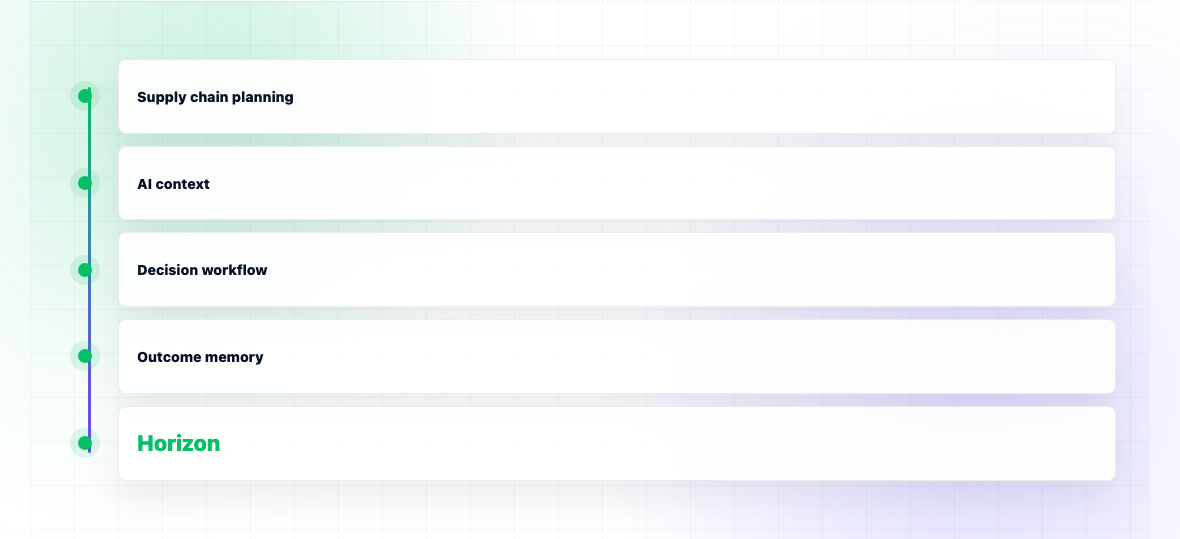
Anaplan alternatives queries split into two distinct populations. The first is finance leaders looking for connected planning alternatives — usually comparing to Workday Adaptive Planning, Pigment, Board, OneStream. The second is supply chain leaders whose company adopted Anaplan as a planning platform but who find it lacks the operational depth they need — comparing to supply-chain-native platforms like Kinaxis, o9, SAP IBP, Horizon, RELEX.
This page is primarily for the second population. The first population — finance-led — should look at finance-native alternatives, which we briefly cover but don't focus on. The supply-chain perspective: Anaplan is a strong modeling platform, but most supply chain planning needs more than a modeling platform. Demand sensing, multi-echelon inventory optimization, finite capacity scheduling, and forecasting are operational capabilities that need to be in the platform rather than modeled from scratch.
The alternatives below are categorized for the supply chain perspective primarily, with notes on finance-led alternatives where relevant.
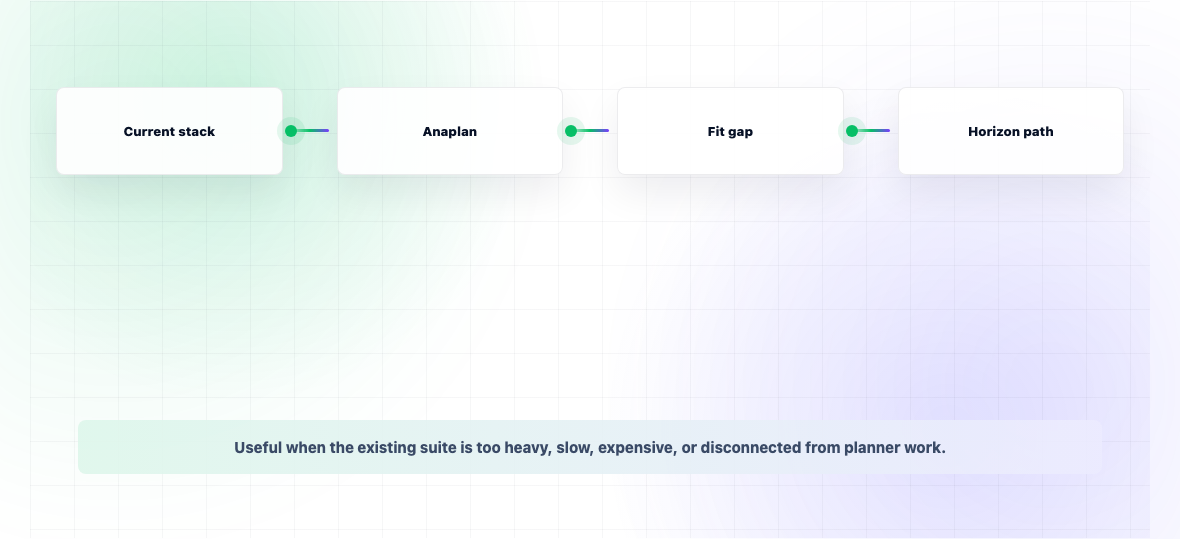
Why considered as Anaplan alternative: Supply-chain-native operational depth at mid-market scale. Native demand sensing, multi-echelon inventory optimization, finite capacity scheduling, forecasting. Integrated platform rather than a modeling layer requiring operational logic built from scratch.
Strengths versus Anaplan: Native operational capabilities (demand forecasting with ensemble methods and per-SKU model selection, MEIO with stochastic service-level optimization, sequence-dependent setup scheduling). Decision execution layer proposes specific operational actions. Faster deployment for supply chain scope.
When Anaplan still wins: Companies where finance owns planning and operational depth matters less than connected modeling across functions.
Why considered as Anaplan alternative: Mid-market integrated supply chain planning with AI capability.
Strengths versus Anaplan: Operational supply chain depth. Long category presence.
Why considered as Anaplan alternative: Strong fit for retail and CPG operations needing operational planning depth.
Strengths versus Anaplan: Demand sensing depth. Retail-specific capability.
Why considered as Anaplan alternative: Enterprise-class supply chain planning with concurrent architecture. Named a Leader in 2026 Gartner Magic Quadrant.
Strengths versus Anaplan: Native supply chain depth. Concurrent planning architecture. Established enterprise reference base.
When Anaplan still wins: Connected planning across non-supply-chain functions where Hyperblock flexibility matters.
Why considered as Anaplan alternative: AI-driven enterprise supply chain planning with knowledge graph architecture.
Strengths versus Anaplan: modern architecture. Operational supply chain depth.
Why considered as Anaplan alternative: Mature enterprise supply chain planning, particularly for SAP customers.
Strengths versus Anaplan: Native SAP integration. Operational supply chain depth.
ensemble forecasting with automatic per-SKU model selection, decision execution layer proposing specific actions.
Enterprise AI architecture with knowledge graph approach.
Probabilistic AI-driven planning as a focused capability.
Direct competitor to Anaplan in finance-led planning, particularly for Workday HCM/Finance customers.
Newer modeling platform. Strong UI and modeling flexibility.
Unified planning across finance and operations with corporate performance management.
Strong financial consolidation with connected planning capability.
Genuinely strong fit. Don't switch if this is your need.
Alternatives for finance-led IBP with different architectural approaches.
Three structured questions clarify whether Anaplan or alternatives fit better. First: who owns planning in your organization — finance, supply chain, or executive team with both as peers? Finance-led typically fits Anaplan, supply-chain-led typically fits supply-chain-native platforms. Second: how much operational depth do you need beyond modeling? If demand sensing, multi-echelon inventory optimization, and production scheduling are essential capabilities, Anaplan's modeling approach requires building these from scratch — supply-chain-native platforms have them built in. Third: does modern architecture matter? Anaplan has added AI capabilities but the core architecture is modeling-first, not AI-first.