If you're researching Anaplan versus SAP IBP, the underlying question is usually: who should own integrated business planning and what platform supports that ownership? Anaplan and SAP IBP take genuinely different approaches. Anaplan optimizes for connected planning where finance, supply chain, sales, and corporate planning operate on a shared modeling platform. SAP IBP optimizes for supply-chain-led planning with native financial integration through the SAP ecosystem.
The choice between them often reveals organizational realities about who owns planning. We're including Horizon in this comparison because a third common pattern exists: mid-market companies whose supply chain function needs operational planning depth that Anaplan's modeling approach doesn't provide, but whose scale doesn't justify SAP IBP's enterprise cost and timeline. For these companies, mid-market supply-chain-native platforms like Horizon often fit better than either Anaplan or SAP IBP.
The framing throughout: finance-led vs supply-chain-led ownership, and enterprise vs mid-market scale.
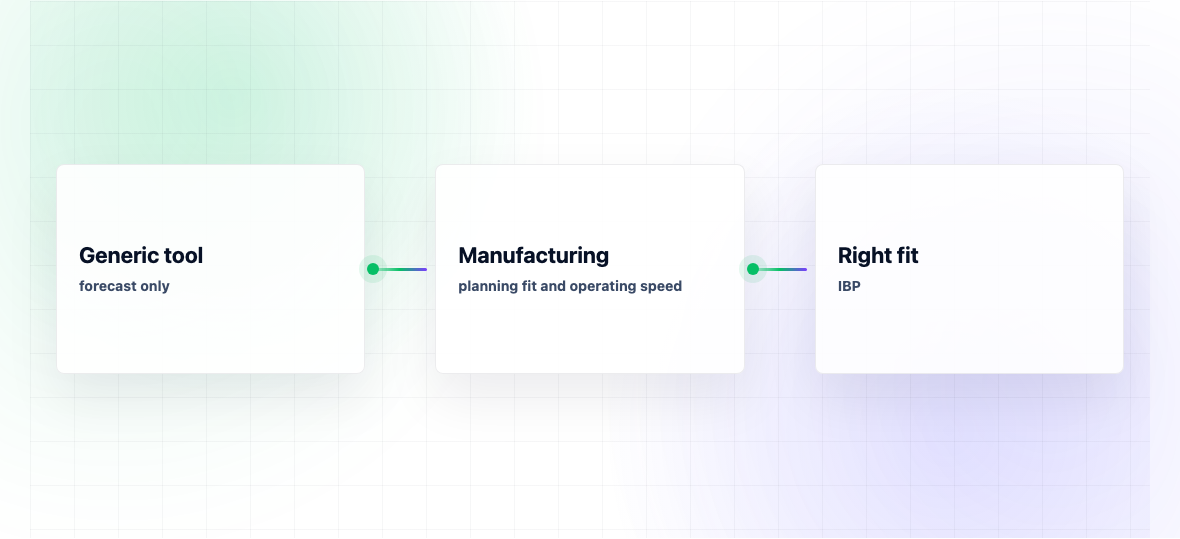
Horizon does not compete with Anaplan for finance-led connected planning. If finance owns your planning rhythm and you need connected modeling across multiple functions, Anaplan is a genuinely good fit and Horizon is not a substitute. We've seen companies try to use supply-chain-native platforms (including Horizon) to support finance-led connected planning — it doesn't work well. The platforms optimize for different things.
Horizon does not compete with SAP IBP at enterprise scale. Fortune 500 manufacturers with SAP ecosystem investment and global complexity are better served by SAP IBP than by mid-market platforms. We won't pursue those deals.
Where Horizon competes effectively: mid-market manufacturers ($100M-$3B revenue) with supply-chain-led planning. For these companies, Anaplan's modeling-first approach requires building supply chain operational logic from scratch — typically months of analytical work and ongoing maintenance. SAP IBP's enterprise architecture is over-scaled — 12-24 month implementation and seven-figure TCO disproportionate to mid-market scale. Horizon's mid-market supply-chain-native architecture delivers operational depth out-of-box at mid-market scale.
The decision framework: identify ownership model first (finance-led or supply-chain-led), then scale (enterprise or mid-market). Finance-led organizations should evaluate Anaplan, Board, and OneStream — Horizon is not relevant. Supply-chain-led enterprises should evaluate SAP IBP, Kinaxis, o9 — Horizon is not relevant. Supply-chain-led mid-market companies should evaluate Horizon, Logility, RELEX — Anaplan and SAP IBP are typically over-scaled or over-coupled.
Many companies actually run complementary platforms — Anaplan for finance-led connected planning across functions, supply-chain-native platform (Horizon, Kinaxis, SAP IBP depending on scale) for operational supply chain. This works well when the integration between the two platforms is set up properly. Forcing either Anaplan or a supply-chain-native platform to do both jobs typically delivers worse outcomes than complementary deployment.
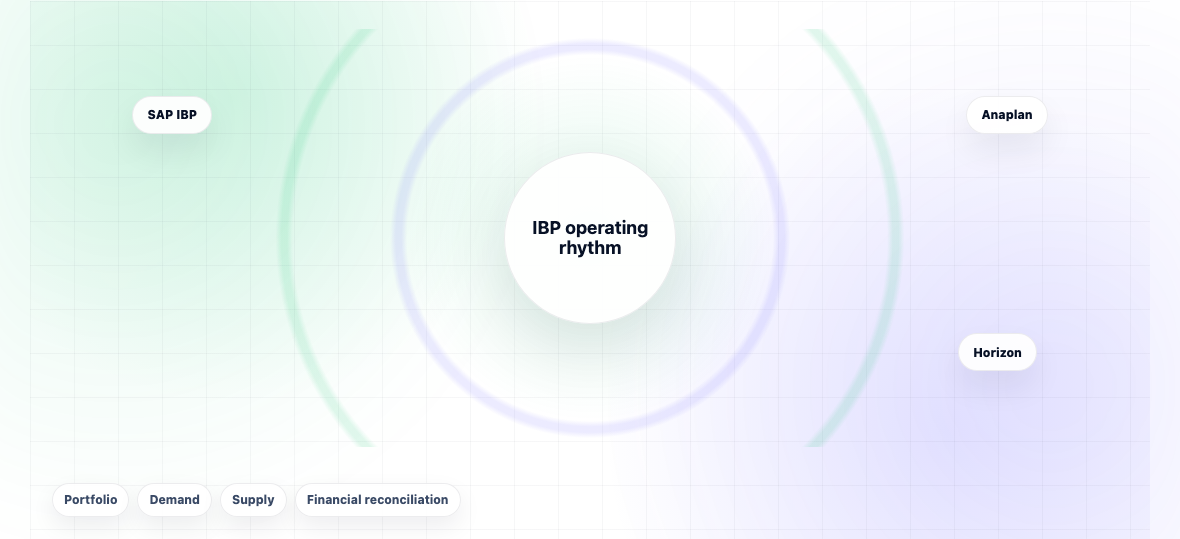
The Anaplan vs SAP IBP question is rarely just a software comparison — it usually reflects deeper organizational decisions about who owns planning. Finance-led organizations tend to gravitate toward Anaplan because the platform fits the finance-led operating model. Supply-chain-led organizations tend to gravitate toward SAP IBP because the platform fits the supply-chain-led operating model with finance integration. Companies that haven't resolved who owns planning often struggle in evaluation because the two platforms optimize for different ownership models.
The mid-market dimension adds another consideration. Both Anaplan and SAP IBP are enterprise platforms — TCO and implementation timelines that fit Fortune 500 budgets often don't fit mid-market scale. Mid-market companies sometimes get to month 6 of evaluation before recognizing this, having spent that time comparing enterprise approaches that neither fit their scale.
The platforms below are evaluated by who fits which ownership model at which scale.
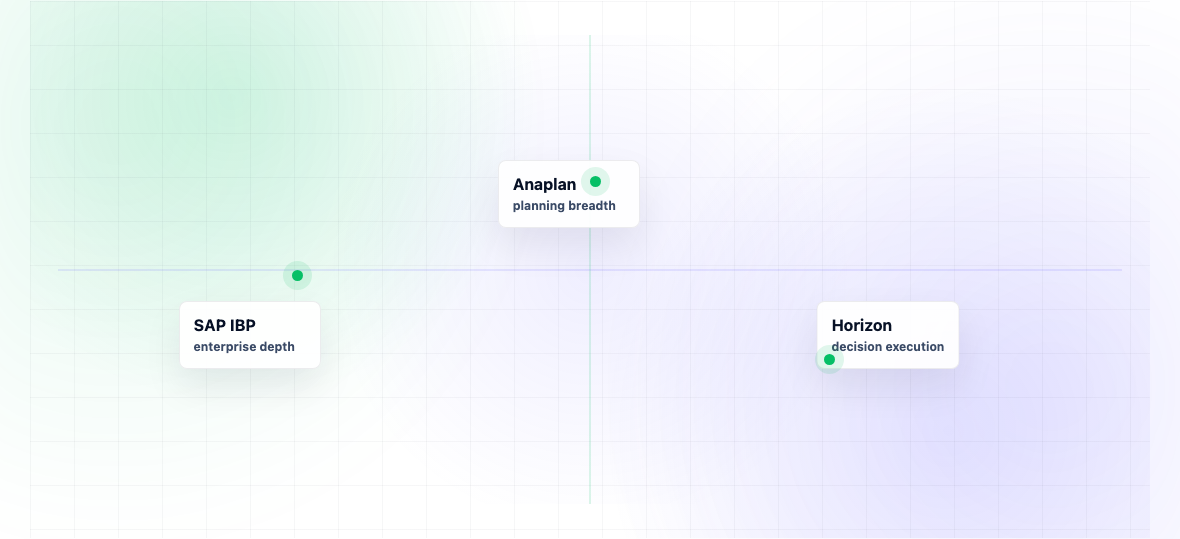
Best fit: finance-led planning organizations across enterprise and upper mid-market scale. Companies where finance owns the planning rhythm and connected planning across multiple functions (finance, supply chain, sales, headcount) delivers more value than operational depth in any single function.
Best fit: large multinational manufacturers ($3B+ revenue) running SAP S/4HANA. Supply-chain-led planning with finance integration through native SAP ecosystem. Strong reference base in pharma, chemicals, CPG.
Best fit: mid-market manufacturers ($100M-$3B revenue) with supply-chain-led planning needing operational depth. 1-10 plants, 500-5,000 active SKUs. Not built for finance-led connected planning across non-supply-chain functions.
Hyperblock calculation engine for real-time multi-dimensional modeling. Modeling-first architecture — customers build planning structures that match their operating model. Strong flexibility for unusual planning structures and cross-functional connections.
Enterprise supply chain planning with native SAP integration. Mature capability across demand planning, supply planning, inventory optimization, S&OP, IBP. Financial integration through SAP ecosystem.
supply chain planning sized for mid-market. Ensemble forecasting with automatic per-SKU model selection. Multi-echelon inventory optimization. Finite capacity scheduling. Decision execution layer proposing specific operational actions. Configuration-driven deployment.
High modeling flexibility, lower native operational depth. Demand forecasting algorithms, multi-echelon inventory math, and finite capacity scheduling logic typically need to be modeled by the customer rather than provided natively. Time-to-value for supply chain operational use cases is longer because the logic needs to be built.
Mature native operational depth across demand planning, supply planning, inventory optimization. Standard supply chain math built into the platform rather than requiring customer modeling. Lower modeling flexibility for unusual planning structures.
Native operational depth at mid-market scale. Ensemble forecasting, MEIO, finite capacity scheduling built into the platform. modern architecture. Lower modeling flexibility than Anaplan for non-supply-chain functions; not designed for finance-led connected planning across multiple functions.
Highly variable based on scope and modeling complexity. Simple connected planning (e.g., basic S&OP) deploys in 3-6 months. Complex supply chain models built from scratch typically take 9-18 months. Multiple connected functional models add deployment time per model.
Full deployment typically 12-24 months. Single module deployment 6-9 months.
6-10 weeks per module. Full integrated platform 6-9 months total.
Three-year TCO for mid-market manufacturer: $1.5-3.5M depending on connected planning scope. For enterprise: $3-10M.
Three-year TCO for mid-market manufacturer: $2-4M. For enterprise: $5-15M+.
Three-year TCO for mid-market manufacturer: $700K-$1.5M. 50-70% lower than Anaplan or SAP IBP at the same scale.