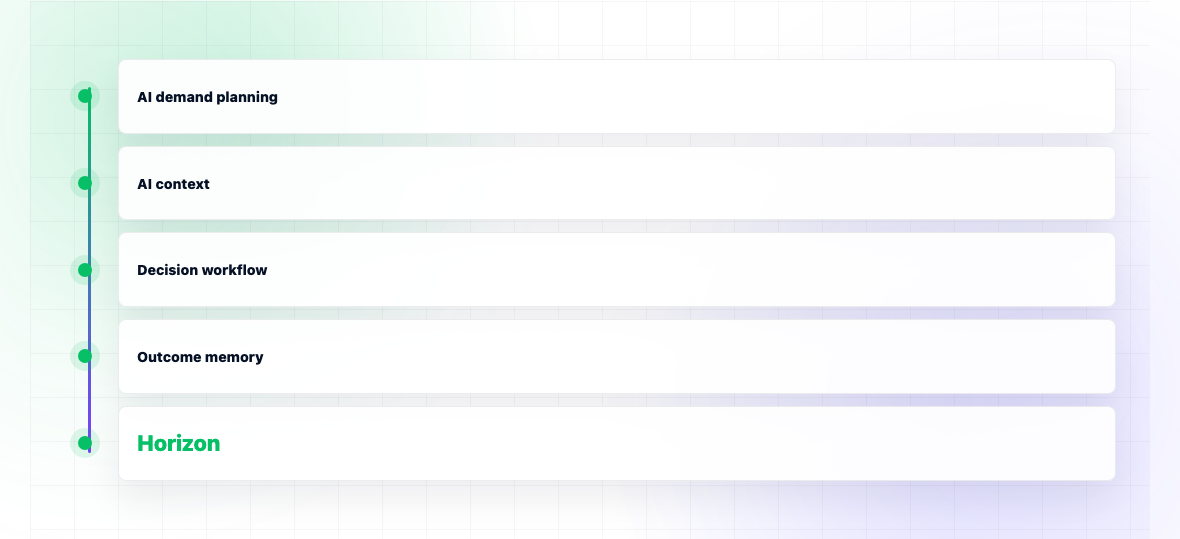
"AI demand planning" is a broad label covering several technically different capabilities. Some platforms use machine learning to select forecasting algorithms per SKU automatically (replacing manual model selection). Some use neural networks for pattern recognition in promotional, seasonal, or causal demand drivers. Some use probabilistic methods (Bayesian or Monte Carlo approaches) for forecast confidence intervals. Some use AI for anomaly detection or exception management rather than the forecast itself.
The platforms below distinguish by which AI capabilities they actually deliver versus which they market. The buyer's job is to understand which kind of AI matters for your operation and pick accordingly — generic "AI demand planning" claims aren't evaluable without specifics.
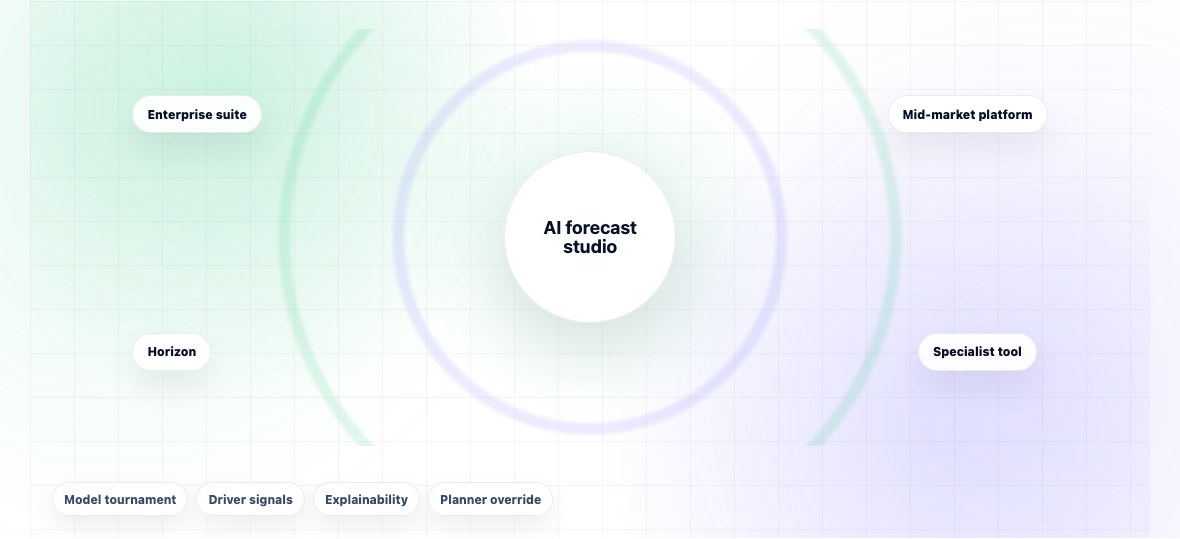
Horizon fits mid-market manufacturers $100M-$3B with heterogeneous demand patterns (mix of promotional, seasonal, stable, and intermittent SKUs). The ensemble forecasting approach is the technical differentiator: rather than picking one method (statistical or ML) and applying to all SKUs, Horizon automatically selects the best-performing method per SKU based on historical accuracy. This addresses the reality that different demand patterns benefit from different methods — and most real portfolios have multiple pattern types.
Where Horizon doesn't fit: global enterprises with multinational complexity typically fit o9 or Kinaxis better; operations whose AI needs include very advanced causal modeling across complex relational data fit o9's knowledge graph approach better; operations with only stable baseline demand patterns may not benefit from AI capabilities and can use simpler statistical platforms. We'll be specific about fit in early conversations.
The honest reality: AI in demand planning delivers meaningful accuracy improvement for some demand patterns and modest-to-zero improvement for others. ML methods typically help most on promotion-driven SKUs (5-12 points MAPE improvement common), causal-demand SKUs (where external drivers like weather or events affect demand), and operations with rich data history. ML methods help less on stable baseline SKUs (where statistical methods work well), on intermittent demand SKUs (where pattern recognition has little to work with), and on operations with limited or poor-quality demand history.
The implication: the right AI demand planning platform is one whose AI capabilities match your demand pattern mix. Platforms claiming universal AI superiority typically over-promise. Platforms with ensemble approaches (multiple methods per SKU, with automatic selection based on which works best per pattern) typically deliver more consistent results across heterogeneous portfolios.
Built for: Mid-market manufacturers wanting probabilistic AI-driven planning.
Strengths: Probabilistic forecasting with confidence intervals. Strong handling of demand variability. Fast deployment.
Limitations: Newer entrant, smaller reference base than established platforms.
Built for: Mid-market and enterprise operations wanting probabilistic methods.
Strengths: Probabilistic forecasting integrated with inventory optimization. Strong on intermittent and slow-moving items.
Built for: Large enterprises wanting AI-driven planning with knowledge graph architecture.
Strengths: Knowledge graph supports AI reasoning across product-customer-channel relationships. ML for demand forecasting and sensing. The only vendor named Customers' Choice in 2025 Gartner Peer Insights for Supply Chain Planning.
Limitations: Enterprise scale and cost. Requires mature data engineering.
Built for: Large enterprises using concurrent planning with AI enhancements.
Strengths: AI added to concurrent planning foundation through Maestro AI suite. Strong demand sensing.
Built for: SAP-centric enterprises.
Strengths: AI capabilities embedded across IBP modules. Native SAP integration.
Luminate platform with AI for demand sensing and planning. Strong retail-CPG focus.
Built for: Mid-market manufacturers $100M-$3B revenue, 500-5,000 SKUs.
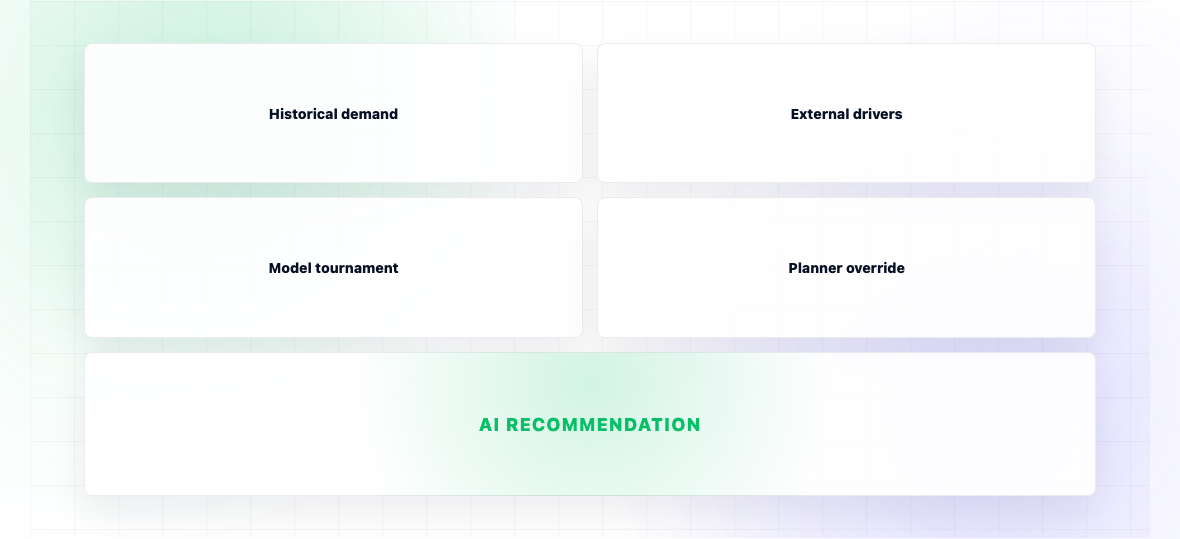
Strengths: Ensemble forecasting with automatic per-SKU model selection — statistical methods (Holt-Winters, ARIMA, Croston) and ML methods (gradient-boosted trees) selected based on which performs best per SKU. Promotional uplift modeling. Decision execution layer that proposes specific forecast adjustments and overlay recommendations to planners. NVIDIA Inception membership.
Limitations: Not built for global multinational complexity or 50,000+ SKU portfolios.
AI through Logility Expert Advisor for demand planning workflow assistance and forecast improvement.
Modern cloud-native platform with ML-driven demand sensing for retail and CPG.
Three factors drive the shortlist. First, demand pattern mix: portfolios heavy on promotions and causal demand benefit most from ML methods; portfolios heavy on stable baseline or intermittent demand benefit less. Second, data maturity: rich, clean demand history enables more sophisticated AI; limited or messy data limits AI value. Third, scale: enterprise platforms (o9, Kinaxis, SAP IBP, Blue Yonder) fit $3B+ operations; mid-market integrated (Horizon, Logility, RELEX) fit $100M-$3B; specialists (Flowlity, ToolsGroup) fit specific use cases.