AI in supply chain planning spans more than demand forecasting. It includes supply variability prediction (anticipating supplier disruptions before they happen), inventory optimization with probabilistic methods, scheduling with reinforcement learning approaches, anomaly detection across plans, and decision recommendation engines that propose specific actions rather than only producing reports. The platforms that label themselves "AI supply chain planning" vary widely in which capabilities they actually deliver.
This page covers the main categories — from AI-positioned enterprise platforms to specialists to hyperscaler offerings — with honest fit guidance about which buyer profile fits which approach.
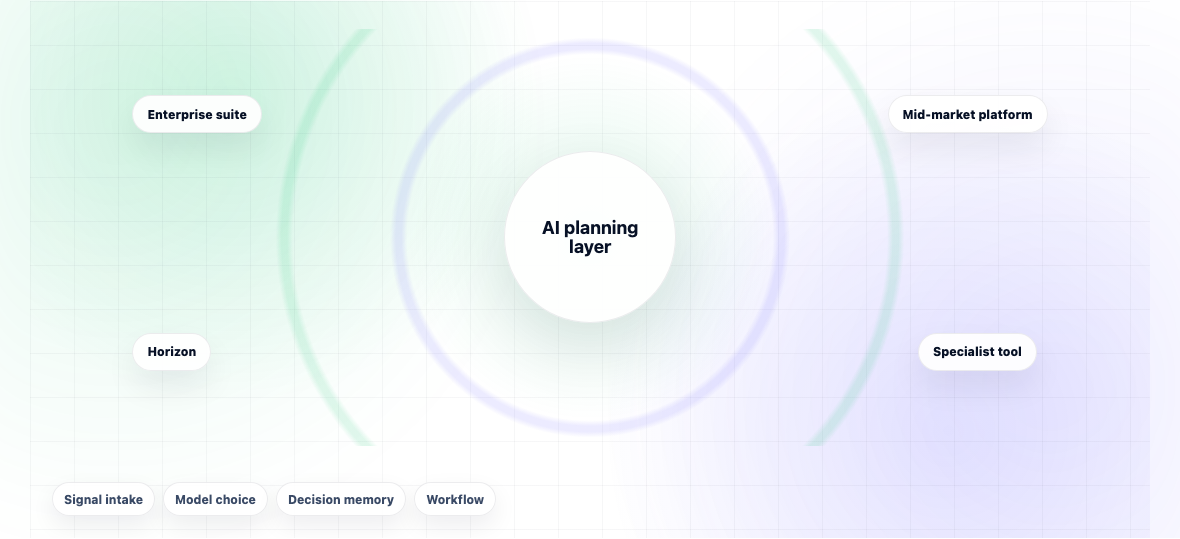
Horizon fits mid-market manufacturers $100M-$3B wanting integrated AI across the supply chain rather than AI in one functional area. The platform applies AI methods where they help (ensemble demand forecasting with per-SKU model selection, probabilistic MEIO, constraint-based scheduling) and uses statistical methods where they work better (stable demand SKUs, simple network structures). The decision execution layer is the operational differentiator: AI doesn't just produce analytical output for planners to interpret — it proposes specific actions across the supply chain.
Where Horizon doesn't fit: Fortune 500 multinationals with multi-ERP, multi-region operations typically need enterprise platforms (o9, Kinaxis, SAP IBP, Blue Yonder); operations with very complex relational data may benefit from o9's knowledge graph approach more than Horizon's ensemble approach; data science teams building bespoke AI capability often fit hyperscaler or pure ML platforms better. We'll be honest about fit in early conversations.

Vendors mean different things by AI SCP. Three common patterns: AI as marketing (older platforms with AI features bolted on, mostly statistical methods rebranded), AI as architecture (platforms designed with AI/ML embedded throughout, like o9's knowledge graph approach), and AI as workflow (platforms that use AI to assist planners with specific decisions, like Horizon's decision execution layer or Logility's Expert Advisor). All three can deliver value, but they're different things and the buyer needs to understand which they're getting.
The honest evaluation question: ask the vendor to demonstrate three specific AI-driven decisions on your actual data. Generic AI capability claims aren't evaluable. Specific demonstrated capabilities are. The list below distinguishes by what platforms actually deliver versus what they market.
Built for: Large enterprises wanting AI embedded across planning through knowledge graph architecture.
Strengths: Knowledge graph supports AI reasoning across complex product-customer-channel-supplier relationships. Embedded ML throughout. Customers' Choice in 2025 Gartner Peer Insights.
Limitations: Enterprise cost and complexity. Requires mature data engineering.
Built for: Large enterprises using concurrent planning with AI enhancements.
Strengths: Maestro AI suite layers AI capabilities on concurrent planning foundation. Strong scenario analysis. 2026 Gartner MQ Leader.
AI capabilities embedded across IBP modules. Best fit for SAP-centric enterprises.
AI across demand sensing, supply optimization, and execution. Strong retail-CPG focus.
Built for: Mid-market manufacturers $100M-$3B revenue, 1-10 plants, 500-5,000 SKUs.
Strengths: Integrated AI across demand (ensemble forecasting), inventory (probabilistic MEIO), and scheduling. Decision execution layer proposes specific actions to planners across the full supply chain — forecast overlays, safety stock adjustments, capacity changes, supplier expedites. NVIDIA Inception membership.
AI through Logility Expert Advisor for planning workflow assistance.
ML-driven planning with strong retail-CPG demand sensing.
Probabilistic AI as focused capability. Strong for mid-market demand and inventory.
Probabilistic methods across demand and inventory.
Built for: AWS customers wanting AI for specific supply chain use cases.
Strengths: Strong AWS integration. ML methods from Amazon.
Limitations: Limited functional breadth versus dedicated planning platforms.
Built for: Google Cloud customers wanting digital twin capability.
Strengths: Strong GCP integration. ML methods.
Limitations: Limited functional breadth.
Three factors drive the shortlist. First, scale: enterprise platforms (o9, Kinaxis, SAP IBP, Blue Yonder) fit $3B+ operations; mid-market integrated (Horizon, Logility, RELEX) fit $100M-$3B; specialists fit specific use cases. Second, what kind of AI matters: ML for demand forecasting, probabilistic methods for inventory, optimization with constraints for scheduling, recommendation engines for planner decisions. Different platforms emphasize different AI types. Third, integration scope: full integrated AI across demand, supply, inventory, scheduling versus AI for one functional area.