APS (Advanced Planning and Scheduling) is one of the broadest terms in supply chain software. Some vendors use it to mean detailed production scheduling specifically. Others use it to mean the full planning stack — demand, supply, master scheduling, and detailed scheduling combined. The same product can be described as "APS," "supply chain planning," or "manufacturing optimization" depending on which marketing page you read.
This page does not produce a top-10 ranking. Instead, it categorizes the APS platforms most manufacturers will encounter by scope (detailed-scheduling-only versus full-stack), by manufacturing mode (discrete vs process), and by company size. The lineup is drawn from real evaluations across mid-market and enterprise manufacturers.
The goal is to help a manufacturing or supply chain leader narrow a shortlist from "everyone claiming APS" to "3-4 platforms that genuinely fit our scope and manufacturing mode."
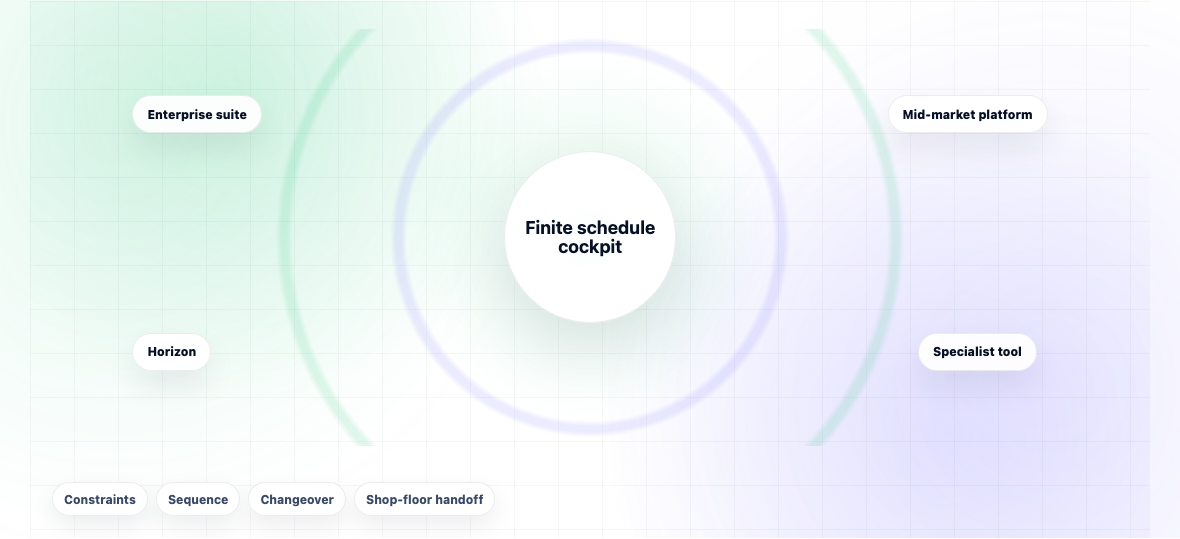
Horizon is positioned for mid-market full-stack APS — companies wanting demand, supply, inventory, and detailed scheduling in a single platform without enterprise-suite cost or timeline. The platform fits $100M-$3B revenue manufacturers with 1-10 plants in discrete, process, and CPG modes.
What distinguishes Horizon as full-stack APS: the scope genuinely covers demand planning, supply planning, inventory optimization, finite capacity scheduling, and distribution planning in one platform with shared data. The detailed scheduler consumes the production plan from supply planning automatically. Inventory targets from optimization flow into replenishment. The integration that companies typically struggle to build between standalone APS components is native here.
What distinguishes Horizon as APS: forecasting uses ensemble methods with automatic per-SKU model selection. Inventory optimization uses stochastic service-level optimization. Scheduling uses constraint programming with metaheuristics for larger problems. The decision execution layer extends across the full APS — proposing forecast adjustments to demand planners, replenishment actions to inventory teams, schedule changes to production schedulers — rather than only producing reports.
For companies needing standalone detailed scheduling, Horizon's scheduling module can deploy independently. For companies needing full-stack APS in mid-market scale, Horizon competes with Logility and RELEX (with somewhat different strengths). For Fortune 500 global enterprises with 12-24 month deployment budgets, enterprise platforms (Kinaxis, o9, SAP IBP, OMP) typically fit better.
Where Horizon doesn't fit: semiconductor fabs, refineries, operations with extremely specialised constraint structures, or companies whose constraints don't fit standard discrete/process/CPG patterns. Alternatives like More Optimal's low-code optimization platform may fit better for the last case.
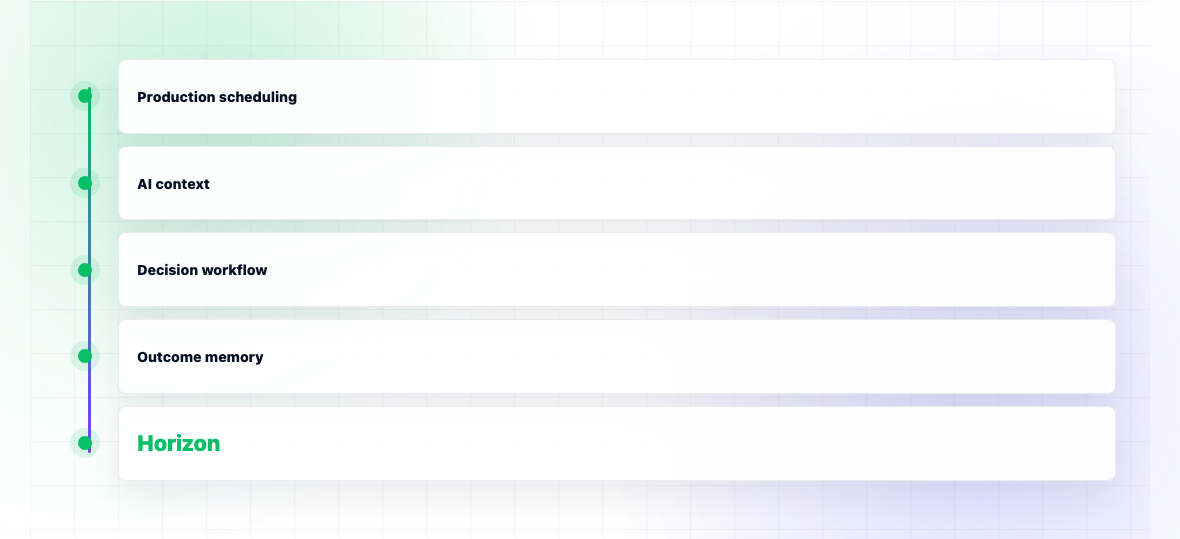
The breadth of the APS term creates predictable evaluation failures. A buyer comparing "APS platforms" often ends up with a shortlist mixing platforms that do detailed scheduling only (PlanetTogether, Asprova, Siemens Opcenter) with platforms that do full-stack planning including detailed scheduling (Kinaxis, o9, Horizon). These aren't really competitors — they solve different problems at different scopes. Comparing them in a single evaluation produces confused requirements and frustrated vendors.
The other reason buying confusion is expensive: APS is typically a 5-8 year platform commitment, and the wrong scope choice locks the company into either expensive integration work (standalone APS bolted onto separate planning) or under-utilized capability (full-stack platform when standalone scheduling was sufficient).
The categories below distinguish APS platforms by scope first, then by scale, then by manufacturing mode fit. Identify your scope need before comparing platforms — it's the highest-leverage decision in the evaluation.
Built for: $3B+ revenue manufacturers wanting concurrent planning across demand, supply, inventory, and detailed scheduling. Named a Leader in 2026 Gartner Magic Quadrant.
Strengths: Concurrent architecture, strong scenario analysis, broad scope.
Limitations: Implementation 12-18 months. TCO $1M+ annually.
Built for: Large global enterprises with mature data engineering wanting AI-driven full-stack APS.
Strengths: Meta-solver approach for scheduling problems. Deep AI/ML embedding. Knowledge graph architecture.
Limitations: Configuration complexity. Requires data engineering capability.
Built for: SAP S/4HANA manufacturing customers wanting integrated APS within SAP stack.
Strengths: Native SAP integration. Mature in pharma, chemicals, CPG.
Limitations: SAP ecosystem lock-in. Implementation 12-24 months.
Built for: Enterprise manufacturers wanting integrated APS through Blue Yonder platform.
Strengths: Strong retail and CPG capability. AI through Luminate.
Limitations: Implementation cost and complexity.
Built for: Oracle ERP customers wanting unified APS.
Strengths: Native Oracle integration. Embedded AI. Single platform across demand, supply, manufacturing.
Limitations: Best fit when Oracle ERP is the foundation.
Built for: Process industry enterprises. Named highest in 2026 Gartner Magic Quadrant for Process Industries.
Strengths: Deep process-industry capability. Integrated planning and scheduling.
Limitations: Process industry focus.
Built for: Mid-to-large discrete and process manufacturers needing deep finite-capacity scheduling.
Strengths: Mature constraint-handling. Strong reference base in automotive, aerospace, industrial.
Limitations: Standalone scheduling — integration with broader planning required.
Built for: Complex enterprise manufacturing with unusual constraint structures.
Strengths: Deep constraint programming. Handles specialised constraints other tools struggle with.
Limitations: Enterprise pricing. Configuration-heavy.
Built for: High-mix, low-volume discrete manufacturers needing detailed sequencing.
Strengths: Strong sequencing math. Mature in Japanese-style manufacturing and automotive supply chain.
Limitations: Implementation requires specialised expertise.
Built for: $100M-$3B revenue manufacturers wanting full-stack APS (demand, supply, inventory, detailed scheduling) without enterprise-suite cost.
Strengths: Single platform covering demand planning, supply planning, inventory optimization, finite capacity scheduling, and distribution planning. Native AI capabilities. Decision execution layer that proposes specific planning and scheduling actions to users. 6-10 week deployment per module versus 12-24 months for enterprise platforms.
Limitations: Not built for Fortune 500 global complexity or semiconductor/refinery scheduling.
Built for: Mid-market manufacturers and distributors wanting AI-first full-stack APS.
Strengths: AI through Logility Expert Advisor. Broad functional coverage.
Limitations: Implementation longer than cloud-native competitors.
Built for: Retail and CPG manufacturers wanting full-stack APS, especially in European markets.
Strengths: Strong retail capability. Cloud-native architecture.
Limitations: Less suited to pure discrete manufacturing.
Built for: Mid-market discrete and process manufacturers needing dedicated APS that integrates with ERP.
Strengths: Strong constraint-management capability. Drag-and-drop interface. Established in food processing, pharma, electronics, automotive.
Limitations: Detailed scheduling only — integration with broader planning required.
Built for: Mid-market manufacturers wanting APS within Siemens portfolio.
Strengths: Mature scheduling capability. Strong integration with Siemens MES.
Limitations: Best fit when Siemens is the broader manufacturing stack.
Horizon's scheduling module can also be deployed as standalone detailed scheduling for companies that already have demand and supply planning elsewhere and need only the scheduling component. The integrated platform is the typical deployment but module-level deployment is supported.
Built for: Mid-market manufacturers wanting flexible low-code optimization rather than rigid pre-packaged APS.
Strengths: Low-code platform — customers model their own specific rules. Cloud-hosted with built-in optimization algorithms. European mid-market reference base.
Limitations: Configuration effort upfront. Best fit when standard APS templates don't match operations.
Horizon fits this category too because the architecture is (per-SKU model selection, ML for volatile SKUs, decision execution proposing actions). Different from older APS platforms with bolted-on AI.
Also fits this category as optimization-led (mathematical optimization rather than ML-pattern-led) with a low-code platform architecture.
Probabilistic planning with strong inventory and demand integration. Fits when probabilistic methods specifically suit the operations.
Mid-market consumer goods and manufacturing with Atlas Planning. Strong demand planning depth feeding APS.
First decision: full-stack APS or detailed scheduling only? If you need demand, supply, inventory, and scheduling together, look at Category 1 (enterprise) or Category 3 (mid-market). If you have demand and supply planning elsewhere and need only detailed scheduling, look at Category 2 (enterprise specialists) or Category 4 (mid-market specialists).
Second decision: scale. Enterprise platforms need 12-24 months and $1M+ TCO; mid-market deploys in 6-12 months at lower cost.
Third decision: manufacturing mode. Discrete, process, or unusual constraint structures? Match the platform to your mode rather than assuming generic capability.