"Automotive demand planning" covers very different problems depending on where the company sits in the supply chain. OEMs (Ford, GM, Stellantis, Toyota, BMW, etc.) plan production volumes against forecast consumer demand, dealer orders, and fleet sales � multi-billion-dollar planning at global scale. Tier 1 suppliers plan against OEM call-offs that can swing dramatically week-to-week. Tier 2 and Tier 3 suppliers plan against Tier 1 schedules that themselves depend on OEM volumes. Aftermarket parts distributors plan against installed vehicle demand patterns spanning decades of vehicle lifetimes.
The platforms that fit each segment differ significantly. This page covers all segments with honest fit guidance � including being clear about where Horizon fits (mid-market suppliers and aftermarket) and where it doesn't (OEMs).
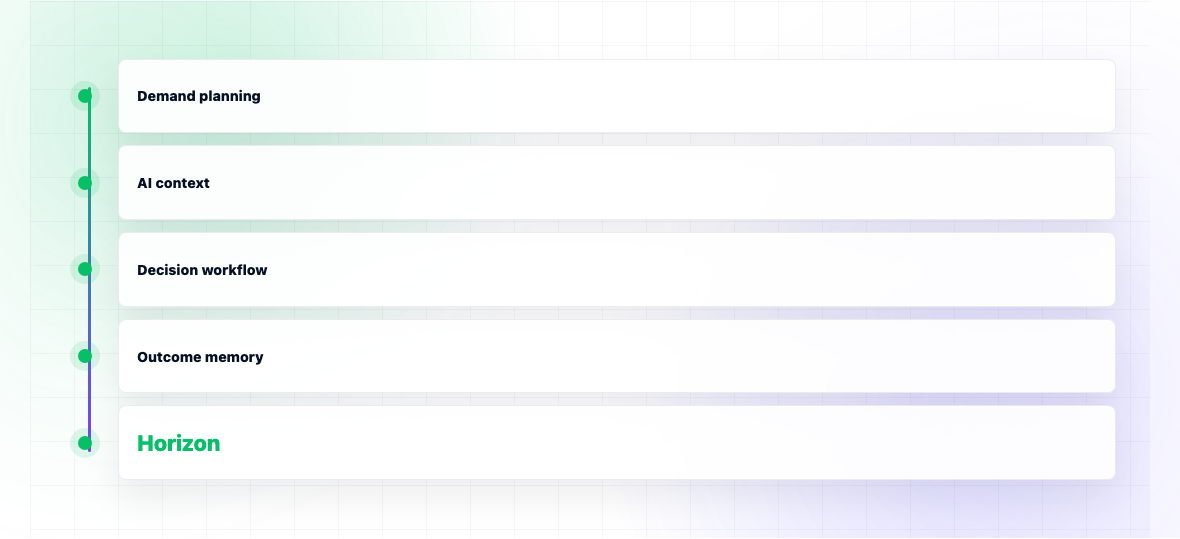
Horizon fits mid-market automotive companies in the $100M-$3B range � primarily Tier 2 and Tier 3 suppliers, smaller Tier 1 suppliers, component manufacturers, and aftermarket parts distributors. The platform handles the specific challenges these companies face: call-off volatility from OEM and Tier 1 customers (where weekly volume swings of 20-50% are common), program-vs-aftermarket demand pattern mixes within the same portfolio, customer-specific demand patterns that need separate forecasting per major customer, and lead time variability from upstream suppliers.
Where Horizon doesn't fit (we'll be explicit about this): OEMs (Ford, GM, Stellantis, Toyota, Volkswagen, BMW, Honda, Nissan, etc.) need enterprise platforms with multi-region, multi-ERP capability � Kinaxis, SAP IBP, o9, or Blue Yonder are the right choices. Mega-Tier-1 suppliers ($5B+ revenue, multi-region) similarly need enterprise platforms. Highly specialised automotive segments (semiconductor for ADAS, specialty chemistry for batteries) often have specific platform needs we don't fit. We'll recommend the right enterprise platform in early conversations rather than pursue mis-fit deals.
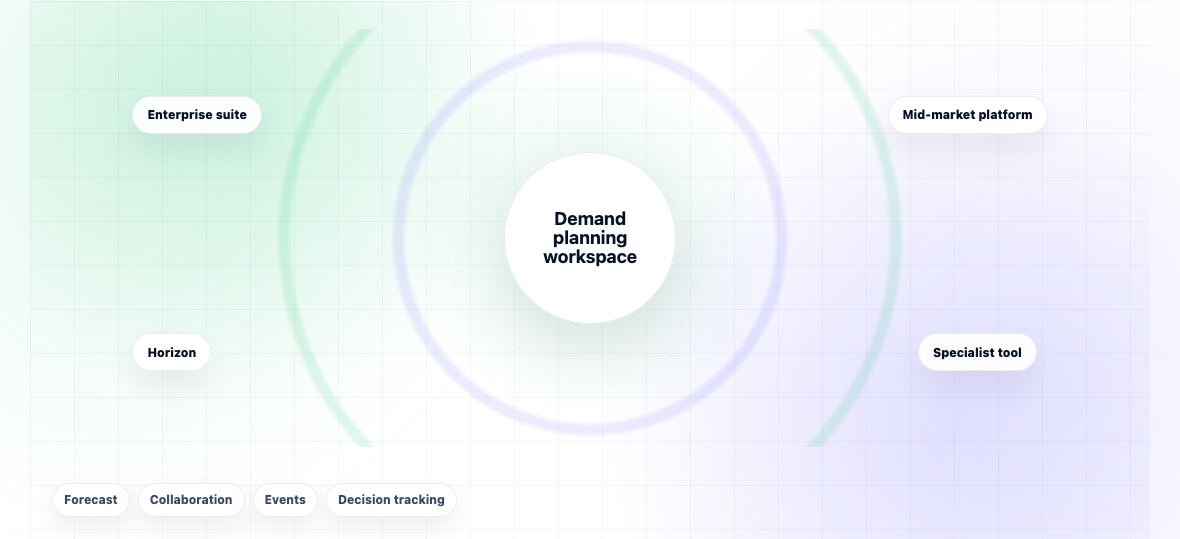
The most consequential decision in automotive demand planning is matching platform scale to tier position. OEMs need enterprise platforms with multi-region, multi-ERP capability and concurrent planning across complex global operations. Tier 1 mega-suppliers ($5B+) typically also need enterprise platforms. Tier 2/Tier 3 suppliers and smaller Tier 1 suppliers ($100M-$3B) typically fit mid-market integrated platforms. Aftermarket distributors typically fit distribution-focused platforms.
The mismatched-platform pattern is common in automotive: a Tier 2 supplier spends 18 months implementing an enterprise platform (often because their OEM customer recommended it) and uses 30-40% of the capability. The right platform choice usually matches scale, not industry alone. The list below segments by tier position to make this explicit.

Strong reference base across major OEMs. Concurrent planning architecture handles global multi-region operations. 2026 Gartner MQ Leader.
Native fit for SAP-centric OEMs. Mature financial integration.
AI-driven knowledge graph approach. Strong for complex product configurations.
Established automotive reference base. Strong supply chain execution integration.
Concurrent planning handles call-off volatility from multiple OEM customers.
Native SAP integration for SAP-centric Tier 1 operations.
AI for cross-customer demand sensing.
High-mix manufacturing depth, particularly common in Japanese-affiliated Tier 1 operations.
Built for: Mid-market automotive component manufacturers and lower-end Tier 1 suppliers in $100M-$3B range.
Strengths: Ensemble forecasting handles call-off volatility � different methods for stable program SKUs versus volatile call-off SKUs. Customer-specific demand pattern modeling. Decision execution layer proposes specific responses to call-off changes (expedite materials, adjust scheduling, communicate to upstream suppliers). Configuration-driven deployment in 6-10 weeks per module.
Limitations: Not built for OEM-scale global complexity or mega-Tier-1 operations with $10B+ revenue.
Mid-market automotive supplier reference base. Atlas Planning capability.
Atlas Planning with automotive component manufacturer references.
Modern platform; less automotive-specific but works for automotive aftermarket and parts distribution.
Strong distribution focus. Established aftermarket parts reference base.
Probabilistic methods handle long-tail aftermarket parts (intermittent demand) particularly well.
Manufacturer-distributor aftermarket operations in $100M-$3B range. Lead time variability handling matters for the multi-supplier networks typical in aftermarket.
The shortlist almost entirely follows scale and tier position. OEMs and mega-Tier-1 ($5B+): enterprise platforms (Kinaxis, SAP IBP, o9, Blue Yonder). Mid-market Tier 1/2/3 ($100M-$3B): mid-market integrated (Horizon, Logility, John Galt, RELEX). Aftermarket and parts distribution: distribution specialists (Slimstock, ToolsGroup) or integrated platforms with distribution capability (Horizon, RELEX). The mistake to avoid: mid-market suppliers using OEM-recommended enterprise platforms typically over-buy by 2-3x.