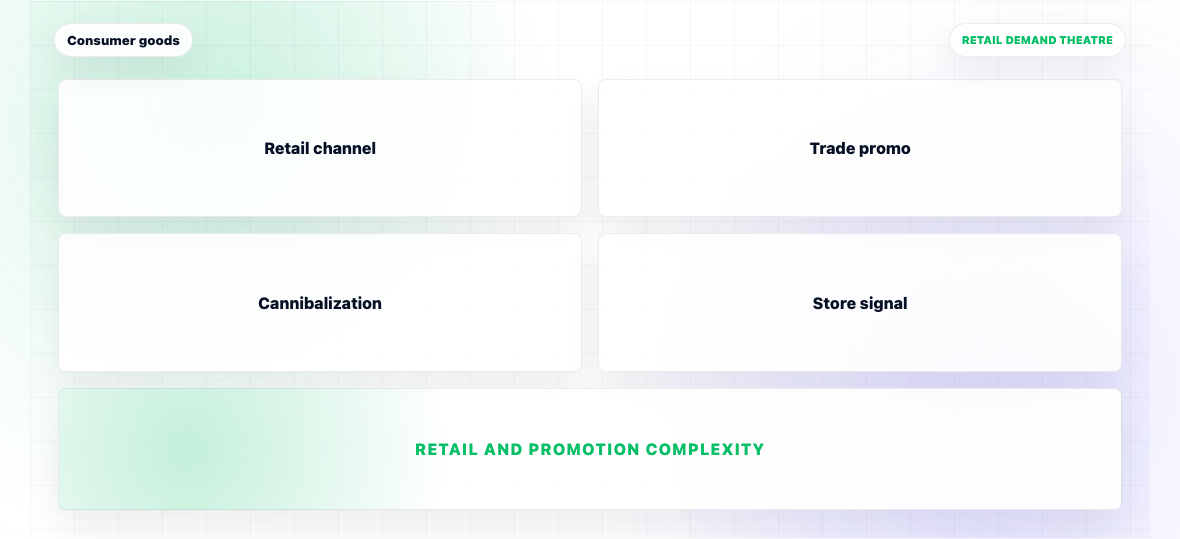
Demand planning in consumer goods (CPG) sits at the intersection of complex channel dynamics, heavy promotional activity, and increasingly fragmented retail. The same SKU often moves through grocery retail, mass merchant, club, drug, online, and direct-to-consumer channels — each with different demand patterns, promotional rhythms, and replenishment dynamics. Retail customer promotional calendars drive volume swings of 30-200% above baseline that need to be planned in detail. Brand and pack-size cannibalisation means moving promotional activity on one SKU affects demand on related SKUs across the same shelf set.
The platforms that fit consumer goods are those with mature trade promotion management capability, strong retail demand sensing, and channel-aware forecasting. This page covers that subset of the demand planning category.
Horizon fits consumer goods manufacturers in the $100M-$3B range, typically regional or national, with significant promotional activity. Strongest fits include packaged food and beverage operations with mid-market retail customer mix, personal care and household goods manufacturers, and specialty CPG categories where the brand-pack-channel complexity is meaningful but not at multinational scale.
What works well technically: ensemble forecasting with automatic per-SKU model selection — gradient-boosted trees for promotion-driven SKUs typically deliver 5-12 points of MAPE improvement on those specific SKUs, while statistical methods handle stable baseline SKUs efficiently. Per-customer-per-SKU forecasting supports channel-aware planning. Promotional overlay capture is structured (promotion type, expected lift, customer, dates) rather than free-form, so FVA can separate promotional accuracy from baseline accuracy.
What works well operationally: the decision execution layer proposes specific actions during weekly and monthly cycles — apply this promotional lift override based on similar past promotions, adjust safety stock for these promotional SKUs in the pre-promotion week, reroute inventory between DCs to support promotional pull. Planners spend time on judgment decisions rather than mechanical adjustments.
Where Horizon doesn't fit: multinational top-20 CPG with deep trade promotion management integration requirements (SAP IBP and Blue Yonder typically fit better), operations whose primary need is trade promotion ROI optimization rather than operational planning (Anaplan often fits better here), or very specialised CPG categories with unusual channel dynamics. We'll be specific in early conversations.
Consumer goods demand planning needs to handle several capabilities that less complex industries don't require to the same depth. Trade promotion management integration — connecting promotional plans to demand forecasts so promotional uplift is modeled at SKU-customer-week granularity. Channel-specific forecasting where the same SKU has different demand patterns in different channels. Cannibalisation modeling so that promoting Product A captures the demand effect on Products B and C in the same brand or category. Replenishment integration with retailer DC and store data when available, since retailer point-of-sale data is more predictive than shipment data.
The platforms that succeed in CPG generally have these capabilities natively. Those that don't can be deployed in CPG but require workarounds in adjacent systems. The list below distinguishes by depth of CPG-specific capability.
Built for: Large CPG manufacturers running SAP S/4HANA. Particularly common in multinational CPG operations.
Strengths in CPG: Mature trade promotion management integration through SAP CRM. Strong financial reconciliation. Established reference base in major CPG categories — beverages, packaged food, personal care, household.
Limitations: Implementation 12-24 months. TCO often $1M+ annually. Best fit when SAP is the ERP foundation.
Built for: Large CPG enterprises wanting AI-driven demand sensing and trade promotion optimization.
Strengths in CPG: Strong external data integration (syndicated retail data, weather, channel data). Knowledge graph handles brand-pack-channel-customer complexity well. AI/ML for trade promotion lift modeling.
Limitations: Configuration complexity. Requires data engineering capability.
Built for: CPG manufacturers with heavy retail channel exposure. Named a Leader in 2026 Gartner Magic Quadrant.
Strengths in CPG: Deep retail-grade demand sensing. Trade promotion management. Strong reference base in beverage, packaged food, personal care.
Limitations: Implementation cost and complexity. Less competitive for mid-market.
Built for: CPG enterprises wanting concurrent planning across demand, supply, inventory.
Strengths in CPG: Concurrent planning architecture handles promotional volatility well — when promotional uplift is updated, supply and inventory views update in real time. Strong reference base.
Limitations: Implementation 12-18 months. TCO $1M+ annually.
Built for: Consumer goods manufacturers $100M-$3B revenue, typically regional or national rather than global, with significant promotional activity and channel mix.
Strengths in CPG: Ensemble forecasting with automatic per-SKU model selection — different methods for promotion-driven SKUs versus stable baseline SKUs. Structured promotional overlay capture with FVA tracking by promotion type. Channel-level forecast disaggregation. Decision execution layer that proposes specific overlay actions during promotional planning cycles — particularly relevant when retail customers confirm promotional calendars 6-8 weeks out and planners need to adjust the operational plan quickly.
Limitations: Trade promotion management integration is at the planning level rather than deep TPM-system integration. Not built for global multinational CPG complexity.
Built for: CPG manufacturers with significant retail channel, especially European markets.
Strengths in CPG: Strong retail-grade demand sensing. Modern cloud-native interface. Established in major European CPG categories.
Limitations: Less suited to pure foodservice or B2B operations.
Built for: Mid-market CPG manufacturers wanting AI-first demand planning.
Strengths in CPG: AI through Logility Expert Advisor (LEA). Mature reference base in packaged food, personal care, household goods.
Limitations: Implementation cycles longer than newer cloud-native competitors.
Built for: Mid-market consumer goods manufacturers.
Strengths in CPG: Atlas Planning platform with strong demand planning depth. Good reference base in packaged food and personal care.
Limitations: Smaller reference base than the largest competitors.
Strong fit when CPG demand planning is led by commercial/finance teams rather than supply chain. Better at trade promotion ROI analysis than at operational demand planning.
Probabilistic methods handle CPG demand variability. Strong inventory integration helps with promotional planning where forecast uncertainty matters.
Three factors drive the CPG shortlist. First, channel mix: heavy retail favors platforms with deep demand sensing (Blue Yonder, RELEX, o9). Heavy foodservice and B2B favor more general platforms (Horizon, Logility). Second, promotional intensity: high-frequency promotional CPG (beverages, packaged food) needs strong trade promotion modeling. Lower-promotion CPG (personal care basics, household goods) needs less depth here. Third, scale: $3B+ multinational typically fits enterprise; $100M-$3B fits mid-market integrated.