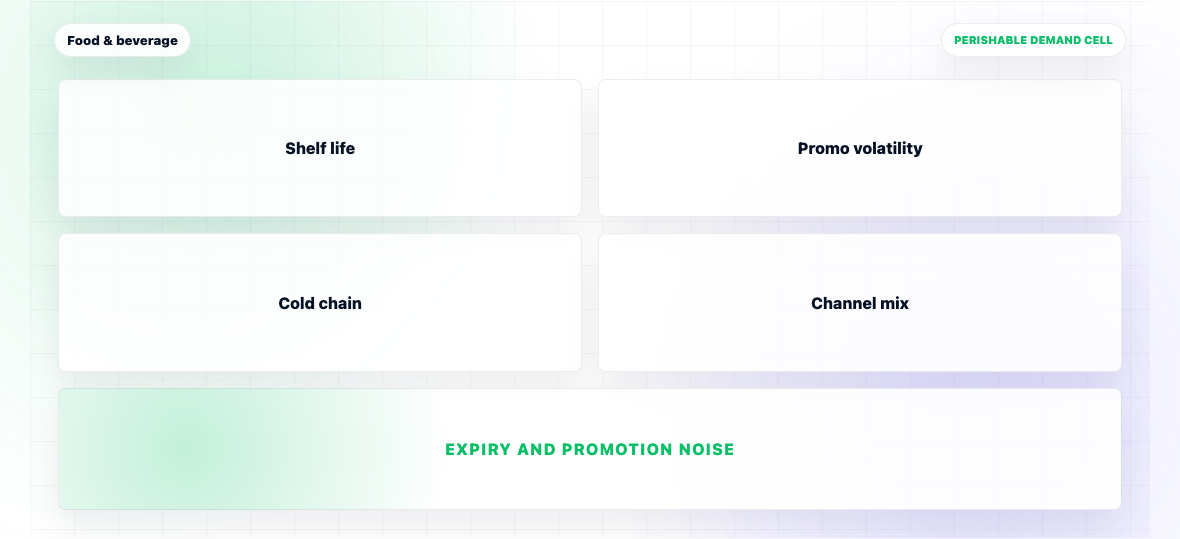
Demand planning in food and beverage manufacturing is harder than the same function in most other industries, and the platforms that fit it well are a smaller subset of the general category. Shelf life turns forecast errors into write-offs faster than in any other manufacturing vertical — a 10% over-forecast of fresh dairy becomes a 10% scrap charge within days. Promotional volatility is large and largely customer-driven, with retailer promotion calendars often confirmed less than 8 weeks before execution. Seasonality runs deep, with annual cycles, holiday peaks, and weather-driven demand all overlapping. Channel mix shifts faster than in most industries as retailers, foodservice, and e-commerce compete for the same SKUs.
This page covers the platforms that genuinely handle these constraints, not the broader demand planning category. The lineup is drawn from real evaluations at food and beverage manufacturers ranging from regional dairies to international beverage brands.
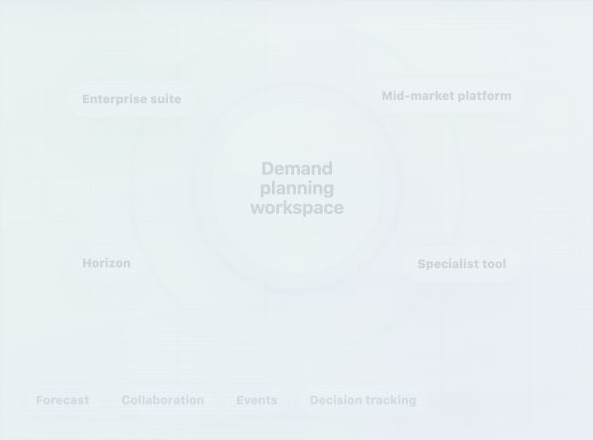
Horizon fits food and beverage manufacturers in the $100M-$3B range, typically regional or national rather than global. Strongest fits include dairy and dairy-adjacent operations (where shelf life and seasonal demand both matter), packaged food manufacturers with mixed retail and foodservice channels, beverage manufacturers with significant promotional activity, and specialty food operations where SKU portfolios are heterogeneous.
What works well technically: ensemble forecasting (Holt-Winters variants for seasonal SKUs, gradient-boosted trees for promotion-driven SKUs, Croston for slow-moving specialty items) with automatic per-SKU model selection — this addresses the heterogeneity that's characteristic of food and beverage portfolios. Promotional overlay capture is structured rather than free-form. FVA reporting separates promotional uplift accuracy from baseline accuracy. Shelf life flows from demand into inventory recommendations as a hard constraint.
What works well operationally: the decision execution layer proposes specific actions during weekly and monthly planning cycles — adjust safety stock for these short-shelf-life SKUs, reroute these orders to avoid expiry, propose this promotional uplift override based on similar past promotions. Planners spend time on decisions rather than calculations.
Where Horizon doesn't fit: very large multinational CPG with 10,000+ SKUs across many regional markets, very specialised foodservice operations with day-to-day menu planning constraints, or operations where trade promotion management depth (versus general promotional planning) is critical and SAP IBP or Blue Yonder fit better. We'll be specific in early conversations.
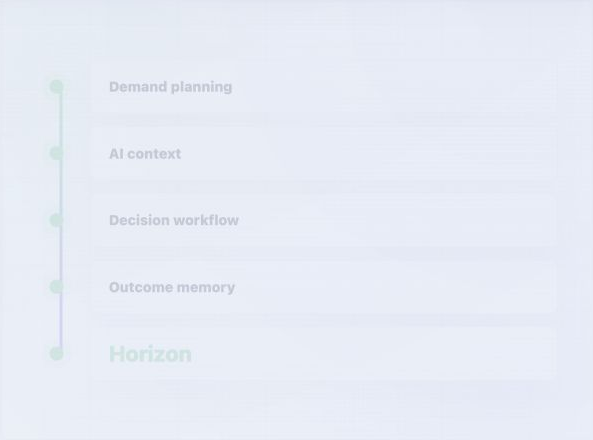
The standard demand planning capabilities — statistical forecasting, exception management, S&OP integration — are necessary but not sufficient for food and beverage. The platforms that succeed here add specific capabilities the category needs: short-shelf-life forecasting horizon handling (weeks rather than months as the primary planning window), promotional uplift modelling that handles cannibalisation between same-brand SKUs, weather-driven demand sensing for seasonal products, channel mix tracking where the same SKU has different demand patterns in retail versus foodservice, and trade promotion management integration.
Platforms that lack these capabilities can still deploy successfully in food and beverage — but the planning team works around the gaps with spreadsheets, which defeats the point of buying integrated software. The platforms below have at least the core capabilities the category demands.
Built for: Large food and beverage manufacturers running SAP S/4HANA, particularly multinational CPG-style operations.
Strengths in food and beverage: Mature trade promotion management integration. Strong financial reconciliation for margin tracking by product line. Established reference base in beverage, dairy, and confectionery.
Limitations: Implementation 12-24 months. TCO often $1M+ annually. Best fit when SAP is the ERP foundation.
Built for: Large CPG and food and beverage enterprises wanting AI-driven demand sensing.
Strengths in food and beverage: Strong external data integration (weather, syndicated retail data, channel data). Knowledge graph architecture handles the complex relationship between brand, pack size, channel, and customer.
Limitations: Configuration complexity. Requires data engineering capability.
Built for: CPG manufacturers and beverage companies with significant retail channel.
Strengths in food and beverage: Deep demand sensing with retail-grade methods. Trade promotion management. Established reference base in beverage and packaged food.
Limitations: Implementation cost and complexity. Less competitive for mid-market.
Built for: Process-heavy food and beverage manufacturers — beverage, dairy, bakery, confectionery. Named highest in 2026 Gartner Magic Quadrant for Process Industries.
Strengths in food and beverage: Process-industry depth (campaign scheduling, shared resources, sequence-dependent setups). Strong shelf-life handling.
Limitations: Less suited to discrete components of food and beverage operations.
Built for: Food and beverage manufacturers $100M-$3B revenue, regional and national rather than global, 1-10 plants.
Strengths in food and beverage: Ensemble forecasting with automatic per-SKU model selection — particularly relevant for the heterogeneous demand patterns typical in food and beverage portfolios (some SKUs highly seasonal, some promotion-driven, some stable). Native shelf-life handling in inventory module. Decision execution layer that proposes specific overlay actions to demand planners during promotional planning cycles. Configuration-driven deployment in 6-10 weeks per module.
Limitations: Not built for global multi-national complexity or 10,000+ SKU portfolios.
Built for: CPG and food and beverage manufacturers with significant retail channel, especially European markets.
Strengths in food and beverage: Strong retail-grade demand sensing. Modern cloud-native interface. Established in dairy, bakery, beverages.
Limitations: Less suited to pure foodservice or industrial food operations.
Built for: Mid-market food and beverage manufacturers wanting AI-first demand planning.
Strengths in food and beverage: AI through Logility Expert Advisor (LEA). Mature reference base in packaged food.
Limitations: Implementation cycles longer than newer cloud-native competitors.
Built for: Mid-market consumer goods and food manufacturers.
Strengths in food and beverage: Atlas Planning platform with strong demand planning depth. Reasonable reference base in packaged food and beverages.
Limitations: Smaller reference base than the largest competitors.
Built for: Food and beverage manufacturers wanting probabilistic forecasting combined with inventory.
Strengths: Probabilistic methods help with shelf-life-driven inventory targeting. Strong on intermittent and slow-moving items.
Built for: Mid-market food and beverage operations wanting AI-driven probabilistic planning.
Strengths: Probabilistic approach handles demand variability well. Fast deployment.
Three factors typically drive the shortlist. First, channel mix: heavy retail channel favors RELEX, Blue Yonder, o9 (all with strong demand sensing). Foodservice and industrial favor Horizon, OMP, Logility. Second, scale: under $500M typically fits mid-market integrated; $100M-$3B fits mid-market or enterprise; over $3B typically fits enterprise. Third, shelf life criticality: very short shelf life (fresh dairy, prepared foods) often favors platforms with native shelf-life handling in both demand and inventory (Horizon, OMP, RELEX).