"Industrial manufacturing" is a broad category covering industrial equipment, machinery, components, capital goods, construction equipment, agricultural equipment, and industrial fluids and materials. Demand patterns vary substantially across these sub-segments � capital equipment has long, project-driven cycles; industrial components have flow-through demand from downstream manufacturer customers; aftermarket parts have long-tail service demand from installed bases. The common thread: B2B customer relationships dominate, customer-specific demand patterns matter, and supply chain extends through complex multi-tier supplier networks.
This page covers demand planning platforms for industrial manufacturers across the sub-segments, with honest fit guidance by scale and complexity.
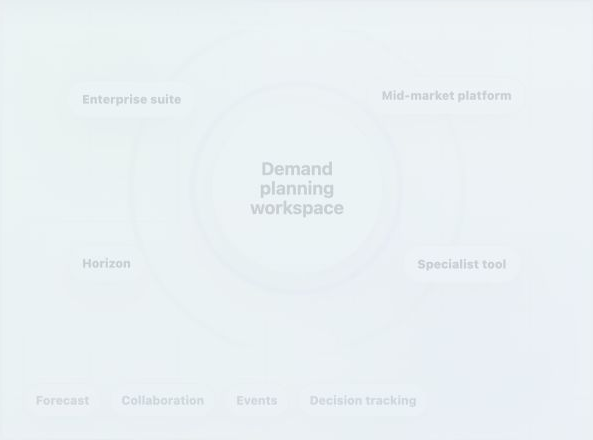
Horizon fits mid-market industrial manufacturers $100M-$3B with portfolios mixing standard products, configured components, and aftermarket parts. The ensemble forecasting approach handles the inherent heterogeneity � stable program SKUs forecast differently than volatile project-driven SKUs, which differ from intermittent aftermarket parts. Per-SKU automatic model selection picks the right method per SKU rather than forcing a single approach across the portfolio.
What works well technically: customer-specific demand patterns are modeled separately, which matters for B2B operations with significant customer concentration. The integrated aftermarket parts capability handles long-tail installed-base demand without requiring separate systems or workarounds. Decision execution layer proposes specific actions during planning cycles � adjust forecast for this customer's order change, expedite this aftermarket part based on installed base service pattern, reroute inventory between locations to balance regional demand.
Where Horizon doesn't fit: very large multinational industrial operations (Caterpillar, John Deere, Siemens scale) typically need enterprise platforms; pure ETO operations with project-driven demand only often benefit from project-management-integrated tools beyond standard demand planning; highly specialized industrial sub-segments (semiconductors, specialty materials with unusual chemistry constraints) may need segment-specific platforms. We'll be specific about fit in early conversations.

Most industrial manufacturers face several planning challenges simultaneously. Make-to-order and engineer-to-order activity for capital equipment and large components needs different forecasting approaches than make-to-stock for standard products. Aftermarket parts business creates long-tail SKU portfolios with intermittent demand that pure-manufacturing platforms handle poorly. Customer concentration (a few large customers driving significant demand) creates both forecasting opportunity (predictable patterns from large stable customers) and risk (loss of a single customer dramatically affects forecasts).
The platforms that fit industrial manufacturing handle this multi-challenge environment. Single-method platforms (heavy ML-only or heavy statistical-only) typically struggle with the heterogeneity. Ensemble approaches and multi-mode platforms typically deliver better results across industrial portfolios.
Built for: Large industrial manufacturers running SAP S/4HANA.
Strengths: Mature industrial reference base. Native SAP integration. Strong for SAP-centric multinational industrial operations.
Limitations: Implementation 12-24 months.
Built for: Large industrial enterprises with multi-region operations. 2026 Gartner MQ Leader.
Strengths: Concurrent planning handles complex global operations.
Built for: Large industrial enterprises wanting AI-driven planning.
Strengths: Knowledge graph for complex product-customer relationships.
Industrial reference base, particularly in industrial distribution-adjacent operations.
Strong for industrial process operations (chemicals, materials, fluids).
Built for: Mid-market industrial manufacturers $100M-$3B revenue, 1-10 plants, 500-5,000 active SKUs.
Strengths: Ensemble forecasting handles the heterogeneity typical in industrial portfolios � capital equipment SKUs use different methods than standard components, which differ from aftermarket parts. Customer-specific demand pattern modeling for B2B customer concentration. Integrated aftermarket parts capability for installed-base service demand. Configuration-driven deployment in 6-10 weeks per module.
Limitations: Not built for very large multinational industrial operations or 10,000+ SKU portfolios.
Mid-market industrial manufacturer reference base. AI through Logility Expert Advisor.
Atlas Planning platform with industrial manufacturer references.
Modern cloud-native platform. Less industrial-specific than CPG-focused.
Probabilistic methods handle aftermarket and intermittent demand particularly well.
Probabilistic AI-driven planning for mid-market industrial operations.
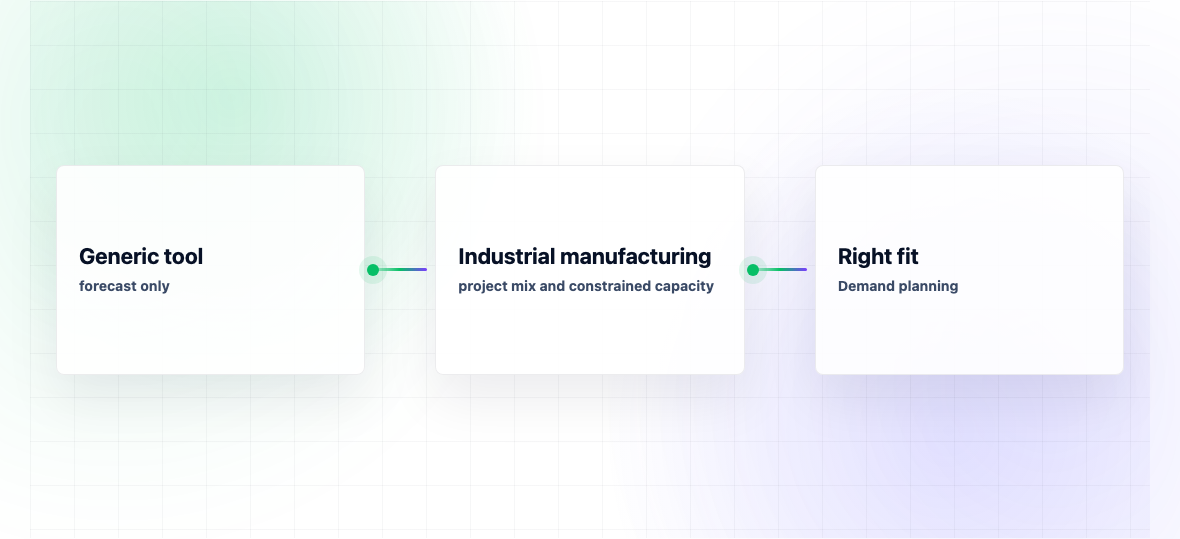
Three factors drive the shortlist. First, scale: $3B+ multinational fits enterprise platforms; $100M-$3B fits mid-market integrated. Second, portfolio mix: heavy aftermarket business favors platforms with strong intermittent demand handling (Horizon, ToolsGroup, SAP IBP); pure capital equipment with project-driven demand may benefit from ETO-focused tools combined with traditional demand planning. Third, customer concentration: heavy B2B customer concentration favors platforms with customer-specific demand modeling (Horizon, Logility, Kinaxis) over generic SKU-level forecasting.