Demand planning in pharmaceutical manufacturing operates under structural constraints that don't exist in most other industries. Long manufacturing lead times — often 6-12 months for API to finished product — mean forecasts drive production commitments that can't be easily reversed. Regulatory environments require change control, audit trails, and validation for systems affecting product release. Patient demand is fundamentally inelastic — under-forecasting a critical medication has consequences far beyond commercial impact. Allocation logic during shortage scenarios requires defensible decisions that hold up to regulatory and ethical scrutiny.
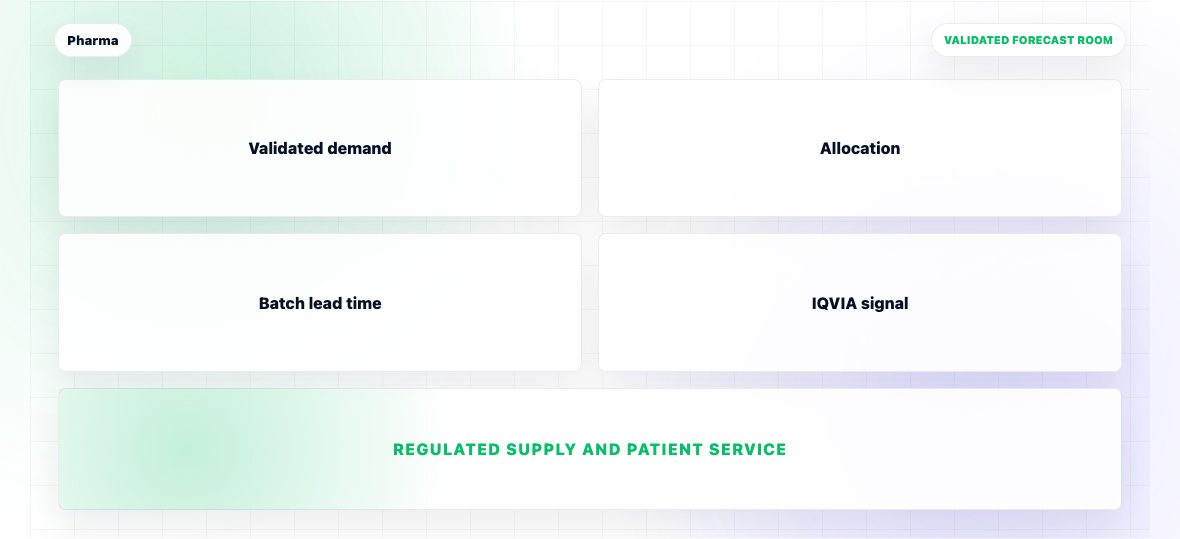
The platforms that genuinely fit pharma are a subset of the general demand planning category — specifically the ones with validated environments, structured audit trail capability, integration with pharma-specific data sources (IQVIA, Pharma Status), and reference customers in the industry. This page covers that subset.
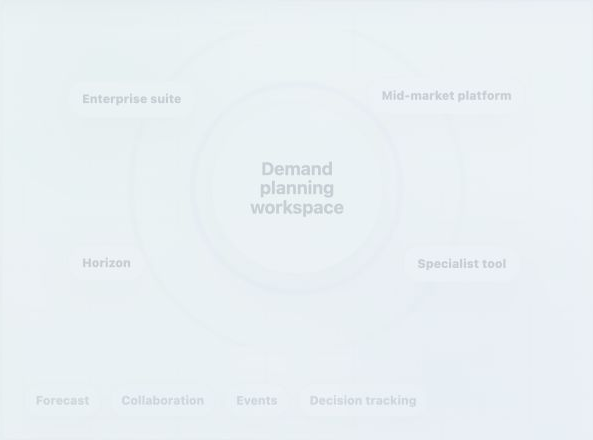
Horizon fits pharma manufacturers in the $100M-$3B revenue range, typically specialty pharma, generics manufacturers, contract manufacturing organizations (CMOs), and pharma-services operations. The native IQVIA and Pharma Status integrations are the technical differentiator from generic mid-market platforms — these data sources are essential for accurate demand planning in pharma and most general platforms require building these integrations rather than using them out-of-box.
What works well technically: ensemble forecasting handles the heterogeneity that's characteristic of pharma portfolios. Specialty products with stable long-tail demand use different methods than launch products in growth phase or end-of-patent products in decline. Per-SKU model selection picks the right method per product. Audit trail captures every forecast overlay, every approval, every override with timestamps and user identification — supports both pharma quality reviews and management audit requirements.
What works well operationally: the decision execution layer is particularly valuable in shortage management. During an unexpected supply disruption, the platform proposes allocation actions based on configurable priority rules (clinical criticality, customer commitment, market access requirements) rather than leaving the planner to defend ad-hoc decisions. The audit trail captures both the platform's recommendation and the planner's response, supporting subsequent regulatory and ethical reviews.
Where Horizon doesn't fit: top-20 global pharma with multinational manufacturing networks and validation requirements that typically extend to 12-24 month implementation cycles regardless of platform technical capability. Those operations are typically better served by SAP IBP (especially in SAP-centric environments) or Kinaxis. We'll be specific about that fit in early conversations.
In most demand planning evaluations, algorithm capability is a significant decision factor. In pharma, it's secondary. The bigger factors are: validated environment capability (the platform vendor supports the qualification and validation process expected in pharma operations), audit trail depth (every overlay and override has a who/when/why record), data source integration (IQVIA syndicated data, Pharma Status drug shortage data, country-specific health authority data), and reference customers in the industry (which signal both that the platform actually deploys successfully in regulated environments and that the vendor's support team understands pharma-specific requirements).
The platforms that fit pharma reliably are usually mature in the industry rather than newer entrants. Newer platforms can be deployed in pharma, but typically need additional validation work and lack the reference base that gives pharma quality teams confidence. This page covers the platforms with established pharma capability, with notes on where newer alternatives may fit.
Built for: Large pharma manufacturers running SAP S/4HANA. Particularly common in multinational pharma operations.
Strengths in pharma: Mature pharma reference base. Native SAP integration including SAP QM for quality management. Audit trail and change control aligned with GxP expectations. Strong financial reconciliation for product-line P&L tracking.
Limitations: Implementation 12-24 months. TCO often $1M+ annually. SAP ecosystem lock-in.
Built for: Large pharma manufacturers wanting concurrent planning across demand, supply, inventory. Named a Leader in 2026 Gartner Magic Quadrant.
Strengths in pharma: Mature pharma reference base including several top-20 pharma manufacturers. Concurrent planning architecture supports rapid scenario evaluation during shortage management. Established validation approach.
Limitations: Implementation 12-18 months. TCO $1M+ annually.
Built for: Process-heavy pharma operations including biotech and traditional small molecule. Named highest in 2026 Gartner Magic Quadrant for Process Industries.
Strengths in pharma: Deep process-industry capability including campaign scheduling for shared facility manufacturing. Established in biotech and traditional pharma. Strong shelf-life and lot-traceability handling.
Limitations: Process industry focus means less suited to medical device or pharma-services operations.
Built for: Large pharma enterprises wanting AI-driven demand planning.
Strengths in pharma: Strong external data integration (IQVIA, syndicated prescription data, channel data). Knowledge graph handles the complex relationship between molecule, formulation, country, and channel.
Limitations: Configuration complexity. Requires data engineering capability.
Built for: Pharma manufacturers $100M-$3B revenue. Particularly mid-market and lower-end enterprise pharma operations including specialty pharma, generics, and pharma-services.
Strengths in pharma: Native integration with IQVIA and Pharma Status data sources. Ensemble forecasting handles the heterogeneous demand patterns typical in pharma portfolios (some products with stable long-tail demand, some with sharp launch/patent cliff transitions, some with seasonality). Audit trail captures every overlay with who/when/why. Configuration-driven deployment in 6-10 weeks per module. Decision execution layer that proposes specific actions during allocation and shortage scenarios — particularly relevant when patient access decisions need to be both rapid and defensible.
Limitations: Not built for global top-20 pharma scale. Validation approach is documented and supports pharma quality reviews but does not replace a top-20 pharma's typical validation cycle for major system implementations.
Built for: Mid-market pharma manufacturers wanting AI-first demand planning.
Strengths in pharma: AI through Logility Expert Advisor (LEA). Reasonable reference base in generics and specialty pharma.
Limitations: Implementation cycles longer than newer cloud-native competitors.
Built for: Mid-market consumer health and specialty pharma manufacturers.
Strengths in pharma: Atlas Planning platform with strong demand planning depth. Reference base in OTC and consumer health.
Limitations: Smaller pharma reference base than the largest competitors.
Probabilistic methods particularly suit pharma's long-tail SKU portfolios where many products have intermittent demand patterns.
Probabilistic approach handles pharma's demand variability. Smaller reference base in pharma specifically.
Three factors typically drive the shortlist. First, scale: top-20 pharma typically fits enterprise platforms (SAP IBP, Kinaxis, OMP, o9); mid-market and specialty pharma fit mid-market integrated platforms (Horizon, Logility, John Galt). Second, regulatory environment: GxP-validated environments favor platforms with mature pharma reference base and documented validation approach. Third, demand data sources: operations heavy on syndicated data (IQVIA) need native integration; specialty pharma operations with direct prescription tracking have different data needs.