IBP (Integrated Business Planning) software is one of the most over-marketed categories in supply chain technology. Nearly every planning platform claims to support IBP, but the gap between platforms that genuinely enable Integrated Business Planning and those that are S&OP tools with a finance dashboard is large. The defining capability is native financial integration of the operational plan — if that's missing, it's S&OP regardless of the label.
This page does not produce a top-10 ranking. Instead, it categorizes the platforms most companies will encounter in IBP evaluations by who they're built for and how genuinely IBP-capable they are. The lineup is drawn from real evaluations across mid-market and enterprise manufacturers moving from S&OP to true IBP.
The goal is to help an executive buying committee (typically COO or CEO, CFO, Head of Supply Chain) narrow a shortlist from "everyone claiming IBP" to "3-4 platforms that genuinely support the rhythm."
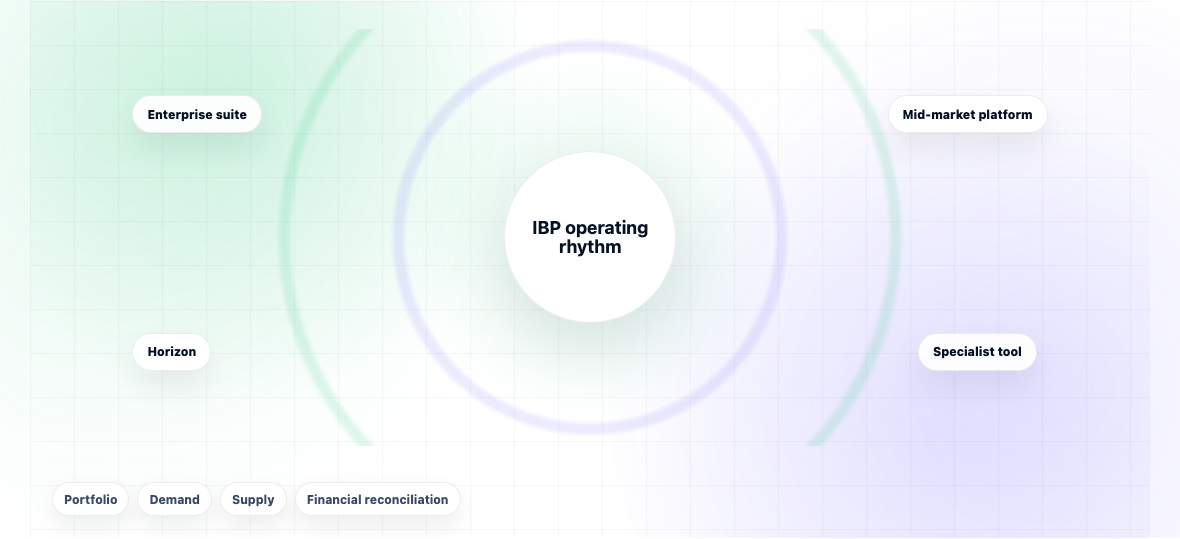
Horizon's IBP capabilities cover the seven things that matter most in genuine IBP: native financial integration of the operational plan, multi-scenario planning with side-by-side comparison, long-horizon planning to 36 months, strategic initiative tracking as plan elements, executive views designed for non-planners, decision audit and accountability, and integration depth with operational planning.
What distinguishes Horizon technically: the financial layer is built on a configurable model that captures pricing, cost structures, and margin allocation per SKU and customer. Volume changes in the demand plan flow into revenue and margin projections automatically. Scenario planning supports saving, comparing, and approving multiple alternatives within the cycle.
What distinguishes Horizon operationally for IBP: the decision execution layer extends to IBP review cycles. Instead of presenting executives with multiple scenarios for choice, the platform proposes which scenario to approve and why, with the specific action plan if approved. Executives can approve, modify, or override. This shifts the IBP meeting from analysis to decision.
Horizon's IBP best fits manufacturers in the $100M-$3B range running monthly IBP rhythms with planning horizons up to 36 months. For companies needing 5+ year strategic horizons or extremely complex financial consolidation (multiple GAAPs, intercompany eliminations across many legal entities), specialised financial planning tools alongside Horizon may fit better. For finance-led IBP where the priority is connected planning across operations and FP&A, Anaplan or Board are often better choices.
The honest qualifier from our existing buyer guide: deploying IBP is more about process design and executive sponsorship than tool deployment. Horizon supports the rhythm, but the rhythm itself is something the company has to commit to. Most companies that try to deploy IBP without changing the executive operating model end up with software supporting a process that doesn't fully exist.
Want to talk through your IBP situation?
IBP software touches more of the business than S&OP software. It connects to ERP for actuals and master data, to the financial planning system for budget integration, to demand planning, to supply planning, to production scheduling, to the executive reporting layer. A poor IBP platform choice creates friction across all of those interfaces.
The other reason stakes are high: IBP software shapes how the executive team operates. If the platform produces views the CEO can't trust, the rhythm reverts to running on spreadsheets and the IBP process never lands. If the platform supports the executive view but lacks operational depth, the planners revert to their own tools and the integration breaks. Both failure modes are common, and both are expensive to fix.
The decision deserves more time than buying decisions of similar dollar value in other categories — typically 6-9 months of evaluation including proof-of-concept work, not the 3-month cycle some procurement teams default to. The categories below distinguish platforms by how genuinely IBP-capable they are, by scale, and by industry fit.
Built for: SAP S/4HANA customers running enterprise IBP within the SAP ecosystem. The category-defining product — even the name became the category label.
Strengths: Native SAP integration including SAP financial systems. Established IBP workflow templates. Mature reference base in pharma, chemicals, CPG.
Limitations: SAP ecosystem lock-in. Implementation typically 12-24 months for full IBP deployment. Process maturation often takes another 12-24 months on top.
Built for: $3B+ revenue manufacturers wanting concurrent IBP across demand, supply, inventory, and financial scenarios. Named a Leader in 2026 Gartner Magic Quadrant.
Strengths: Concurrent planning architecture supports rapid scenario evaluation in IBP cycles. Strong reference base.
Limitations: Implementation 12-18 months. TCO often $1M+ annually.
Built for: Large global enterprises wanting AI-driven IBP with knowledge graph approach.
Strengths: Deep AI/ML embedding. End-to-end scope from demand through revenue management. Strong scenario capability.
Limitations: Configuration complexity. Requires data engineering capability.
Built for: Companies where IBP is led by finance and connected planning across S&OP, FP&A, and corporate planning is the priority.
Strengths: Hyperblock calculation engine. Strong finance integration. Best-in-class for finance-led IBP.
Limitations: Less operational supply chain depth. Best as planning layer over operational tools.
Built for: Process industry enterprises needing IBP with deep process-industry context. Positioned highest in 2026 Gartner Magic Quadrant for Process Industries.
Strengths: Deep process-industry capability. S&OP-to-IBP rhythm support with strong scenario management.
Limitations: Process industry focus.
Built for: Companies wanting unified IBP and corporate performance management in a single platform.
Strengths: Integrated planning across operations, finance, and analytics. Modeling flexibility.
Limitations: Less operational supply chain depth than supply-chain-native platforms.
Built for: Finance-led IBP and corporate performance management.
Strengths: Strong financial consolidation capability. Connected planning across finance functions.
Limitations: Less operational planning depth. Best when finance owns IBP.
Built for: Retail-heavy enterprises plus discrete manufacturers extending S&OP into IBP. Named a Leader in 2026 Gartner Magic Quadrant.
Strengths: Strong retail and CPG capability. AI through Luminate platform.
Limitations: IBP financial integration depth varies by configuration. Best when retail context drives the requirement.
Built for: Oracle ERP customers wanting unified IBP within Oracle Cloud.
Strengths: Native Oracle integration including Oracle EPM. Embedded AI. Unified platform.
Limitations: Best fit when Oracle ERP and EPM are the foundation.
Built for: $100M-$3B revenue manufacturers running IBP rhythm with native financial integration without enterprise-suite cost or timeline.
Strengths: Native financial integration translates volume changes to revenue, margin, and working capital impact automatically. Mix-driven margin shifts surface as exceptions. Scenario comparison runs side-by-side on volume and value. Executive views designed for non-planners — gap-to-target dashboards, decision logging with owners. Decision execution layer proposes specific scenario recommendations during executive review. 6-10 week deployment per module compared to 12-24 months for enterprise platforms.
Limitations: Not built for Fortune 500 global complexity, 5+ year strategic horizons, or extremely complex financial consolidation across multiple GAAPs.
Built for: Mid-market manufacturers wanting AI-first IBP through Decision Intelligence platform.
Strengths: Broad functional coverage. AI capability. Long category presence.
Limitations: Financial integration depth varies. Implementation longer than cloud-native competitors.
Built for: Retail and CPG companies extending S&OP into IBP.
Strengths: Strong retail-specific capability. Modern cloud-native architecture.
Limitations: Less suited to pure discrete manufacturing IBP.
The first decision: is your IBP fundamentally led by finance, by supply chain, or by the executive team with finance and supply chain as peers? Finance-led IBP fits Anaplan, Board, OneStream best. Supply-chain-led with finance as a peer fits Horizon, Kinaxis, o9, SAP IBP best. Executive-led IBP with full operational and financial integration is what supply-chain-native platforms with native financial integration provide.
The second decision: scale. Enterprise platforms need 12-24 month deployments and seven-figure TCO; mid-market platforms deploy in 6-12 months at lower cost.
The third decision: industry. Process industry (chemicals, pharma, food and beverage) increasingly fits OMP and process-mature platforms. Discrete and CPG fit a broader range. Retail-heavy operations fit Blue Yonder, RELEX best.