Inventory optimization is the category with the strongest measurable ROI in supply chain software — working capital release is direct and immediate, and a $500M manufacturer achieving 20% inventory reduction frees up roughly $16M of cash within 6-12 months. The buying decision matters because the gap between "we have inventory optimization" and "we have multi-echelon optimization with real risk-pooling math" is large, and the wrong choice means the working capital opportunity stays unrealized.
This page does not rank platforms 1-10. Vendor leaderboards published by content sites are mostly marketing artefacts. Instead, it categorizes the platforms most buyers will encounter by who they're built for, what they're strong at, and where they struggle.
The lineup is drawn from Gartner Peer Insights, the 2026 Gartner Magic Quadrants for Supply Chain Planning Solutions, and platforms that appear repeatedly in real inventory optimization evaluations. The goal: help a supply chain or finance leader narrow a shortlist from "everyone in the category" to "3-4 platforms that genuinely fit our profile."
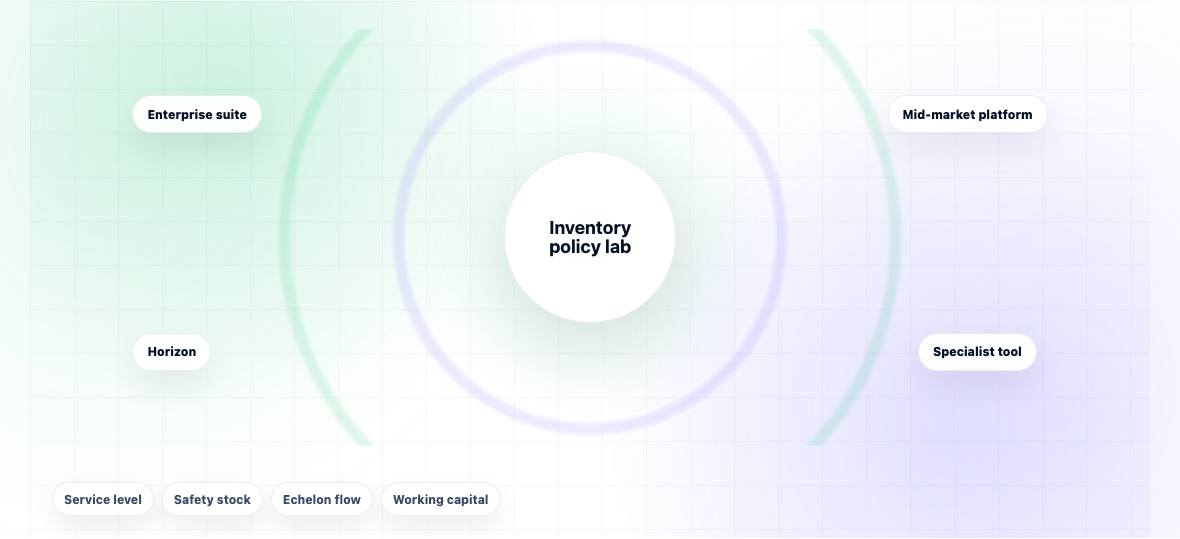
Horizon's inventory optimization module covers manufacturers with 500-5,000 active SKUs and 2-30 stocking locations — the integrated mid-market segment. The platform appears in three categories because the architecture genuinely spans them: integrated platform (alongside RELEX and Logility), (alongside Flowlity and Datup), and serves the upper end of smaller operations.
What distinguishes Horizon technically: full multi-echelon optimization using stochastic service-level evaluation with simulation-based methods, not sequential single-echelon calculations. Lead time variability is derived from receipt history and used in safety stock calculations explicitly. Non-normal demand distributions are handled, including specialised methods for intermittent demand (Croston, TSB).
What distinguishes Horizon operationally: the inventory module shares data with demand planning, so forecast accuracy improvements automatically translate to safety stock reductions in the next cycle. The decision execution layer proposes specific replenishment actions (reorder these SKUs, transfer from DC A to DC B, adjust target inventory for these locations) which planners approve or modify — different from tools that only generate optimized policies for someone else to execute manually.
Where Horizon is less competitive: very large networks (50,000+ SKUs, 100+ locations) sometimes need specialized inventory tools that scale further. Pure distribution or retail operations without manufacturing context sometimes find better fit with specialist platforms like Slimstock or Blue Ridge. We'll be specific about that fit in early conversations.
The defining capability that separates real inventory optimization from basic safety stock calculation is multi-echelon inventory optimization (MEIO) — math that exploits risk pooling at upstream nodes to reduce total network inventory. Single-echelon methods, which treat each location independently, typically produce 15-25% more total inventory than MEIO at the same service levels.
Many vendors claim MEIO. Far fewer have genuinely network-level optimization rather than sequential single-echelon calculations dressed up with the MEIO label. The math distinction is technical but its financial impact is large — for a $500M manufacturer carrying $80M of inventory, real MEIO versus single-echelon-with-MEIO-marketing is the difference between $12-20M of cash release and $4-6M.
The second variable is lead time handling. Many companies hold safety stock primarily for lead time uncertainty rather than demand uncertainty. Platforms that treat lead times as constants — which is the default in many ERPs and some basic inventory tools — typically over-recommend safety stock by 10-20%. Real inventory optimization treats lead time variability as a first-class input with its own statistical analysis.
The categories below distinguish platforms by where they sit on these capabilities, plus by the company profile they're built for.
Built for: SAP S/4HANA customers running enterprise-scale inventory networks.
Strengths: Native SAP integration. Multi-echelon optimization capability. Strong in pharma, chemicals, CPG.
Limitations: SAP ecosystem lock-in. Implementation typically 12-18 months for inventory module.
Built for: Oracle ERP customers needing inventory optimization within the broader cloud SCM suite.
Strengths: Native Oracle integration. AI capabilities. Unified platform with adjacent functions.
Limitations: Best fit when Oracle ERP is the foundation.
Built for: Retail and CPG enterprises plus discrete manufacturers needing enterprise-scale inventory optimization.
Strengths: Mature retail-grade methods. Strong demand sensing integration.
Limitations: Implementation cost and complexity. Less competitive for pure manufacturing.
Built for: Large enterprises wanting inventory optimization concurrent with demand and supply planning.
Strengths: Concurrent calculation across demand, supply, and inventory.
Limitations: Inventory depth varies by deployment configuration.
Built for: Process industry enterprises with complex multi-echelon networks.
Strengths: Deep inventory optimization for chemicals, pharma, food and beverage. Strong network-wide capability.
Limitations: Process industry focus.
Built for: Manufacturers and distributors wanting probabilistic inventory optimization plus demand planning.
Strengths: Long track record in probabilistic methods. Strong on slow-moving and intermittent demand. Multi-echelon math.
Limitations: User interface less modern than newer entrants.
Built for: Mid-market and enterprise manufacturers wanting integrated inventory optimization.
Strengths: Long category presence. AI-first positioning. Multi-echelon capability.
Limitations: Implementation cycles longer than newer cloud-native competitors.
Built for: Retail and CPG operations needing demand sensing combined with inventory optimization.
Strengths: Strong retail capability. Multi-echelon math. Modern interface.
Limitations: Less suited to pure discrete manufacturing.
Built for: Large complex networks needing procurement and inventory together.
Strengths: Broader supply chain context with procurement integration.
Limitations: Less specialist depth than pure inventory tools.
Built for: SMB and mid-market companies in distribution-heavy and retail-heavy industries. European footprint particularly strong. Often the most appropriate choice for smaller, retail-heavy companies.
Strengths: Specialist focus on inventory and demand planning combined. Strong wholesale and retail vertical fit. Established reference base in European mid-market.
Limitations: Less suited to discrete manufacturing with complex BOMs and multi-stage production.
Built for: $100M-$3B revenue manufacturers, 500-5,000 SKUs, 2-30 stocking locations.
Strengths: Full multi-echelon optimization with stochastic service-level evaluation. Lead time variability handling derived from receipt history. Integration with demand planning means forecast accuracy improvements automatically translate to safety stock reductions. Decision execution layer that proposes specific replenishment actions to planners rather than just producing reports.
Limitations: Not built for 50,000+ SKU portfolios or 100+ location networks.
Built for: SMB and lower mid-market manufacturers and distributors.
Strengths: Accessible pricing, fast deployment, strong fit with NetSuite and other mid-market ERPs.
Limitations: Less depth than specialist tools for complex multi-echelon networks.
Horizon also fits here because the AI architecture is genuinely native, not a layer on top of legacy methods. Ensemble forecasting feeds inventory math directly. Per-SKU model selection adapts safety stock policies as demand patterns change.
Built for: Mid-market manufacturers wanting probabilistic AI-driven inventory planning.
Strengths: Probabilistic forecasting feeds dynamic buffers. Documented 38% inventory reduction at Plum Living. Fast deployment.
Limitations: Newer entrant with smaller reference base.
Built for: Supply chain teams wanting deep learning forecasting integrated with replenishment.
Strengths: Deep learning approach, 8-week deployment claim, integration breadth.
Limitations: Less established reference base than specialist competitors.
Built for: SMB and mid-market wanting dynamic simulation-based planning.
Strengths: Fast deployment, scenario simulation, accessible pricing.
Limitations: Less suited to complex multi-plant operations.
Built for: Mid-market manufacturers wanting AI-based inventory and demand planning.
Strengths: AI demand forecasting combined with MEIO. Modern interface.
Limitations: Smaller market presence than established competitors.
Featured here as well as in Category 2 because Slimstock's strongest fit is precisely this segment — smaller and retail-heavy companies where inventory and demand specialisation matters more than integrated production planning. For companies whose primary problem is inventory across many SKUs in wholesale, distribution, or retail without complex manufacturing context, Slimstock often outperforms larger integrated platforms.
Built for: Distribution-focused small businesses.
Strengths: Specialist distribution capability, accessible pricing, established reference base in wholesale.
Limitations: Less suited to manufacturing operations.
Built for: Smaller manufacturers and distributors.
Strengths: Demand and inventory integration, accessible pricing.
Limitations: Less depth than specialist tools for complex networks.
Already covered in Category 3 — also fits here for smaller operations replacing Excel for the first time.
The first decision is whether your primary need is inventory optimization specifically or integrated planning with strong inventory capability. If the priority is dedicated inventory optimization in isolation, the specialist platforms (ToolsGroup, Slimstock, Logility's standalone module) often win. If the priority is inventory integrated with demand planning and broader supply chain functions, integrated platforms (Horizon, RELEX) typically deliver better long-term value.
The second decision is scale and complexity: enterprise vs mid-market vs SMB. The third is industry fit: process vs discrete vs retail/distribution.