Multi-echelon inventory optimization (MEIO) is one of the most under-bought capabilities in supply chain planning. Most companies running multi-stage networks — central DCs feeding regional DCs, raw material inventory feeding WIP feeding finished goods, or supplier-buffer-plant chains — manage inventory at each echelon independently. The result is structurally over-stocked networks where buffer at one level doesn't account for buffer at adjacent levels. Risk pooling effects across echelons go uncaptured.
MEIO addresses this by optimizing inventory positions across the network rather than at each location separately. Done correctly, it typically releases 10-25% of working capital at the same service levels — or improves service levels at the same inventory. This page covers the platforms that genuinely deliver MEIO capability rather than just labeling traditional inventory tools as multi-echelon.
Horizon fits mid-market manufacturers and distributors with 2-30 stocking locations and 500-5,000 active SKUs. The technical approach: network topology is modeled explicitly (which locations supply which downstream locations, with what lead times and variability), service levels are optimized at each echelon as a system rather than independently, and risk pooling effects flow into safety stock calculations. Non-normal demand distributions are handled, which matters because most real demand patterns aren't normal — using normal-distribution math on non-normal demand systematically over-recommends safety stock.
Where Horizon doesn't fit: very large networks (50+ stocking locations or 10,000+ SKUs) typically fit enterprise platforms or distribution specialists better. Operations whose primary need is strategic network design rather than ongoing operational MEIO often fit Coupa better. Pure distribution operations without manufacturing components often fit Slimstock or other distribution specialists more efficiently. We'll be specific about fit in early conversations rather than pursue mis-fit deals.
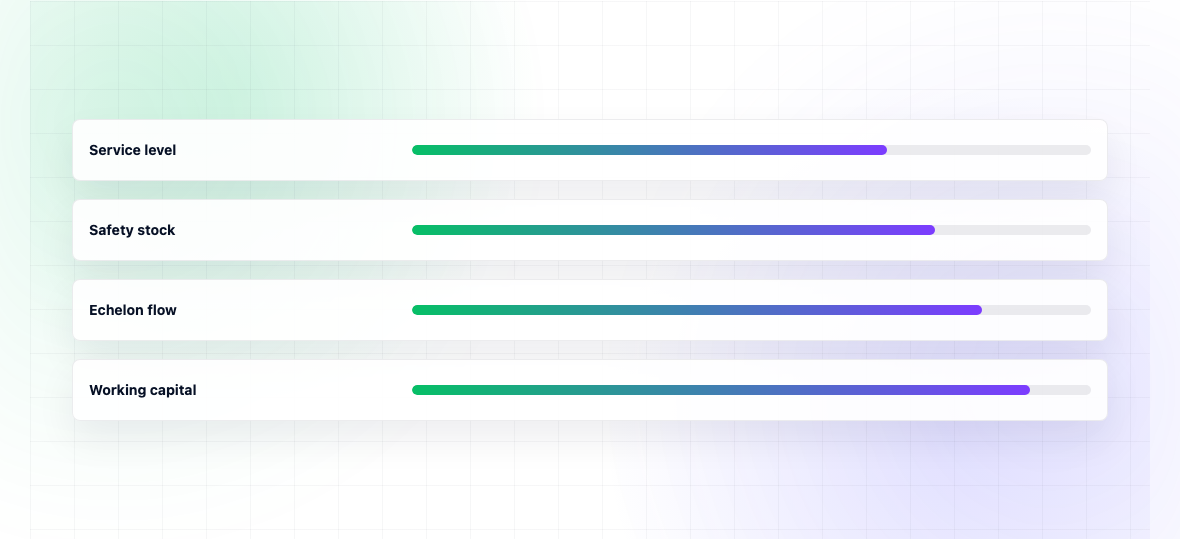
The MEIO label gets applied loosely. Many inventory optimization platforms calculate safety stock at each location independently, then label the result "multi-echelon" because it covers multiple locations. That's multi-location, not multi-echelon. True MEIO does three things differently: it models the network topology (which locations supply which downstream locations, with what lead times), it pools risk across echelons (recognizing that upstream buffer reduces downstream buffer requirements), and it optimizes service levels at each echelon as a system rather than as independent decisions.
The platforms below either do genuine MEIO or are honest about the limitation. The diagnostic question: ask the vendor to walk through how they model the relationship between safety stock at a regional DC and safety stock at the central DC that supplies it. Platforms with real MEIO can explain the math; platforms with multi-location labeling typically can't.
Built for: Mid-market and enterprise operations wanting probabilistic MEIO with deep inventory math.
Strengths: Probabilistic forecasting drives stochastic service-level optimization. Strong handling of intermittent demand and lumpy patterns. Mature MEIO math with network-aware optimization.
Limitations: Standalone inventory tool — integration with broader planning typically required.
Built for: Distribution and wholesale operations, particularly in Europe.
Strengths: Native MEIO within an inventory-focused platform. Handles distribution networks particularly well.
Limitations: Less suited to manufacturing with complex BOMs and routings.
Built for: Strategic network design with inventory optimization as part of broader supply chain modeling.
Strengths: Deep network modeling capability. Strong for strategic studies.
Limitations: More design-tool than ongoing operational platform.
Built for: Large SAP-centric enterprises.
Strengths: Mature MEIO within IBP for Inventory module. Native SAP integration.
Limitations: Implementation 12-24 months. TCO $1M+ annually.
Built for: Large enterprises with complex multi-region inventory networks.
Strengths: MEIO integrated with concurrent planning architecture — inventory views update when demand or supply changes.
Limitations: Enterprise scale and cost.
Built for: CPG and retail-heavy enterprises.
Strengths: Strong MEIO with retail-grade integration. Established reference base.
Limitations: Best fit for enterprise scale.
Built for: Oracle ERP customers.
Strengths: Native Oracle integration. Embedded AI for inventory math.
Built for: Mid-market manufacturers and distributors $100M-$3B revenue, 2-30 stocking locations.
Strengths: Genuine MEIO with stochastic service-level optimization, network topology modeling, risk pooling across echelons. Non-normal demand distributions handled. Lead time variability flows into safety stock calculations explicitly. Integrated with demand and supply planning rather than standalone.
Limitations: Most effective on networks up to ~30 stocking locations and 5,000 active SKUs. Larger networks typically fit enterprise platforms.
Built for: Mid-market manufacturers wanting integrated inventory and demand planning.
Strengths: MEIO as part of Logility Digital Supply Chain Platform. Mature inventory math.
Built for: CPG and retail operations needing inventory optimization with strong demand sensing.
Strengths: Modern cloud-native platform. Strong retail integration.
Distribution-specific MEIO for SMB and mid-market distributors. Accessible pricing.
Combined demand and inventory planning for smaller distributors and manufacturers.
SMB-focused, accessible pricing, strong NetSuite integration. Limited MEIO depth at the high end.
Three factors drive the shortlist. First, network complexity: simple 2-echelon networks fit most platforms; 3+ echelon networks with cross-echelon dependencies narrow the list to genuine MEIO specialists or strong mid-market integrated platforms. Second, demand pattern complexity: portfolios with significant intermittent or lumpy demand favor probabilistic methods (ToolsGroup, Flowlity, Horizon). Third, integration scope: standalone MEIO works if your demand and supply planning is already mature; integrated MEIO (Horizon, Logility, RELEX) works if you want one platform across functions.