Production scheduling software is a category where the marketing materials look similar across vendors but real capability varies dramatically by manufacturing mode. A scheduler built for discrete assembly handles different math than one built for process manufacturing, and both differ from continuous-flow operations. Many evaluation projects fail because they compare tools from different categories without recognising the differences.
This page does not produce a top-10 ranking. Instead, it categorizes the production scheduling and APS (Advanced Planning and Scheduling) platforms most manufacturers will encounter by who they're built for, what they're strong at, and where they struggle. The lineup is drawn from real evaluations across discrete, process, and CPG manufacturing.
The goal is to help a manufacturing operations leader narrow a shortlist from "everyone in the category" to "3-4 platforms that genuinely fit our profile."
Horizon's production scheduling module fits mid-market and lower-end enterprise manufacturers ($100M-$3B revenue) with 1-10 plants in discrete, process, and CPG modes. The platform appears in both the mid-market category and the cloud-native category because the architecture genuinely spans them.
What distinguishes Horizon technically: the scheduling engine uses constraint programming for problems where the structure suits it and metaheuristics for larger problems where speed matters. Sequence-dependent setups, parallel resources, multi-stage routings, batch and lot constraints, and material availability are all handled natively. Multi-objective optimization is configurable per customer — most discrete manufacturers optimize for tardiness minimization with secondary setup minimization; process manufacturers typically invert the weighting because changeover cost dominates.
What distinguishes Horizon operationally: the scheduling module shares data with demand planning, supply planning, and inventory optimization. The detailed schedule consumes the production plan from supply planning, validates capacity feasibility, and produces the executable schedule. Material requirements feed back to procurement automatically. The decision execution layer proposes specific actions to schedulers — schedule changes, expedite recommendations, reroute suggestions — rather than only producing Gantt charts.
Where Horizon is less competitive: semiconductor fabs, refineries, and operations with extremely specialised constraint structures are typically better served by industry-specific tools (Asprova for high-mix automotive, DELMIA/Quintiq for aerospace, specialised refinery scheduling tools). For companies whose constraints don't fit standard discrete/process/CPG patterns, alternatives like More Optimal's low-code optimization platform may fit better.
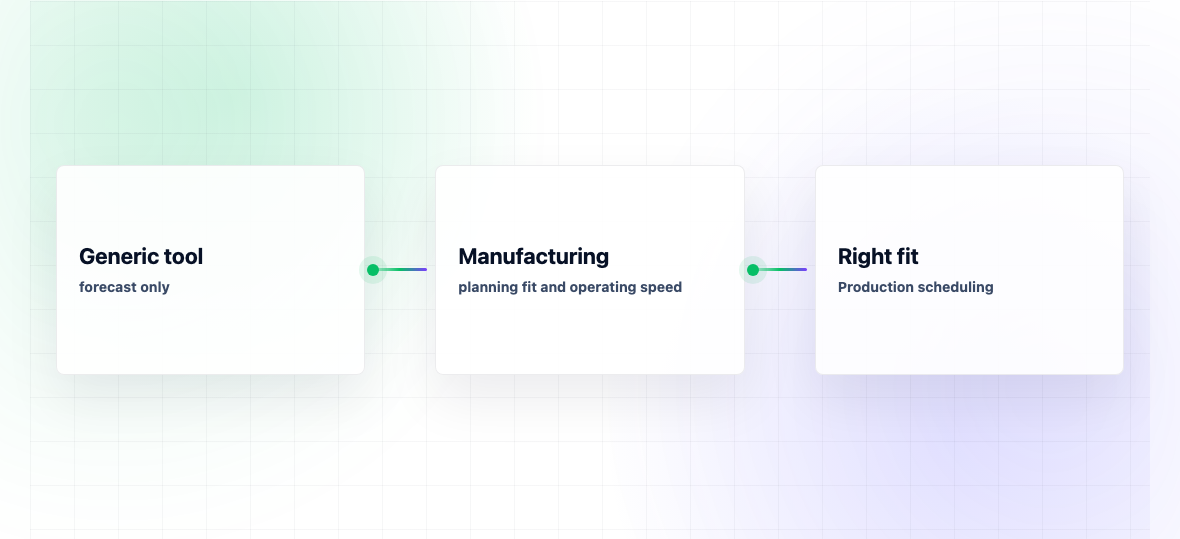
Production scheduling software typically becomes deeply integrated into shop floor operations. Schedulers use it daily. The schedule it produces drives MES, operator dispatching, and material movement. Switching schedulers later is harder than switching most other planning tools because the operational rhythm has settled into the platform.
The other reason these decisions stick is data. Scheduling requires accurate routings, current setup matrices, and reliable resource calendars — data that often gets cleaned up specifically for the scheduler implementation. Once that data investment is made, moving to a different platform means another cleanup pass.
Combined, this means production scheduling software is typically a 5-8 year commitment in practice. The evaluation should reflect that horizon — investing 4-6 months in evaluation against an 8-year operational commitment is the right ratio. Compressing evaluation to 2-3 months because procurement wants speed usually produces decisions that have to be lived with for years.
The categories below distinguish platforms by manufacturing mode fit, by company size, and by how their architecture is. Cross-category comparisons usually waste evaluation time.
Built for: Mid-to-large discrete and process manufacturers needing deep finite-capacity scheduling.
Strengths: Mature constraint-handling capability. Integration with Siemens MES and PLM. Strong reference base in automotive, aerospace, and industrial manufacturing.
Limitations: Implementation complexity. User interface less modern than newer competitors.
Built for: Complex enterprise manufacturing with unusual constraint structures. Strong in aerospace, automotive, semiconductor-adjacent operations.
Strengths: Deep constraint programming capability. Handles specialised constraint structures other tools struggle with.
Limitations: Enterprise pricing and timelines. Configuration-heavy.
Built for: High-mix, low-volume discrete manufacturers needing detailed sequencing.
Strengths: Strong sequencing math, particularly for Japanese-style manufacturing operations. Mature in automotive supply chain.
Limitations: Implementation requires specialised expertise.
Built for: SAP S/4HANA manufacturing customers needing scheduling within the SAP stack.
Strengths: Native SAP integration. Connects to SAP IBP and SAP MES.
Limitations: SAP ecosystem lock-in. Less specialised than dedicated scheduling tools.
Built for: Process industry manufacturers needing integrated planning and scheduling. Named highest in 2026 Gartner Magic Quadrant for Process Industries.
Strengths: Deep process-industry capability. Strong integration with adjacent planning functions.
Limitations: Process industry focus.
Built for: Mid-market discrete and process manufacturers needing dedicated APS that integrates with ERP.
Strengths: Strong constraint-management capability with drag-and-drop interface. Handles sequence-dependent setups well. Established in food processing, pharma, electronics, automotive.
Limitations: Standalone scheduling — integration with broader planning required.
Built for: Mid-market manufacturers wanting APS within Siemens portfolio.
Strengths: Mature scheduling capability. Strong integration with Siemens MES products.
Limitations: Best fit when Siemens is the broader manufacturing stack.
Built for: Mid-market and lower-end enterprise manufacturers ($100M-$3B revenue), 1-10 plants, discrete and process modes.
Strengths: Production scheduling integrated with demand, supply, and inventory in one platform. Native sequence-dependent setup handling. Multi-objective optimization (tardiness, setup time, throughput). Real-time re-scheduling with 2-5 minute partial regeneration. Decision execution that proposes specific schedule adjustments to schedulers rather than just producing Gantt charts.
Limitations: Not built for semiconductor fab scheduling or refinery operations.
Built for: Process and discrete manufacturers using SYSPRO ERP, with planning capabilities included.
Strengths: Integrated with SYSPRO ERP. Material requirements integrated with capacity management.
Limitations: Best fit when SYSPRO is the ERP foundation.
Built for: Smart manufacturing operations wanting scheduling integrated with broader Plex platform.
Strengths: Tight coupling between scheduling and execution (MES, inventory, shipping). Real-time data flow.
Limitations: Best as part of the broader Plex stack.
Built for: Mid-market manufacturers and other supply chain operations needing flexible optimization rather than rigid pre-packaged APS workflows.
Strengths: Low-code optimization platform — customers model their own specific rules and constraints rather than forcing operations into pre-built templates. Cloud-hosted with built-in optimization algorithms. Covers manufacturing scheduling alongside capacity optimization, inventory management, and order batching. Strong European mid-market reference base including Royal Flora Holland, DPG Media, Home Fashion Group, Delihome.
Limitations: Low-code platform requires configuration effort upfront. Best fit when operations have constraints that don't fit standard APS templates and the company has analytical capability to model them.
Built for: SMB manufacturers transitioning from spreadsheets to integrated planning.
Strengths: Affordable, visual scheduling, accessible deployment.
Limitations: Functional depth below dedicated APS for complex operations.
Built for: Discrete manufacturers wanting ERP and scheduling combined.
Strengths: Real-time visibility into plant floor. MES integration. Finite capacity planning.
Limitations: Best fit when DELMIAWorks is the broader manufacturing platform.
Built for: Job shop and custom manufacturers.
Strengths: Job-shop specific workflows. Established in custom manufacturing.
Limitations: Less suited to higher-volume production.
Built for: Small to mid-size manufacturers wanting modern UI and accessible deployment.
Strengths: Modern interface with color-coded Gantt timeline. Strong capacity planning and resource allocation.
Limitations: Newer platform with smaller reference base.
Built for: Manufacturers wanting finite capacity scheduling with rapid implementation.
Strengths: One-time license model. 5-day implementation claim. Established with named references including GE and US Navy.
Limitations: Less suited to modern cloud-native integration patterns.
Horizon also fits here because the scheduling engine combines constraint programming with metaheuristics, integrates AI-driven demand and inventory inputs natively, and proposes specific scheduling decisions to planners through the decision execution layer.
Also fits this category because the low-code optimization platform is cloud-native and uses modern optimization algorithms. Different angle from AI-driven ML: More Optimal is mathematical optimization-led rather than ML-pattern-led.
Built for: Manufacturers wanting APS combined with maintenance (CMMS) and OEE.
Strengths: Live machine availability checks integrated with scheduling. Real-time OEE data for actual run rates. Drag-and-drop board interface.
Limitations: Newer entrant with smaller reference base.
Built for: Modern manufacturers and D2C brands wanting real-time stock, orders, and capacity together.
Strengths: Modern interface, fast deployment, ERP-level control without ERP complexity.
Limitations: Best for smaller or simpler manufacturing operations.
The first decision is manufacturing mode: discrete, process, continuous, or job-shop. The math and constraint structures differ enough that tools built for one mode handle others poorly. The second decision is scale: SMB, mid-market, or enterprise. The third is whether you need standalone scheduling or integrated planning. Most companies should ask the integrated question first — integration with demand and supply planning typically delivers more value than slightly deeper standalone scheduling.