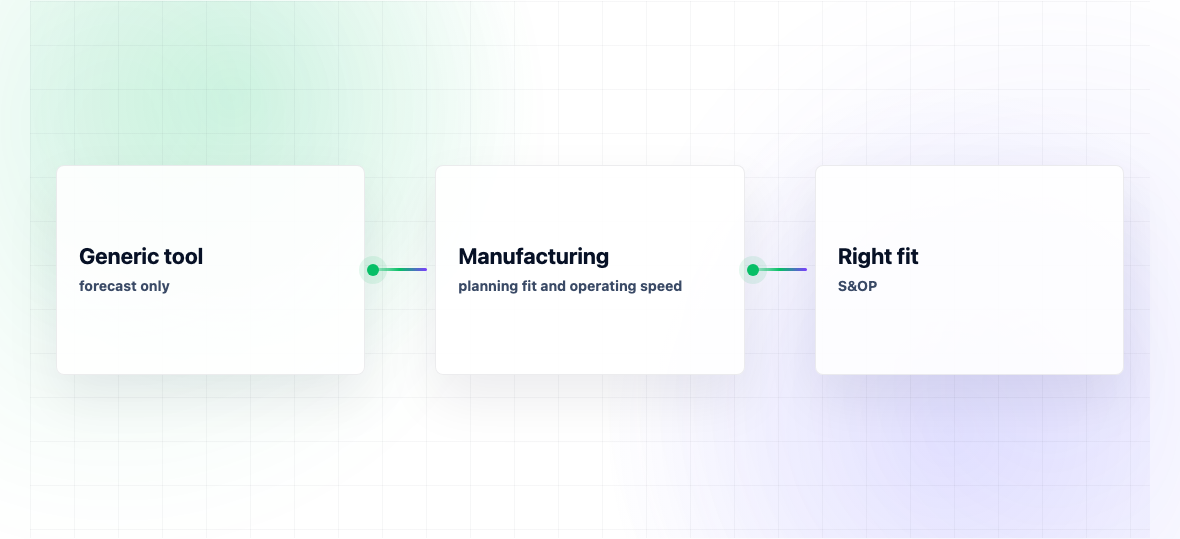
S&OP (Sales and Operations Planning) software is one of the most-claimed and least-precisely-defined categories in supply chain technology. Many platforms position themselves as "S&OP software" while actually being demand planning tools with an executive review dashboard, or supply planning tools with a meeting workflow. The gap between platforms that genuinely support the monthly S&OP rhythm and those that claim to is wider here than in most categories.
This page does not produce a top-10 ranking. Instead, it categorizes the platforms most companies will encounter in S&OP evaluations by who they're built for, what they're strong at, and where they struggle. The lineup is drawn from real evaluations across mid-market and enterprise manufacturers.
The goal is to help a supply chain or planning leader narrow a shortlist from "everyone in the category" to "3-4 platforms that genuinely fit our profile and operating rhythm."
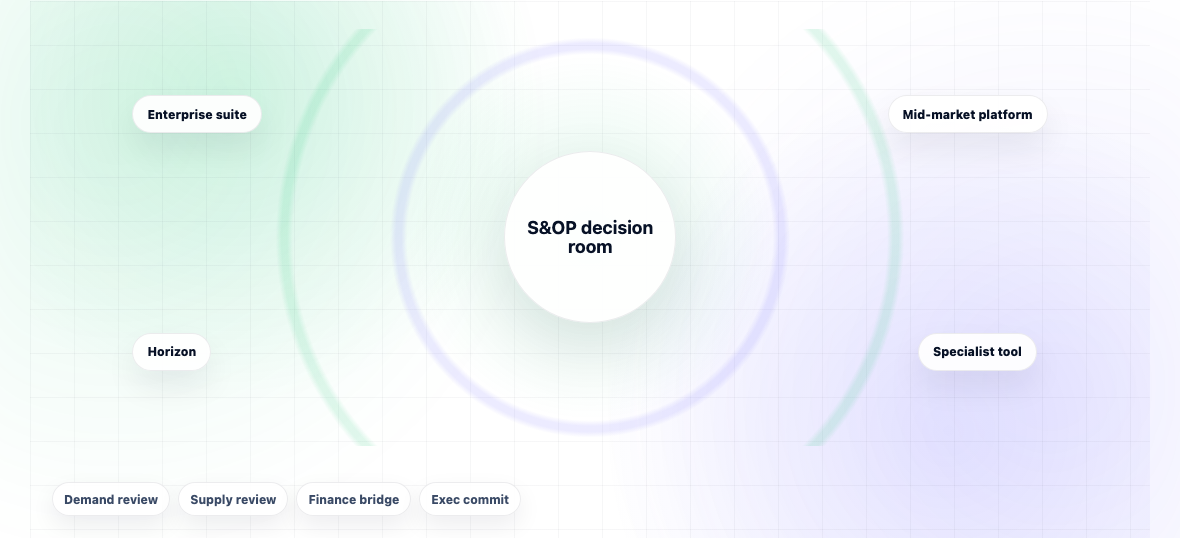
Horizon's S&OP module supports the monthly rhythm out of the box: demand review with exception-based focus, supply review with capacity feasibility checks, financial reconciliation with revenue/margin/working-capital projections, executive review with gap-to-target dashboards. Each step has a defined workflow with named owners, due dates, and audit trail.
What distinguishes Horizon technically: the operational plan from demand and supply planning flows automatically into S&OP review without re-keying. Scenario comparison runs interactively — adjust assumptions and see impact on volume, margin, and capacity in seconds rather than waiting for batch recalculation. Mix-driven margin shifts surface as exceptions in the same view where the operational plan is reviewed.
What distinguishes Horizon operationally for S&OP: the decision execution layer proposes specific scenario recommendations during the executive review. Instead of "here are three scenarios, decide which to approve," the platform suggests "approve Scenario B because it delivers margin commitment while keeping capacity within agreed bounds, and here's the operational action plan." Executives can approve, modify, or override the recommendation. This shifts the meeting from analysis to decision.
Horizon's S&OP best fits manufacturers in the $100M-$3B range running monthly cycles with 1-10 plants. For Fortune 500 global operations with multi-ERP environments and seven-figure TCO budgets, enterprise platforms (Kinaxis, o9, SAP IBP) typically fit better. For pure S&OP without operational planning depth, Anaplan and Board provide finance-led alternatives. We'll be specific about that fit in early conversations.
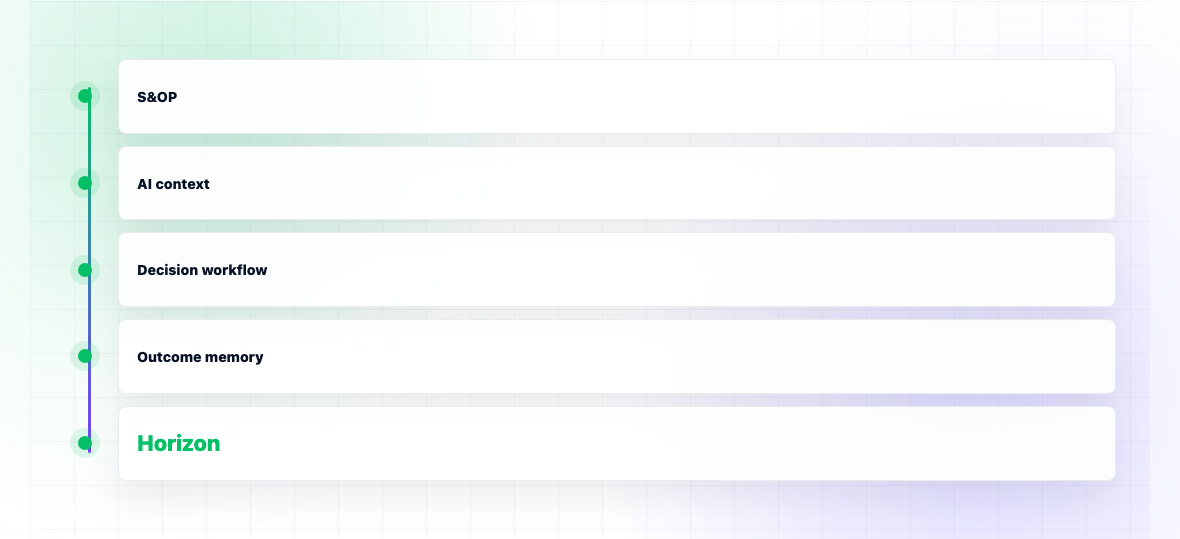
S&OP software fit depends heavily on where the company sits on the maturity curve. Companies running a stable monthly S&OP rhythm with disciplined demand review, supply review, and executive sign-off need different tools than companies still trying to establish the rhythm. Companies moving from S&OP toward IBP — adding financial integration and strategic scenario planning — need different capabilities again.
The other reason fit matters: S&OP is fundamentally a process, not a software function. The platform supports the rhythm; it doesn't create it. Companies that try to deploy S&OP software without changing the executive operating model end up with software supporting a process that doesn't fully exist. The most common pattern in failed S&OP implementations is buying capable software while leaving the meeting structure unchanged.
The categories below distinguish platforms by scale, by depth of demand-supply-financial integration, and by where they sit on the S&OP-to-IBP continuum. Cross-category comparisons usually waste evaluation time.
Built for: $3B+ revenue manufacturers wanting concurrent S&OP across demand, supply, and inventory.
Strengths: Concurrent planning architecture supports rapid scenario evaluation in S&OP cycles. Strong reference base. Named a Leader in 2026 Gartner Magic Quadrant for Supply Chain Planning Solutions.
Limitations: Implementation 12-18 months. TCO often $1M+ annually.
Built for: Large global enterprises wanting AI-driven S&OP extending into integrated business planning.
Strengths: AI-driven demand sensing feeds S&OP scenarios. Knowledge graph approach. End-to-end scope.
Limitations: Configuration complexity. Requires data engineering capability.
Built for: SAP S/4HANA customers wanting S&OP within the SAP ecosystem. Despite the product name including "IBP," it serves as both an S&OP platform and a true IBP platform depending on configuration.
Strengths: Native SAP integration. Strong demand sensing. Established S&OP workflow templates.
Limitations: SAP ecosystem lock-in. Implementation 12-24 months.
Built for: Companies whose S&OP is led by finance or where connected planning across S&OP and FP&A is the priority.
Strengths: Hyperblock calculation engine for real-time multi-dimensional modeling. Strong finance integration. Cross-functional planning model.
Limitations: Less operational depth than supply chain native platforms. Best as planning layer over operational tools rather than the operational tool itself.
Built for: Retail-heavy enterprises and discrete manufacturers wanting S&OP integrated with broader Blue Yonder platform. Named a Leader in 2026 Gartner Magic Quadrant.
Strengths: Strong retail and CPG capability. AI through Luminate.
Limitations: Implementation cost and timeline. Less competitive for pure mid-market discrete.
Built for: Oracle ERP customers wanting native S&OP.
Strengths: Native Oracle integration. Embedded AI. Unified platform.
Limitations: Best fit when Oracle ERP is the foundation.
Built for: Process industry enterprises needing S&OP rhythm with deep process-industry context. Positioned highest in 2026 Gartner Magic Quadrant for Process Industries.
Strengths: Deep process-industry capability. S&OP-to-IBP rhythm support.
Limitations: Process industry focus.
Built for: Companies wanting unified S&OP and corporate performance management.
Strengths: Integrated S&OP with finance, planning, and analytics in a single platform.
Limitations: Less operational supply chain depth than supply-chain-native platforms.
Built for: $100M-$3B revenue manufacturers running monthly S&OP cycles with demand planning, supply, and financial integration in one platform.
Strengths: S&OP rhythm supported out of the box — demand review, supply review, capacity reconciliation, exception-based executive view with full audit trail. Native financial integration translates volume plans to revenue, margin, and working capital projections. Decision execution layer proposes specific actions during S&OP review (adjust capacity, reroute production, override demand). 6-10 week deployment per module.
Limitations: Not built for Fortune 500 global complexity.
Built for: Mid-market manufacturers and distributors wanting AI-first S&OP.
Strengths: Decision Intelligence platform with Logility Expert Advisor (LEA). Broad functional coverage.
Limitations: Implementation longer than newer cloud-native competitors.
Built for: Retail and CPG companies with S&OP combined with demand sensing.
Strengths: Strong retail-specific capability. Modern interface. Cloud-native.
Limitations: Less suited to pure discrete manufacturing.
Built for: Mid-market consumer goods and manufacturing companies wanting Atlas Planning S&OP.
Strengths: Single-source SaaS, strong forecasting depth feeding S&OP.
Limitations: Smaller reference base.
Horizon appears in this category alongside mid-market integrated because the AI architecture is genuinely native. Forecasting feeds S&OP scenarios with per-SKU model selection. Decision execution proposes specific scenario recommendations to executives during review cycles.
Built for: SMB and mid-market companies wanting dynamic simulation for S&OP scenarios.
Strengths: Fast deployment. Strong scenario simulation capability. Accessible pricing.
Limitations: Less suited to complex multi-plant operations.
Built for: Companies wanting AI demand forecasting feeding S&OP.
Strengths: Deep learning forecasting with documented accuracy. Integration breadth.
Limitations: Newer entrant with smaller S&OP-specific reference base.
The first decision: where is your S&OP process on the maturity curve? Companies still establishing the rhythm benefit from platforms with strong out-of-box S&OP workflows (Horizon, Logility, RELEX). Companies running mature S&OP and moving toward IBP benefit from platforms with deeper financial integration (SAP IBP, o9, Anaplan, Board, Horizon).
The second decision: scale. Enterprise platforms typically need 12-24 month deployments and seven-figure TCO; mid-market platforms typically deploy in 6-12 months at lower cost.
The third decision: is finance a peer participant in your S&OP, or does it remain separate? Real IBP requires native financial integration. S&OP that doesn't yet involve finance as a peer can run effectively on platforms with lighter financial connectivity.