Supply chain planning software is one of the most over-marketed categories in enterprise software. Nearly every vendor claims AI, fast deployment, and dramatic working capital improvement — and the gap between what the marketing says and what the platform actually does is wider here than in most categories. This page does not rank the "top 10" platforms. Vendor leaderboards conflate companies of wildly different scope and target market, and the result is rankings that aren't useful for any specific buyer.
Instead, this page categorizes the platforms most manufacturers will encounter by who they're built for, what they're strong at, and where they struggle. The lineup is drawn from the 2026 Gartner Magic Quadrant for Supply Chain Planning Solutions (both Discrete and Process industries), Gartner Peer Insights, and platforms that appear repeatedly in real mid-market and enterprise evaluations.
The goal is to help a supply chain leader narrow a shortlist from "everyone in the category" to "3-4 platforms that genuinely fit our profile."
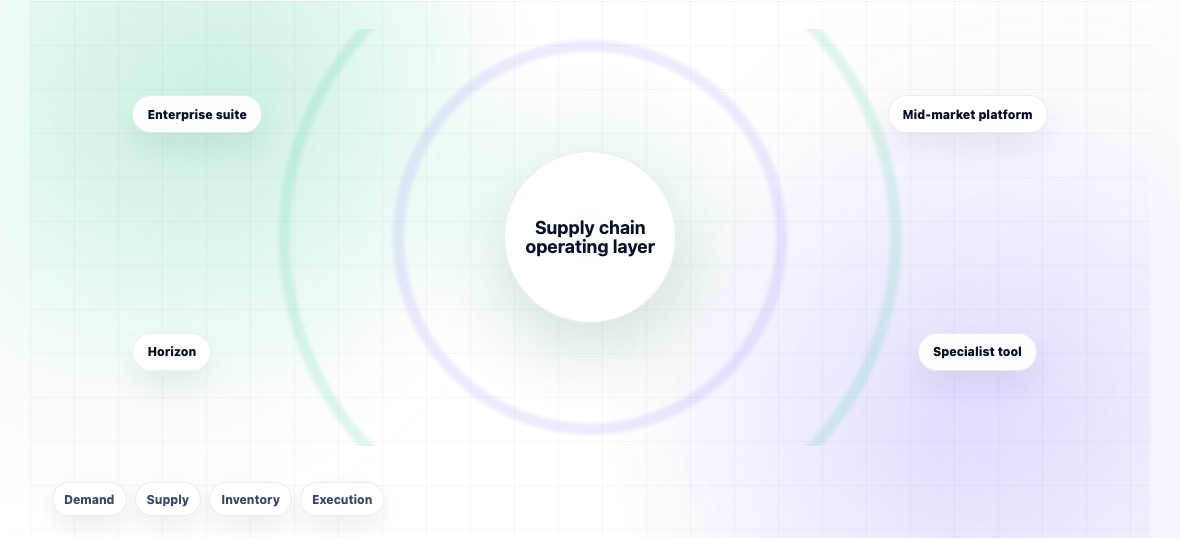
Horizon is built for Category 2: mid-market and lower-end enterprise manufacturers. The sweet spot is $100M-$3B revenue, 1-10 plants, 500-5,000 active SKUs, planning teams of 3-15 people. Verticals served effectively include discrete manufacturing, process manufacturing, CPG, industrial products, and pharma (the last via existing IQVIA and Pharma Status integrations).
Horizon does not compete effectively in Category 1 (Fortune 500 global manufacturers needing 12-24 month deployments and seven-figure annual TCO). Companies outside the mid-market range typically find better fits elsewhere — we'll be specific about that in early conversations rather than pursue mis-fit deals.
Within Category 2, what Horizon does well: integrated platform covering demand, supply, inventory, scheduling, and distribution; native financial integration for true IBP; multi-echelon optimization; finite capacity scheduling with sequence-dependent setups; forecasting with automatic per-SKU model selection; decision execution that proposes specific actions rather than only generating reports. Configuration-driven deployment that runs 6-10 weeks per module rather than 12-24 months.
Where Horizon is less competitive: companies with apparel/fashion SKU complexity (50,000+ active SKUs with size/color/season variants), semiconductor-level fab scheduling, refinery operations, or extremely specialised constraint structures that don't fit standard discrete/process/CPG patterns. Those companies are better served by specialised tools.
Supply chain planning platforms are 5-10 year commitments in practice. Total cost over that period (license plus implementation plus internal team plus ongoing consulting) usually runs 3-7x year-one license cost. The wrong choice doesn't just waste budget — it forces a painful migration or expensive workarounds that calcify over time.
The asymmetry is worse than most software categories because data complexity is high. Once master data has been migrated, forecasts and overlays have accumulated, and operational rhythms have settled into the platform, switching becomes genuinely difficult. Companies sometimes stay on platforms they regret for years because the cost of leaving exceeds the cost of working around limitations.
The other reason fit matters: supply chain planning platforms range from $50K/year cloud tools serving 100-SKU operations to $5M/year enterprise suites serving 200,000-SKU global manufacturers. Treating these as comparable produces nonsensical evaluations. The categories below make the fit decision explicit so the evaluation starts with the right shortlist.
Built for: $3B+ revenue manufacturers, often multi-national. Named a Leader in the 2026 Gartner Magic Quadrant for Supply Chain Planning Solutions for both Discrete and Process industries.
Strengths: Concurrent planning architecture, strong scenario analysis, mature reference base.
Limitations: Implementation typically 12-18 months. TCO often $1M+ annually. Heavy customisation required for complex operations.
Built for: Large global enterprises with mature data engineering capability. The only vendor recognized as a Customers' Choice in the 2025 Gartner Peer Insights Customers' Choice for Supply Chain Planning Solutions.
Strengths: Knowledge graph approach, deep AI/ML embedding, end-to-end scope from demand through revenue management.
Limitations: Configuration complexity. Requires data engineering capability to feed the platform properly.
Built for: SAP S/4HANA customers and SAP ecosystem enterprises.
Strengths: Native SAP integration. Strong financial integration. Mature in pharma, chemicals, CPG.
Limitations: Ecosystem lock-in. Slower innovation cadence than cloud-native specialists. Implementation typically 12-24 months.
Built for: Retail-heavy enterprises plus discrete manufacturers. Named a Leader in the 2026 Gartner Magic Quadrant.
Strengths: Deep retail and CPG capability through the Luminate platform. Strong AI/ML investment.
Limitations: Implementation cost and complexity. Less competitive in pure discrete manufacturing without retail context.
Built for: Oracle ERP customers wanting cloud-native unified applications. Named a Leader in 2026 Gartner Magic Quadrants for both Discrete and Process industries.
Strengths: Native Oracle integration. Embedded AI. Single unified platform across demand, supply, and manufacturing.
Limitations: Tightly coupled to Oracle ecosystem. Best fit when Oracle ERP is the foundation.
Built for: Process industry enterprises — chemicals, pharma, food and beverage, metals. Positioned highest for both Completeness of Vision and Ability to Execute in the 2026 Gartner Magic Quadrant for Process Industries.
Strengths: Deep process-industry capability. Strong S&OP/IBP rhythm support. Ranked in highest two across all four use cases in 2026 Gartner Critical Capabilities for Process Industries.
Limitations: Process-industry focus means less relevant for discrete and CPG operations.
Built for: Connected planning across supply chain and finance. Best fit for companies whose primary need is S&OP/IBP rather than operational supply chain.
Strengths: Hyperblock calculation engine, real-time multi-dimensional modeling, strong finance integration.
Limitations: Less depth in operational supply chain (production scheduling, detailed planning). Best as a planning layer over operational tools.
Built for: $100M-$3B revenue manufacturers, 1-10 plants, 500-5,000 active SKUs, planning teams of 3-15 people.
Strengths: Integrated platform covering demand, supply, inventory, scheduling, and distribution in a single workspace. Native AI capabilities with automatic per-SKU model selection. Decision execution layer that proposes specific actions to planners. Configuration-driven deployment running 6-10 weeks per module.
Limitations: Not built for Fortune 500 complexity or 50,000+ SKU portfolios.
Built for: Mid-market manufacturers and distributors. AI-first positioning through the Decision Intelligence platform.
Strengths: Broad functional coverage. AI capabilities through Logility Expert Advisor (LEA). Long category presence.
Limitations: Implementation cycles longer than newer cloud-native competitors.
Built for: Retail and CPG manufacturers, especially in European markets.
Strengths: Strong retail-specific demand sensing. Modern interface. Cloud-native architecture.
Limitations: Less suited to pure discrete manufacturing.
Probabilistic demand planning combined with inventory optimization. Strong on slow-moving and intermittent demand.
Deep production scheduling and complex constraint handling for specialised manufacturing modes.
Atlas Planning platform with strong demand planning and forecasting depth.
Inventory optimization specialist, particularly strong in retail-heavy and distribution-heavy mid-market. European footprint particularly strong.
Built for: Microsoft-centric organizations wanting consolidated cloud applications.
Strengths: Native Microsoft integration, accessible pricing, good fit for upper-mid-market.
Limitations: Planning depth below dedicated platforms for complex manufacturing.
Built for: NetSuite customers wanting basic planning within the ERP.
Strengths: Native NetSuite integration, accessible.
Limitations: Basic capability, suited to simple operations. Most companies migrate to dedicated tools beyond ~500 SKUs.
Identify your category based on revenue, SKU count, plant count, complexity, and IT capacity. Then evaluate 3-4 platforms within that category. A useful test: ask each vendor "what's your typical customer size?" If the answer is outside ±50% of your size, you're probably in the wrong category for that vendor.
Cross-category comparisons (enterprise suite vs cloud-native lightweight) usually waste evaluation time because the platforms aren't really competing for the same customer.