This is not a leaderboard ranking the "top 10" platforms. Vendor rankings produced by analysts or content sites are mostly marketing artefacts they conflate companies of wildly different scope, size, and target market. The useful question isn't "which platform is best" but "which platform is best for our specific situation."
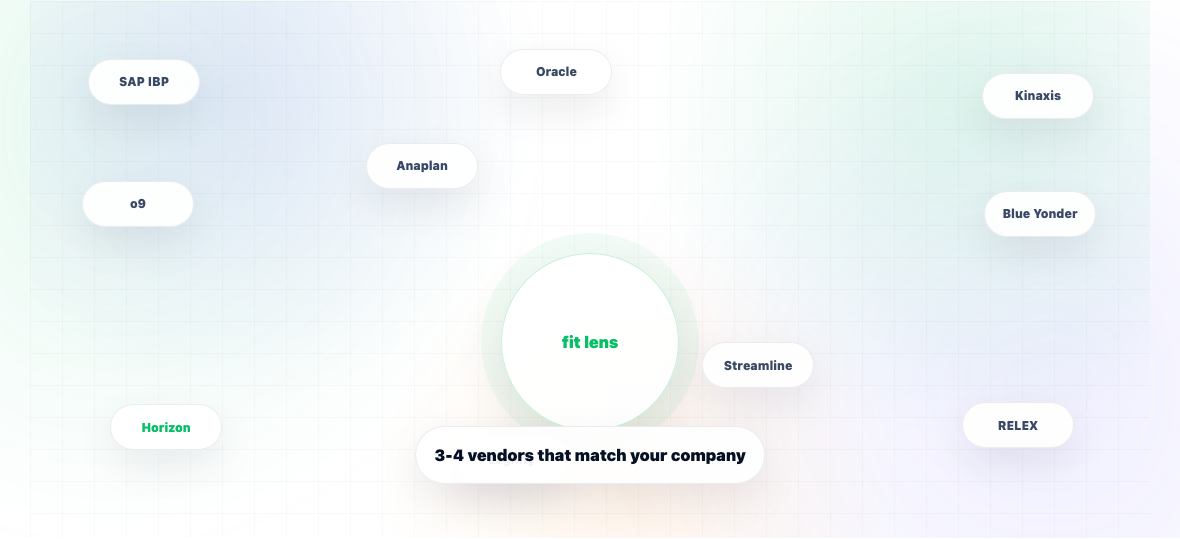
This page categorizes supply chain planning platforms by who they're built for, what they're strong at, and where they struggle. The goal is to help a manufacturer narrow a shortlist from "everyone in the category" to "3-4 platforms that genuinely fit our profile." The platforms named are the ones most manufacturers will encounter in evaluation the list isn't exhaustive but covers the meaningful comparisons.
Horizon is built for Category 2: mid-market and lower-end enterprise manufacturers. The sweet spot is $300M-$3B revenue, 1-5 plants, 500-5,000 active SKUs, planning teams of 3-15 people. Verticals served effectively include discrete manufacturing, process manufacturing, CPG, industrial products, and pharma (the last via existing IQVIA and Pharma Status integrations).
Horizon does not compete effectively in Category 1 (Fortune 500 global manufacturers needing 12-24 month deployments and seven-figure TCO) or Category 5 (small manufacturers needing $30K/year tools). Companies outside the mid-market range typically find better fits elsewhere we'll be specific about that in early conversations rather than pursue mis-fit deals.
What Horizon does well within Category 2: integrated platform covering demand, supply, inventory, scheduling, and distribution; native financial integration for true IBP; multi-echelon optimization; finite capacity scheduling with sequence-dependent setups; configuration-driven deployment that runs 6-10 weeks per module. The platform earned NVIDIA Inception membership for the AI capability across these areas.
What Horizon does less well: companies with apparel/fashion SKU complexity (50,000+ active SKUs with size/color/season variants), companies needing semiconductor-level fab scheduling, or companies with extremely specialised constraint structures that don't fit standard discrete/process/CPG patterns. Those companies are better served by specialised tools.

The supply chain planning category contains platforms ranging from $50K/year cloud tools serving 100-SKU operations to $5M/year enterprise suites serving 200,000-SKU global manufacturers. Treating these as comparable produces nonsensical evaluations. A platform built for a $5B chemicals company has different design choices, different sales motion, different implementation profile, and different TCO than a platform built for a $300M discrete manufacturer. Calling one "better" than the other is meaningless without specifying for whom.
The cost of choosing a platform built for a different scale is real. A mid-market manufacturer that buys an enterprise platform sized for a Fortune 500 typically pays 2-3x what they need to pay, spends 18+ months in implementation when 6-9 months would have been adequate, and ends up using 30-40% of the platform's capability. A large enterprise that buys a platform built for mid-market typically hits scale limits within 18-24 months and faces a painful re-platforming.
The point of this page is to make scale and fit explicit so the evaluation starts with the right shortlist.
Representative platforms: SAP IBP, Oracle SCM Cloud, Kinaxis RapidResponse, o9 Solutions, Blue Yonder.
Built for: $3B+ revenue manufacturers, often multi-national, with complex multi-ERP environments, global manufacturing footprints, and large planning teams (50+ planners).
Strengths: Breadth and depth across every planning function. Strong fit for highly regulated industries (pharma, defense, aerospace). Mature integration with SAP and Oracle ERP suites. Large reference base of similar enterprises.
Limitations: Implementation timelines 12-24 months. TCO typically $2M-$10M+. Heavy customisation often required. Complex enough that mid-market companies typically use 30-40% of capability. Implementation teams stretched across many concurrent customers, leading to mixed delivery quality.
When this fits: Large global enterprise with the IT capacity to manage a multi-year deployment, willingness to invest seven-figure annual TCO, and complexity that genuinely requires the full breadth.
Representative platforms: Horizon Solutions, Logility, RELEX (mid-market segments).
Built for: $200M-$3B revenue manufacturers, 1-5 plants, 500-5,000 active SKUs, planning teams of 3-15 people.
Strengths: Faster implementation (6-9 months for full multi-module). Lower TCO ($300K-$1.5M annual). Configuration-driven rather than customization-heavy. Implementation teams typically more focused on each customer. Strong functional depth in the areas mid-market companies actually use.
Limitations: Capability ceilings on very large or complex deployments. Less reference base for specific vertical use cases that very large enterprises require. Smaller partner ecosystems than enterprise suites.
When this fits: Mid-market manufacturer wanting the full scope of integrated planning without enterprise-suite cost or timeline. Most $500M-$2B manufacturers fall here.
Representative platforms: ToolsGroup (inventory), Quintiq/DELMIA (scheduling), Anaplan (S&OP), John Galt (demand planning), Slim4 (inventory).
Built for: Companies with one function where they need deep specialised capability that integrated platforms don't match. Often used alongside other tools rather than as the unified platform.
Strengths: Deep capability in their specific function. Strong fit for unusual constraint structures or specialised verticals (fashion, perishables, semiconductor).
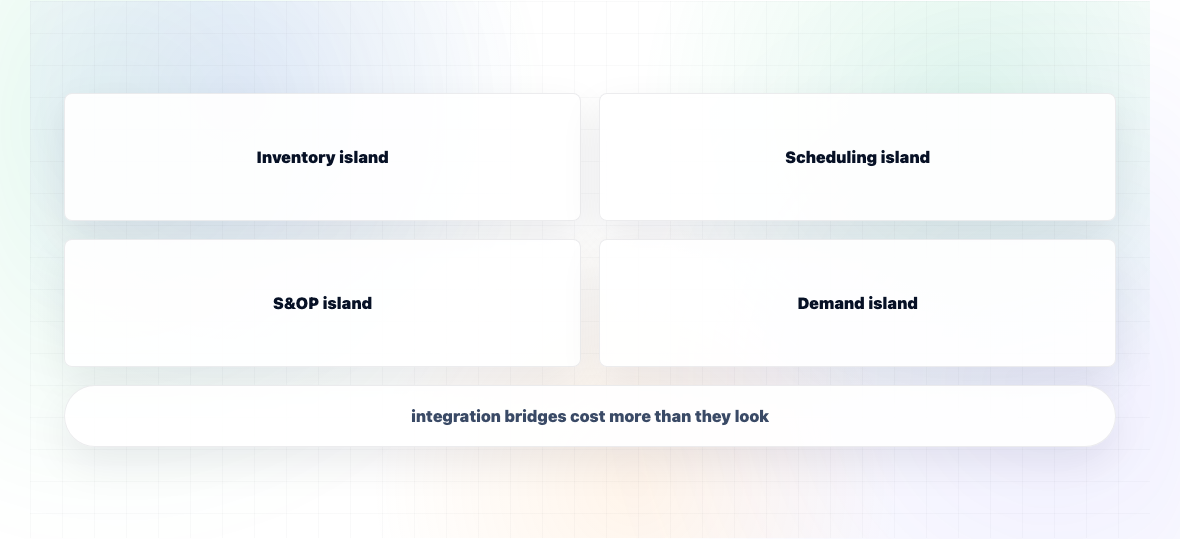
Limitations: Multiple best-of-breed tools require integration that costs more than it appears at evaluation time. Each tool has its own UI, training, support contract, upgrade cycle. The "two systems of truth" problem appears at the boundaries between tools.
When this fits: Large enterprise with one functional area where capabilities genuinely require specialisation that integrated platforms don't match. Less common than the marketing suggests.
Representative platforms: SAP IBP (when bundled with S/4HANA), Oracle Demand Management Cloud (when bundled with Oracle ERP), Microsoft D365 SCM, NetSuite Advanced Inventory.
Built for: Companies that already use the parent ERP and want planning capabilities without integrating a separate platform.
Strengths: Native integration with the ERP. Single vendor relationship. Lower integration cost. Familiar UI for ERP-trained teams.
Limitations: Capability depth varies. Some ERP planning modules (SAP IBP, Oracle SCM Cloud) are functionally complete; others (NetSuite Advanced Inventory) are basic. Lock-in to the parent ERP is structural rather than optional. Innovation often slower than dedicated planning vendors.
When this fits: Companies whose planning needs are well-served by the parent ERP's module and who value vendor consolidation. Verify capability depth carefully not all ERP planning modules are equivalent.
Representative platforms: Streamline, GMDH Streamline, various early-stage SaaS planning tools.
Built for: Smaller manufacturers ($20M-$200M revenue) with simpler planning needs, often replacing Excel as the first dedicated planning tool.
Strengths: Low cost (often $30K-$100K annual). Fast deployment (4-12 weeks). Modern UI. Strong fit for companies moving from Excel for the first time.
Limitations: Functional depth typically not sufficient for complex manufacturing operations. Capability gaps in multi-echelon optimization, finite capacity scheduling, IBP. Limited integration with enterprise ERPs.
When this fits: Smaller manufacturers replacing Excel for the first time, with planning needs that don't require the full breadth of integrated platforms.
The honest practical approach: identify which category your company belongs in based on revenue, SKU count, plant count, complexity, and IT capacity. Then evaluate 3-4 platforms within that category. Cross-category comparisons (enterprise suite vs cloud-native lightweight) usually waste evaluation time because the platforms aren't really competing for the same customer.
A useful test: ask each vendor "what's your typical customer size?" If the answer is outside ±50% of your size, you're probably in the wrong category for that vendor either you'll outgrow them or they'll over-serve you.