Supply planning translates the demand plan into a feasible supply response — what to make, when to make it, what to buy, when to expedite. Done well, it's where demand variability meets supply constraints and produces an executable plan. Done badly, it's where the demand plan gets ignored and operations falls back on heuristics and spreadsheets.
The platforms that deliver supply planning well share common characteristics: they handle finite capacity (not infinite-capacity planning that ignores resource constraints), they propagate demand-supply matching across multi-stage operations (not just MPS at the finished goods level), they integrate with demand planning rather than re-keying demand inputs, and they support scenario evaluation for capacity decisions. This page covers the platforms that meet that bar.
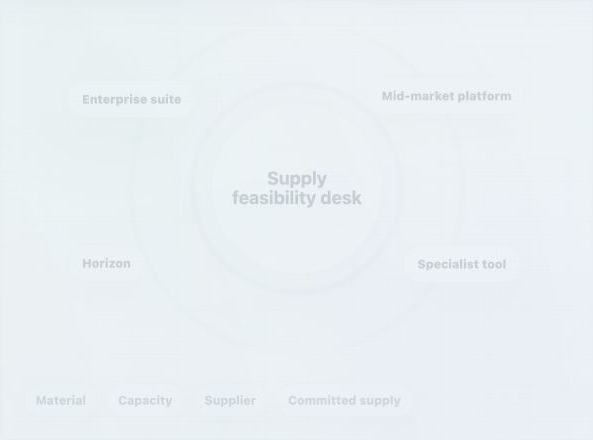
Horizon fits mid-market manufacturers $100M-$3B with 1-10 plants and 500-5,000 SKUs. The supply planning module handles finite capacity, multi-stage propagation through BOMs and routings, and tight integration with the demand plan — when demand changes, supply plans update without re-keying. The decision execution layer proposes specific supply actions to planners (expedite, reallocate, build ahead, change supplier) rather than only producing reports for planners to interpret.
Where Horizon doesn't fit: very large multinational enterprises with multi-ERP, multi-region operations typically need enterprise platforms (Kinaxis, SAP IBP, o9). Process industries with very complex shared-facility planning (refineries, large chemical operations) often fit OMP better. Pure distribution without manufacturing components doesn't need full supply planning — replenishment-focused tools fit better. We'll be specific about fit in early conversations.
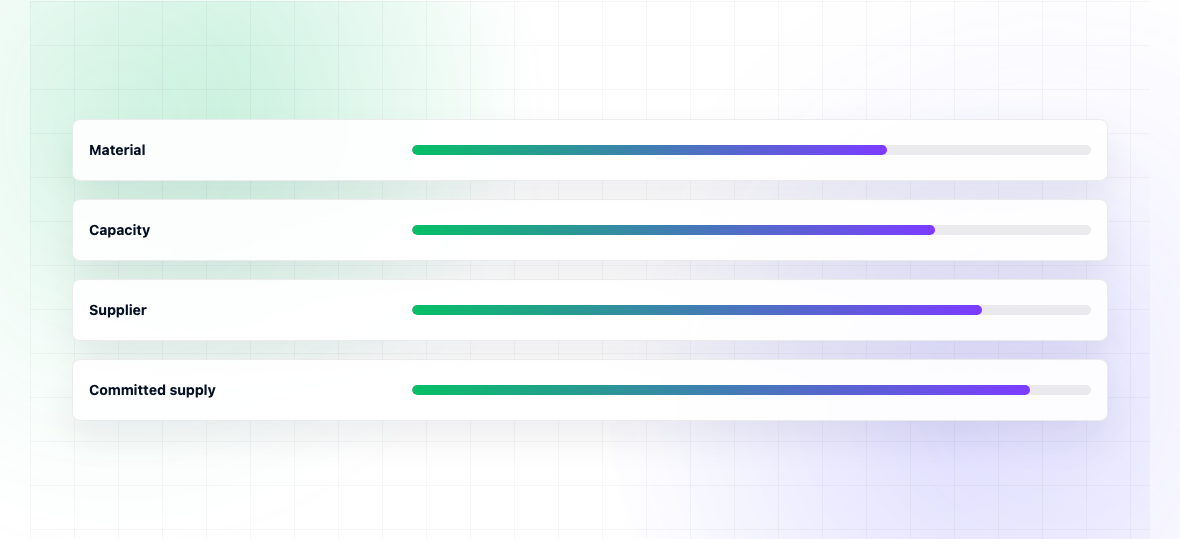
Supply planning is the module most commonly bought as a check-the-box feature rather than as a deliberately evaluated capability. Buyers often assume supply planning works "automatically" once demand planning is in place. It doesn't. The difference between supply planning that produces actionable plans and supply planning that produces ignored output usually comes down to: finite capacity handling, master data quality (BOMs, routings, lead times), and tight integration with the demand plan as it changes.
The platforms below distinguish themselves by depth in these areas. Generic "supply planning" features in ERP systems typically lack the finite-capacity math and integration depth that make supply planning operationally useful. Standalone supply planning specialists offer deeper math but require integration work.
Built for: Large SAP-centric enterprises.
Strengths: Native SAP integration. Mature supply planning capability within IBP for Response and Supply module.
Limitations: Implementation 12-24 months. Enterprise cost.
Built for: Large multinational enterprises wanting concurrent planning.
Strengths: Concurrent planning architecture — supply, demand, and inventory views update together. Strong scenario analysis. Named a 2026 Gartner Magic Quadrant Leader.
Limitations: Enterprise cost and complexity.
Built for: Large enterprises with complex product-supplier relationships.
Strengths: Knowledge graph architecture handles supply network complexity. AI/ML for supply variability prediction.
Built for: CPG and retail-heavy enterprises with significant supply complexity.
Strengths: Strong retail-CPG reference base. Integration with execution systems.
Built for: Process industries — chemicals, pharma, food and beverage. Named highest in 2026 Gartner Magic Quadrant for Process Industries.
Strengths: Deep process-industry supply planning including campaign scheduling, shared facility planning.
Built for: Mid-market manufacturers $100M-$3B revenue, 1-10 plants, 500-5,000 SKUs.
Strengths: Finite capacity supply planning integrated with demand planning. Multi-stage propagation through BOMs and routings. Decision execution layer that proposes specific supply actions to planners — expedite this PO, reallocate this capacity, build ahead for this demand surge. Configuration-driven deployment in 6-10 weeks for the supply module.
Limitations: Not built for global multinational complexity or 10,000+ SKU portfolios.
Built for: Mid-market manufacturers wanting integrated supply and demand planning.
Strengths: Mature supply planning capability. AI through Logility Expert Advisor.
Built for: CPG and retail-heavy operations.
Strengths: Strong retail integration. Modern cloud-native platform.
Built for: Mid-market consumer goods and food manufacturers.
Strengths: Atlas Planning platform with integrated supply planning.
Strong fit when supply planning combines with probabilistic inventory optimization.
Probabilistic supply planning. Best as a focused capability rather than full enterprise supply planning replacement.
Three factors drive the shortlist. First, manufacturing mode: process operations favor OMP, SAP IBP, Horizon; discrete operations have more options. Second, scale: $3B+ multinational fits enterprise platforms; $100M-$3B fits mid-market integrated; under $100M fits specialists or ERP-bundled. Third, integration scope: tight demand-supply integration favors integrated platforms (Horizon, Logility, RELEX, Kinaxis); operations with mature demand planning that just need stronger supply planning can use specialists (ToolsGroup, Flowlity).