Blue Yonder is one of the strongest enterprise supply chain platforms for $3B+ CPG and retail-heavy manufacturers. Named a Leader in the 2026 Gartner Magic Quadrant for Supply Chain Planning Solutions, with deep retail-grade demand sensing, mature trade promotion management integration, and significant execution platform integration. For large CPG operations with substantial retail channel exposure, Blue Yonder often fits well.
Blue Yonder fits less well in several common cases: mid-market manufacturers ($100M-$2B) where Blue Yonder's TCO and implementation timeline exceed reasonable proportion to scale, non-CPG operations where Blue Yonder's retail-CPG specialization isn't a differentiator, companies wanting AI-driven planning without enterprise complexity, and operations whose primary needs are integrated supply chain planning rather than execution-platform integration.
This page is for buyers in those categories. The framing isn't whether Blue Yonder is "good" — it's clearly strong for the customers it fits. The question is whether you're one of those customers.
Horizon is positioned for mid-market manufacturers ($100M-$3B revenue) considering Blue Yonder because it appears on every analyst recommendation list. For mid-market companies, Horizon often offers better fit on three dimensions: scale match, deployment timeline, and industry breadth.
Scale match: Blue Yonder is built for $3B+ CPG enterprises with significant retail channel exposure. Mid-market manufacturers typically use 25-35% of Blue Yonder's capability, paying enterprise pricing for capability they don't deploy. Horizon's feature breadth matches mid-market operational reality.
Deployment timeline: Blue Yonder typically 12-18 months for full deployment. Horizon's configuration-driven approach delivers 6-10 weeks per module — full integrated platform live in 6-9 months at mid-market scale.
Industry breadth: Blue Yonder's strength is CPG and retail. Horizon serves CPG plus discrete manufacturing, process industries, industrial manufacturing, and distribution at mid-market scale — broader industry coverage at mid-market scale.
Where Blue Yonder still wins over Horizon: $3B+ CPG enterprises with significant retail channel, deep trade promotion management depth requirements, and operations needing mature execution platform integration. For those buyers, we'd recommend Blue Yonder in early conversations rather than pursue mis-fit deals.
Blue Yonder appears on most analyst shortlists for enterprise supply chain planning, which means mid-market manufacturers often consider it during evaluation. The result is sometimes a misfit: a $500M food manufacturer spending 14 months in Blue Yonder implementation, ending up using maybe 25% of the platform capability, and paying enterprise-tier TCO for what their scale doesn't justify.
This isn't Blue Yonder's fault — they're transparent about their target market. It's a procurement process problem where mid-market buyers don't filter out enterprise platforms early enough in evaluation. The result is wasted evaluation time and sometimes wrong-tier platform decisions with 5-10 year operational consequences.
The alternatives below are categorized by the type of buyer who typically gets better fit elsewhere than at Blue Yonder.
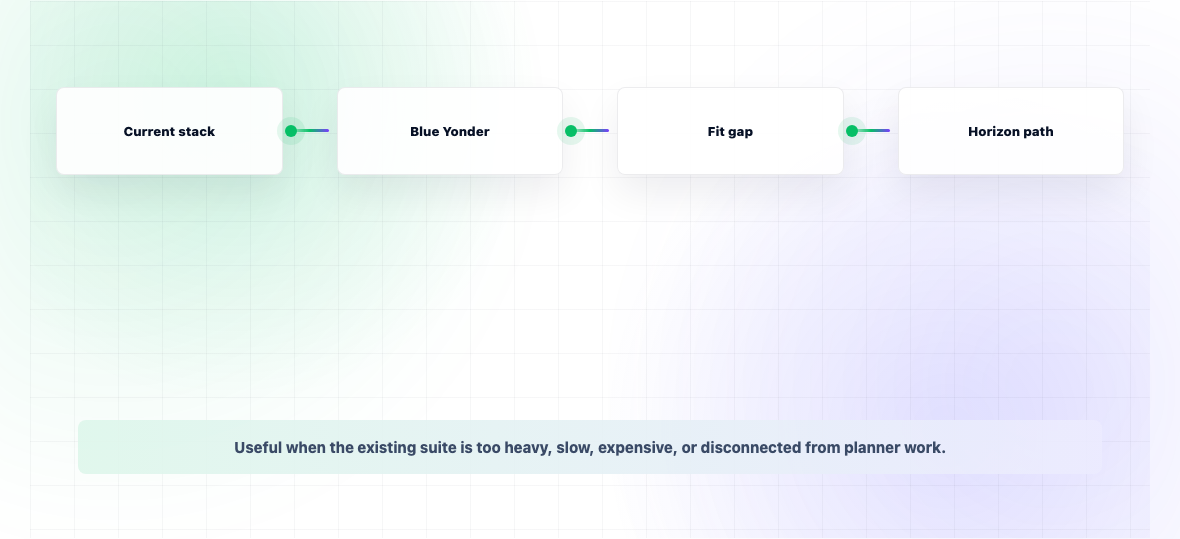
The most common category of buyers looking at Blue Yonder alternatives — companies whose scale doesn't justify enterprise platform cost and timeline.
Why considered as Blue Yonder alternative: Integrated planning platform at mid-market scale. Configuration-driven deployment in 6-10 weeks per module. TCO typically 50-70% lower than equivalent Blue Yonder deployment.
Strengths versus Blue Yonder: Mid-market-scaled licensing and deployment. Decision execution layer that proposes specific actions to planners. Integration with SAP, NetSuite, Oracle, Microsoft Dynamics, and custom ERPs.
When Blue Yonder still wins: $3B+ CPG operations with significant retail channel, deep trade promotion management requirements, and mature execution integration needs.
Why considered as Blue Yonder alternative: Strong fit for CPG and retail-heavy operations at mid-market scale.
Strengths versus Blue Yonder: Modern cloud-native interface. Particularly strong in European CPG markets. Lower TCO at mid-market scale.
Mid-market integrated SCP with AI through Logility Expert Advisor. Strong CPG and packaged food reference base.
Blue Yonder's specialization is in CPG and retail-heavy operations. Non-CPG buyers often get better fit elsewhere.
Better fit for SAP-centric non-CPG enterprises. Native financial integration.
Better fit for non-CPG enterprises with complex multi-region operations (automotive, electronics, aerospace, pharma).
AI-driven knowledge graph platform with broader industry applicability than Blue Yonder's CPG focus.
Mid-market non-CPG manufacturers across discrete, process, and industrial modes.
Strong process industry depth that often exceeds Blue Yonder for chemicals, pharma, food and beverage operations. Named highest in 2026 Gartner Magic Quadrant for Process Industries.
AI-driven knowledge graph architecture exceeds Blue Yonder Luminate AI in architectural depth. Customers' Choice in 2025 Gartner Peer Insights.
Mid-market AI-driven planning with ensemble forecasting and decision execution layer at scale-appropriate cost.
Probabilistic AI-driven planning as focused capability.
Better fit when planning is owned by finance rather than supply chain.
Native Oracle integration. Embedded AI.
Three structured questions clarify whether Blue Yonder or alternatives fit better. First: are you genuinely a CPG or retail-heavy operation where Blue Yonder's specialization is a real differentiator? If you're industrial, automotive, chemical, or general manufacturing, Blue Yonder's CPG focus isn't pulling its weight. Second: does your scale justify enterprise platform cost? Mid-market ($100M-$3B) typically gets better value from mid-market integrated platforms. Third: what percentage of Blue Yonder's capability will you actually use? Below 50% suggests over-buying.