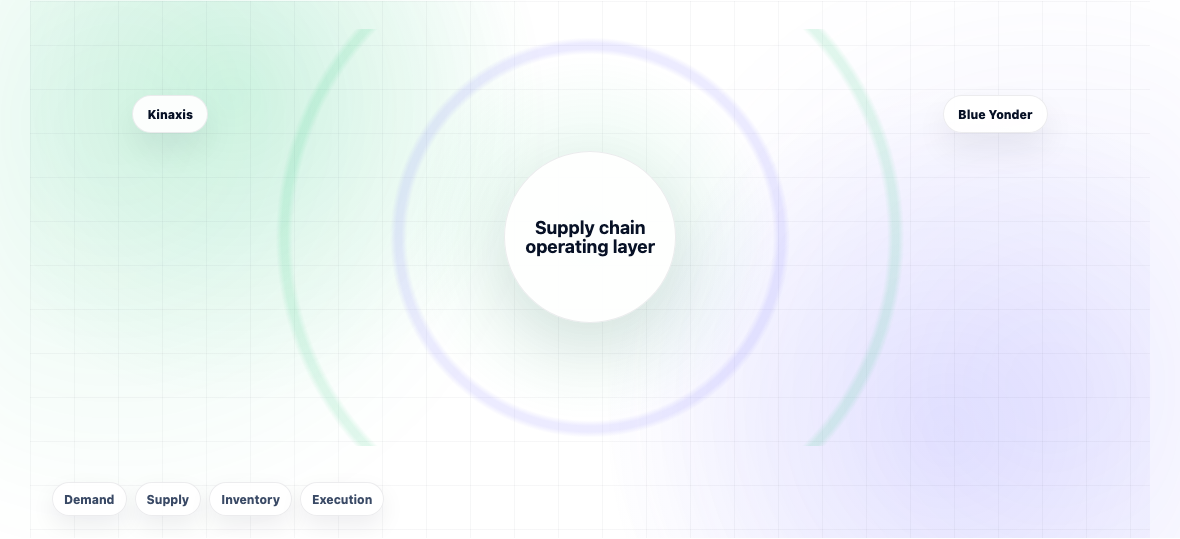
Blue Yonder versus Kinaxis is the comparison enterprise buyers face when both platforms appear on the shortlist. Both are 2026 Gartner Magic Quadrant Leaders. Both serve Fortune 500 manufacturers. But they optimize for different things: Blue Yonder for CPG and retail-heavy operations with deep execution platform integration; Kinaxis for multi-industry, multi-region concurrent planning.
The decision often comes down to industry fit and integration scope. CPG and retail-heavy enterprises typically benefit from Blue Yonder's industry-specific depth. Non-CPG enterprises (automotive, electronics, aerospace, industrial) typically benefit from Kinaxis's multi-industry concurrent planning capability.
Blue Yonder vs Kinaxis is enterprise-scale evaluation. Both target $3B+ enterprises with TCO in $4-15M+ range over three years. Mid-market manufacturers ($100M-$3B revenue) typically use 25-35% of either platform's capability, paying enterprise pricing for capability they don't deploy.
For mid-market CPG and retail-heavy operations, alternatives include Horizon (broad industry), RELEX (CPG-focused), and Logility (established mid-market). For mid-market non-CPG operations, Horizon and Logility are typical fits. Mid-market three-year TCO for integrated SCP typically runs $700K-$2M — proportionate to scale rather than enterprise-tier.
For genuine enterprise buyers, this comparison helps choose between Blue Yonder and Kinaxis based on industry focus and integration scope.
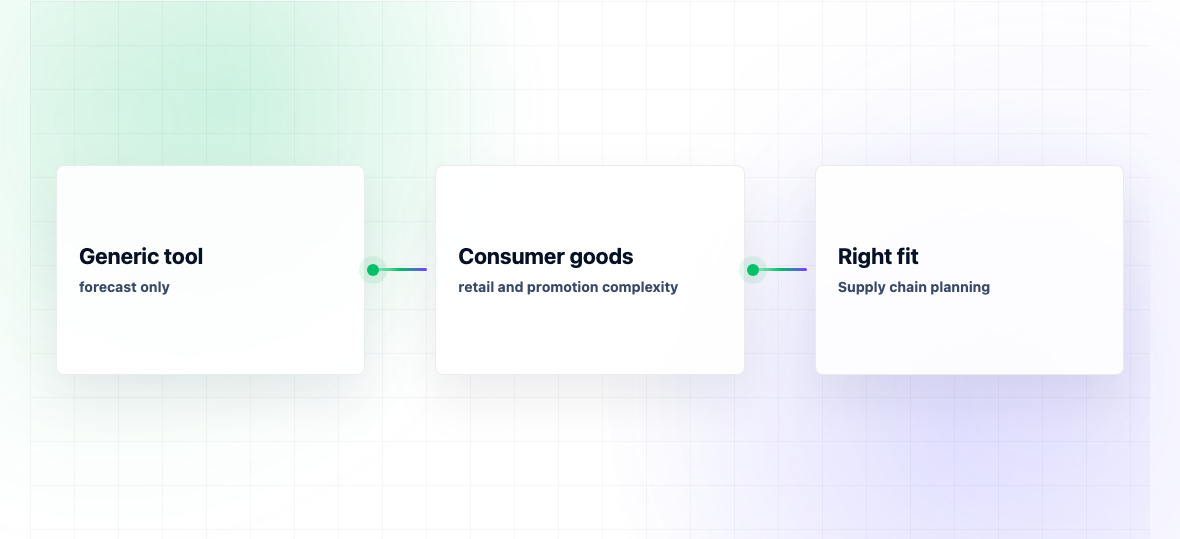
Blue Yonder's strength is CPG and retail-heavy operations: deep trade promotion management, retail point-of-sale integration, store-level replenishment, mature execution platform integration. For operations where these capabilities pull weight, Blue Yonder typically wins. The same depth doesn't differentiate for non-CPG operations — automotive suppliers don't need retail point-of-sale integration; aerospace doesn't need trade promotion management.
Kinaxis's strength is multi-industry concurrent planning architecture. Concurrent planning delivers most value for multi-region, multi-ERP operations needing rapid scenario evaluation across complex global networks. This serves automotive, electronics, aerospace, pharma, and industrial operations broadly, with less CPG-specific depth than Blue Yonder.
Best fit: $3B+ CPG, packaged food, beverage, and retail-heavy manufacturers with significant retail channel exposure and trade promotion management needs. 2026 Gartner Magic Quadrant Leader.
Best fit: $3B+ multinational manufacturers with multi-ERP, multi-region operations across automotive, electronics, aerospace, pharma, industrial. 2026 Gartner Magic Quadrant Leader for both Discrete and Process industries.
Luminate platform with retail-grade demand sensing, trade promotion management, retail point-of-sale integration, and execution platform integration. AI capabilities embedded across planning and execution.
Concurrent planning architecture. All planning views update together in real time when changes happen. Maestro AI layered on concurrent foundation. ERP-agnostic.
Deepest in CPG, packaged food, beverage, consumer products, and retail-heavy operations. Strong execution platform integration with retail systems.
Broad multi-industry: automotive, electronics, aerospace, pharma, industrial. Less CPG-specific depth than Blue Yonder.
Mature execution platform integration through Luminate. Plan-to-execute coordination across warehouse management, transportation, retail execution.
Plan-focused. Execution integration available but less integrated than Blue Yonder's combined platform.
Typical full deployment 12-18 months. Single module 6-9 months.
Typical full deployment 12-18 months. RapidStart accelerators available.
Three-year TCO for $3B+ enterprise: $5-15M+.
Three-year TCO for $3B+ enterprise: $4-12M.
Both platforms typically over-scaled for mid-market. Mid-market integrated platforms (Horizon, Logility, RELEX) deliver similar functional scope at 50-70% lower TCO with faster deployment.