Excel can run supply chain planning. Many small and mid-size manufacturers do this for years, sometimes successfully. The question isn't whether Excel is theoretically capable it's whether the specific complexity of your supply chain has exceeded what Excel can handle without losing significant money to the limitations.
This page compares Excel and dedicated supply chain planning (SCP) software across the dimensions where they actually diverge: multi-echelon math, capacity-aware scheduling, multi-user collaboration, scenario analysis, and integration with execution systems. It then describes the specific scale and complexity thresholds where Excel typically breaks down.
Unlike the demand-planning-specific Excel comparison, this page is about the full scope of supply chain planning production scheduling, inventory across echelons, distribution planning, supply-demand balancing. The thresholds are different from demand planning alone.
Horizon is specifically built for manufacturers crossing the thresholds above 2+ plants, 800-5,000 SKUs, capacity-constrained production, multi-functional planning rhythms. The platform covers demand planning, multi-echelon inventory optimization, supply and production planning, finite capacity scheduling, and distribution planning in a single workspace.
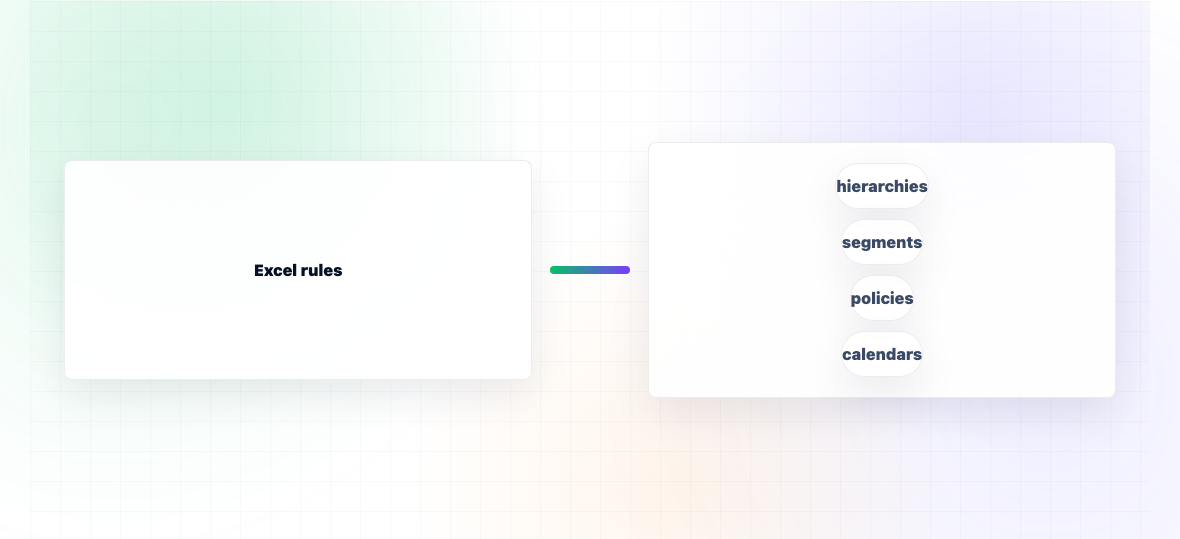
The migration pattern from Excel is well-established. Most companies start with one module typically demand planning or inventory optimization to demonstrate value and validate fit, then expand to adjacent modules over 6-12 months. The Excel-based logic isn't discarded; it's encoded into the platform's configuration. The planning team's expertise transfers; what changes is what they're spending their time on.
Typical year-one financial impact for a $500M manufacturer migrating from Excel: 15-20% inventory reduction (releasing $4-8M of working capital), 8-12 percentage point forecast accuracy improvement, 30-50% reduction in planner time per cycle, 5-10 point OTIF improvement. Implementation: 6-10 weeks for the first module.
The honest scope: companies still below the thresholds (single plant, under 500 SKUs, simple capacity, single-function planning) can often continue in Excel effectively. We'll be specific about whether the company has crossed the threshold rather than push a platform decision before it's warranted.
Excel works in small operations because the math involved is tractable by hand. A single-plant manufacturer with 200 SKUs, a single DC, stable demand, and weekly planning cycles can run effective supply chain planning in well-structured spreadsheets. The volume of decisions is small enough that a competent planner can maintain the calculations.
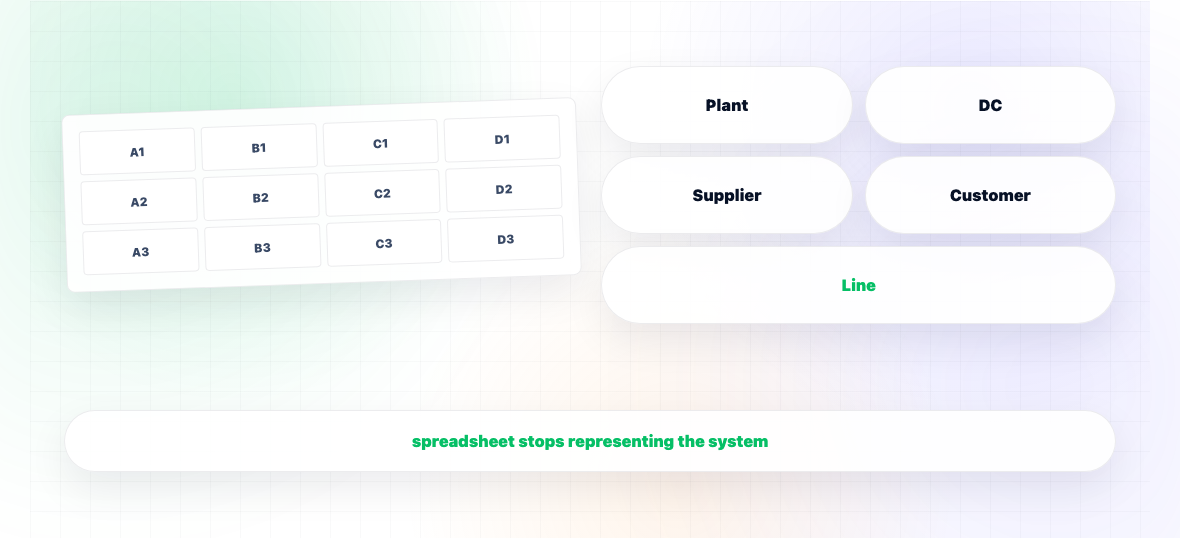
What changes at scale isn't the type of decision it's the combinatorial complexity. A two-plant, three-DC manufacturer with 1,500 SKUs has roughly 75 times more SKU-location combinations than a single-plant, single-DC operation. The number of multi-echelon inventory decisions, capacity-feasibility checks, and supply-demand reconciliations grows faster than linearly. At some point, Excel can no longer track the state of the planning problem accurately, let alone optimize it.
The visible failure mode is plans that look correct on paper but don't survive execution production schedules that ignore real capacity constraints, inventory targets that don't reflect actual lead times, replenishment plans that double-count safety stock between echelons. These failures aren't planner error they're Excel's structural inability to represent the full problem.
Excel: Inventory calculated per location independently. Safety stock at the DC and safety stock at the plant are set without considering risk pooling between them. Result: typically 15-25% more total inventory than necessary.
SCP software: Multi-echelon optimization considers the full network, allocating safety stock to the locations where it delivers the most service for the least working capital. Risk pooling at upstream nodes reduces total inventory while maintaining service levels.
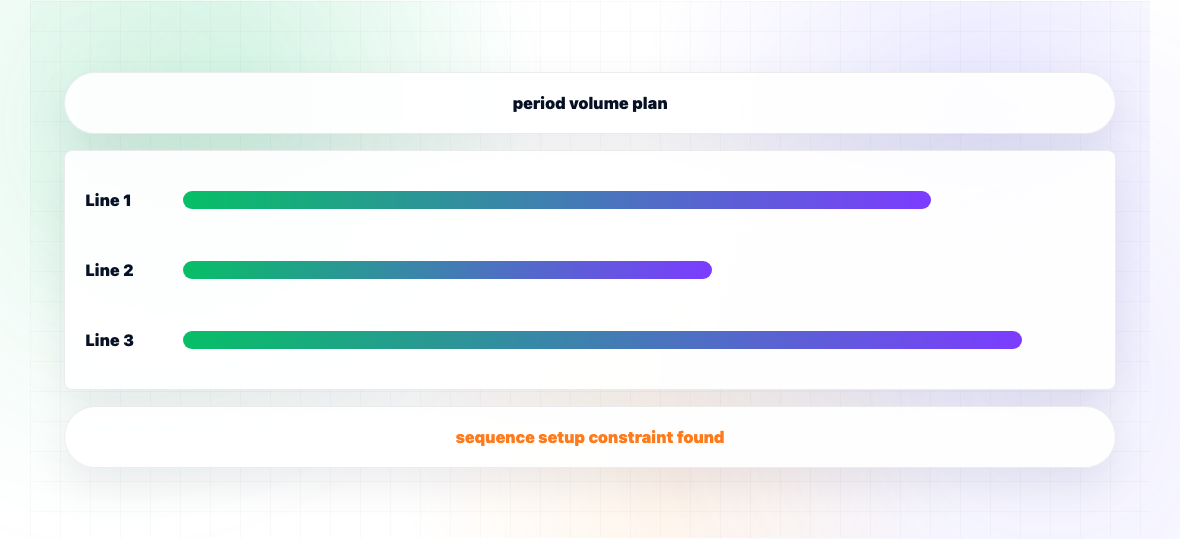
Excel: Production planning produces volume requirements per period. Whether the plan is actually feasible against capacity is checked manually, often after the fact. Sequence-dependent setups and constraint interactions are typically ignored.
SCP software: Finite capacity scheduling produces feasible schedules against actual machine constraints, parallel resources, and sequence-dependent setups. Infeasible plans surface as exceptions in the planning view, not as production problems after the fact.
Excel: Multi-user editing of planning files is brittle. Each function maintains their own file with their own assumptions. Reconciliation between sales, planning, production, and finance is manual and error-prone. "Whose version is current?" is a recurring question.
SCP software: Native multi-user. Each function works in their domain (sales contributes overlays, production reviews capacity, finance reconciles to budget) on shared data with audit trail. The single source of truth is the system, not whichever file was opened last.
Excel: Scenarios require copying the planning workbook and modifying. Each scenario is a separate artefact. Comparing scenarios on cost, service level, and capacity utilisation requires reconciling across multiple files. Practical limit: 2-3 scenarios before maintenance overhead exceeds value.
SCP software: Scenarios saved and compared natively. Side-by-side views show impact on inventory, service level, capacity, cost, margin. Decision logging captures which scenario was chosen and why.
Excel: Output reaches execution systems (ERP, MES, WMS) through manual export-import. Master data updates in ERP require manual reflection in Excel. The integration burden is real and ongoing.
SCP software: Bi-directional integration with ERP, MES, WMS. Master data flows automatically. Approved plans publish to execution systems without re-keying.
Single-location operations can survive in Excel longer. Once a company runs 2+ plants or 2+ DCs, the multi-echelon math becomes the limiting factor. Above 3 stocking locations, the inventory inefficiency from single-echelon Excel-based methods is usually significant 15-25% excess working capital is typical.
Below 500 SKUs, Excel can be made to work with discipline. Above 1,500 SKUs, exception management becomes impossible without automation planners either review everything (and run out of time) or review nothing systematically (and miss problems). The middle range varies by complexity.
For discrete and process manufacturers, the moment changeover times depend on sequence (running A→B is different from B→A), Excel-based scheduling stops being credible. The combinatorial nature of the problem exceeds what manual methods can handle.
When sales, marketing, operations, and finance all need to contribute to the planning cycle, Excel's lack of native multi-user state becomes the bottleneck. The handoffs and reconciliations consume more time than the planning itself.
For businesses where demand uncertainty drives the need for multiple plans (e.g. new product launches, seasonal swings, promotional intensity), Excel's practical limit of 2-3 maintained scenarios becomes constraining. Companies need 5-10 scenarios in the same planning cycle to reason about uncertainty effectively.