Improving forecast accuracy in a manufacturing environment is mostly not about better algorithms. It's about cleaner data, better SKU segmentation, structured overlay capture, and a feedback loop between accuracy measurement and the next forecast cycle. Companies that invest in better algorithms before fixing those structural issues usually see disappointing results.
This page lays out the seven steps that, in our experience across mid-market and enterprise manufacturers, account for the majority of accuracy improvement. They're ordered roughly by impact and by sequence earlier steps unlock the later ones.
A realistic expectation: companies starting from Excel-based forecasting typically gain 8-15 percentage points of MAPE improvement over 12-18 months by working through these steps. Companies already on dedicated software typically gain 3-7 points. Neither pattern is dramatic in a single cycle accuracy improvement compounds.
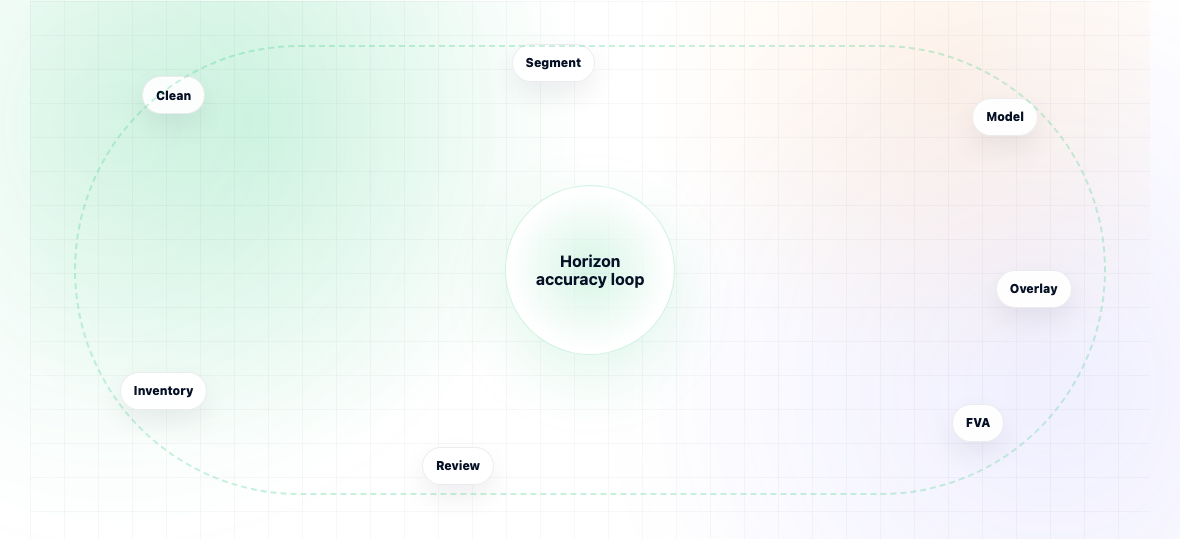
Horizon handles the structural steps automatically: outlier detection during data load (Step 1), automatic SKU segmentation by demand pattern (Step 2), per-SKU model selection from a candidate ensemble (Step 3), structured overlay capture with owner and reason (Step 4), native FVA reporting at the overlay level (Step 5), and exception-based review with configurable thresholds (Step 6).
Step 7 feeding accuracy into safety stock happens because Horizon's demand and inventory modules share the same forecast and the same accuracy metrics. When MAPE drops, the inventory module re-optimizes safety stock targets in the next cycle without manual reconfiguration. This is the integration that captures the working capital benefit of accuracy improvement.
The honest sequencing: deploying Horizon doesn't automatically deliver all 7 steps on day one. Data quality (Step 1) typically requires 2-4 weeks of master data cleanup. Segmentation and per-SKU model selection (Steps 2-3) are configured during deployment. FVA (Step 5) becomes meaningful 3-6 months in once enough overlay data accumulates. The full accuracy improvement compounds over the first year.
The most common mistake teams make is treating forecast accuracy as an algorithm problem. They benchmark models, pilot ML methods, and run accuracy bake-offs while leaving structural issues unaddressed. The math is rarely the bottleneck.
A specific example. A mid-market food manufacturer ran a 6-month accuracy improvement project focused on switching from exponential smoothing to a gradient-boosted ML model. MAPE improved 2 percentage points. The same company then spent the following 6 months segmenting SKUs into stable / volatile / new / intermittent and applying different review cadences to each. MAPE improved 9 percentage points. Same data, same underlying models the structural change drove four times the improvement of the algorithm change.
The reason is that algorithms have ceilings imposed by data quality, SKU heterogeneity, and process discipline. Until those ceilings are raised, switching algorithms is incremental at best. Once they're raised, the algorithm choice matters more but it's the second-order optimization, not the first.

Most accuracy problems start with the training data, not the model. The two specific things to fix:
A 5,000-SKU portfolio is not one forecasting problem it's several. Segment SKUs into four buckets:
Different segments get different methods and different review cadences. This is the single highest-impact structural change in most manufacturers' forecasting processes.
For each stable and volatile SKU, run multiple candidate models (Holt-Winters, ARIMA, gradient-boosted trees) and let the system pick the best-performing one based on holdout testing. Don't standardize on one method across the whole portfolio. Different SKUs have different demand structures; one model is rarely best for all.
Sales and marketing overlays should be captured as discrete items with named owners and reasons not bulk adjustments to the forecast. Examples: "Customer A confirmed Q3 order +500 units," "Promo X expected to lift baseline 30% in week 12-14." The discipline matters because it enables FVA and accountability.
Once overlays are structured, calculate FVA for each overlay step. Share the data back with overlay owners not as a punitive scorecard, but as a feedback loop. Most sales reps' overlays improve over 6-12 months once they see their own FVA data. The few that don't can be removed from the process.
Stop reviewing every SKU every cycle. Use the system to flag SKUs needing attention: high error, drifting bias, large change from last cycle, missing actuals, low forecast vs known customer commitment. Planners review the 10-20% flagged, not the 100%. Hours per cycle drop, and the hours spent are higher-leverage.
An accuracy improvement that doesn't reach inventory policy is invisible to the business. Recalculate safety stock targets quarterly using rolling MAD or MAPE per SKU. As accuracy improves, safety stock requirements drop, and the company captures the working capital benefit. Without this step, you'll have a better forecast and the same inventory.
Horizon automates steps 1 through 6 out of the box, though step 1's data cleanup still takes 2-4 weeks and FVA doesn't get meaningful until 3-6 months of overlay history builds up in demand planning.