IBP software is one of the most over-marketed categories in supply chain technology. Nearly every planning platform now claims to support IBP but the gap between platforms that genuinely enable Integrated Business Planning and those that are S&OP tools with a finance dashboard is large. The buying decision matters because it's typically a 5-10 year platform commitment and the wrong choice forces either expensive workarounds or a painful migration.
This guide is for the executive buying committee typically a COO or CEO, CFO, and Head of Supply Chain at a company moving from S&OP to true IBP. It covers the seven capabilities that genuinely matter, the four red flags that distinguish marketing from substance, what implementation actually looks like, and the questions to ask in a vendor demo that reveal whether the product supports IBP or just claims to.
Horizon's IBP capabilities cover the seven areas above with native financial integration as the core. Volume changes in the demand plan flow into revenue and margin projections automatically. Scenario planning supports saving, comparing, and approving multiple alternatives within the cycle. Strategic initiatives are represented as plan elements with their own assumptions.
The financial layer is built on a configurable model that captures pricing, cost structures, and margin allocation per SKU and customer. For companies with complex pricing (volume discounts, contract pricing, transfer pricing across legal entities), the model can be extended without leaving the platform.
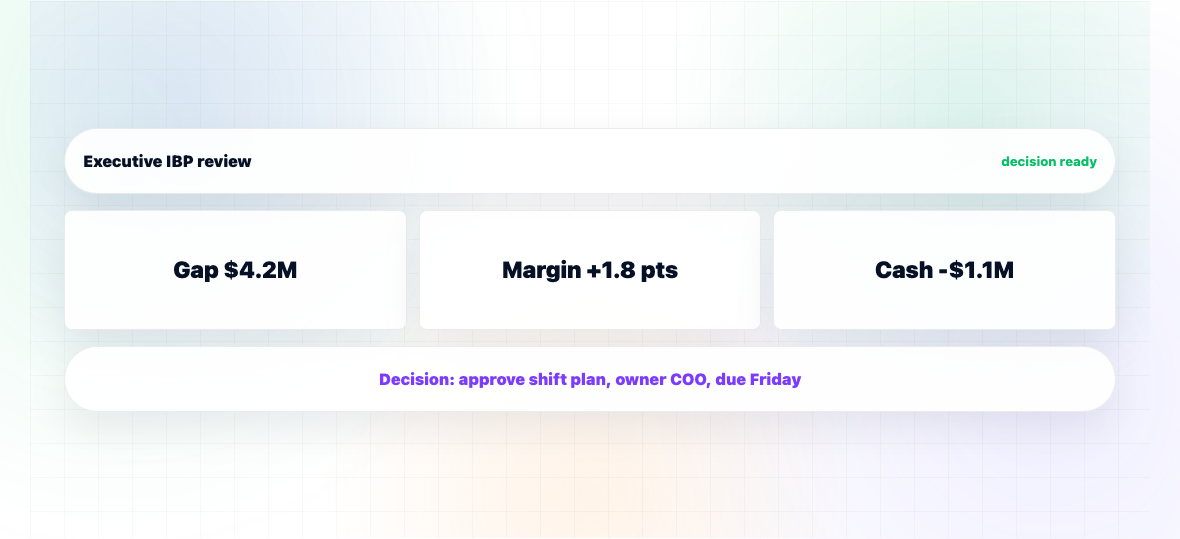
The executive views are designed for non-planners: gap-to-target dashboards, scenario comparison side-by-side, decision logging with owners. The same operational data drives both the planner workflow and the executive review, so there's no "planner view vs CEO view" divergence.
The honest scope: Horizon is best fit for mid-market and enterprise manufacturers running monthly IBP rhythms with planning horizons up to 36 months. Companies needing 5+ year strategic horizons or extremely complex financial consolidation (multiple GAAPs, intercompany eliminations) may need a specialised financial planning tool alongside Horizon. We'll be specific about that fit in early conversations rather than pushing a product into a context it doesn't serve.
See if Horizon fits your IBP evaluation criteria
IBP software touches more of the business than S&OP software. It connects to ERP for actuals and master data, to the financial planning system for budget integration, to the demand planning system, to production scheduling, to the executive reporting layer. A poor IBP platform choice creates friction across all of those interfaces.
The other stakes consideration: IBP software shapes how the executive team operates. If the platform produces views the CEO can't trust, the rhythm reverts to running on spreadsheets and the IBP process never lands. If the platform supports the executive view but lacks operational depth, the planners revert to their own tools and the integration breaks. Both failure modes are common, and both are expensive to fix.
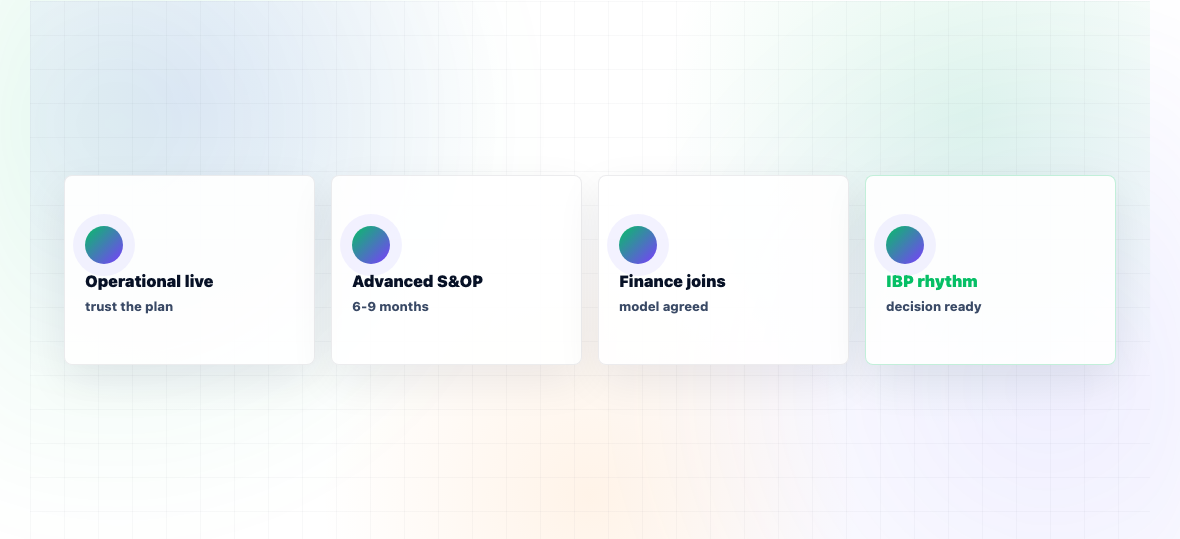
The decision deserves more time than buying decisions of similar dollar value in other categories typically 6-9 months of evaluation including proof-of-concept work, not the 3-month cycle some procurement teams default to.
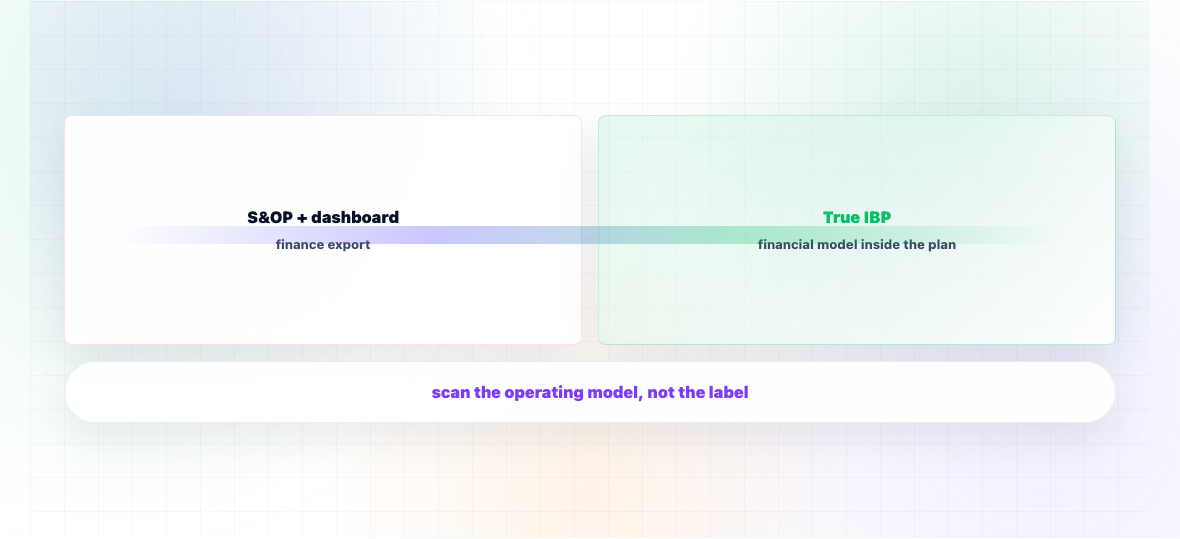
The operational plan (volume) must convert to financial outcomes (revenue, margin, working capital, cash flow) without leaving the platform. Pricing data, cost data, and margin structures live in the system. If financial integration happens via Excel exports to FP&A, the platform is an S&OP tool with a label change, not IBP software.
What to test: Change a SKU mix in the demand plan. Does the margin projection update automatically? Is the working capital impact visible? Can you compare scenarios on financial outcome side-by-side?
True IBP requires comparing alternatives "outsource overflow vs add a shift," "launch in Q2 vs Q3," "invest in capacity vs reshape demand." The platform should support saving, comparing, and approving among multiple scenarios within the cycle. Single-scenario tools force IBP to happen in side meetings with spreadsheets.
What to test: Create three scenarios with different assumptions. Compare them on volume, margin, and working capital side-by-side. Approve one and archive the others with a decision rationale.
IBP runs 24-36 months out. The platform must support this horizon with appropriate granularity (monthly near-term, quarterly long-term) and must handle structural changes that happen at longer horizons (new product launches, capacity changes, plant closures).
What to test: Plan a new product launch 18 months out. Can you set the ramp curve, the capacity allocation, and the cost structure for the launch period? Does it integrate into the regular plan view?
Strategic decisions (M&A integration, market entry, capacity investment) should be visible within the IBP rhythm rather than tracked in parallel meetings. The platform should support representing strategic initiatives as plan elements with their own volume, cost, and timing assumptions.
What to test: Add a strategic initiative e.g. "Plant 2 capacity expansion, $20M, online Q3 2026." Does it show up in the long-horizon view? Does the financial integration reflect the investment?
The CEO and CFO are not planners. The views they consume should be designed for executive decision-making: gap-to-target, scenario comparison, named action items with owners, exception highlights. Platforms built for planners often have rich operational depth but executive views that don't earn trust.
What to test: Show a recent customer's actual executive review pack from the platform (with permission). Does it look like a CEO would use it, or like a planner exported it to PowerPoint?
Decisions made in the IBP review should be captured with named owners, due dates, and follow-up tracking. Without this, the rhythm degrades because actions go missing between cycles.
What to test: In the executive review view, can you log decisions and track them across cycles? Are open items from prior cycles visible at the start of the next?
The IBP layer must connect cleanly to demand planning, supply planning, scheduling, and inventory. Standalone IBP tools that aren't integrated to operational planning create the "two systems of truth" problem the IBP plan and the operational plan diverge over time.
What to test: Check whether the demand plan in IBP is the same demand plan operations is using. If not, the integration is brittle.
If the vendor demos demand and supply planning but skips or hand-waves financial integration, the product is S&OP with a label. Financial integration is the defining capability if it's not front and centre, it's not really there.
Ask reference customers who owns IBP. If the answer is consistently "VP of Supply Chain" or "Supply Chain Director," the product enables advanced S&OP but isn't actually deployed as IBP at those references either.
Vendor screenshots and case studies that show finance "joining" the executive review are different from finance owning the financial integration step. Probe for whether finance does work in the platform or just reviews outputs.
If strategic initiatives are tracked as PowerPoint attachments to the IBP cycle, the platform isn't actually supporting strategic alignment. Real strategic initiative tracking lives in the platform with volume, cost, and timing impacts on the plan.
For a mid-market to enterprise manufacturer, IBP software implementation typically runs:
Companies that promise 3-month IBP deployments are usually deploying advanced S&OP and calling it IBP. The financial integration and process maturation cannot be compressed below ~9 months in any company larger than $200M.
For a mid-market manufacturer ($500M-$2B):
Three-year TCO is typically 5-8x year-one license cost.