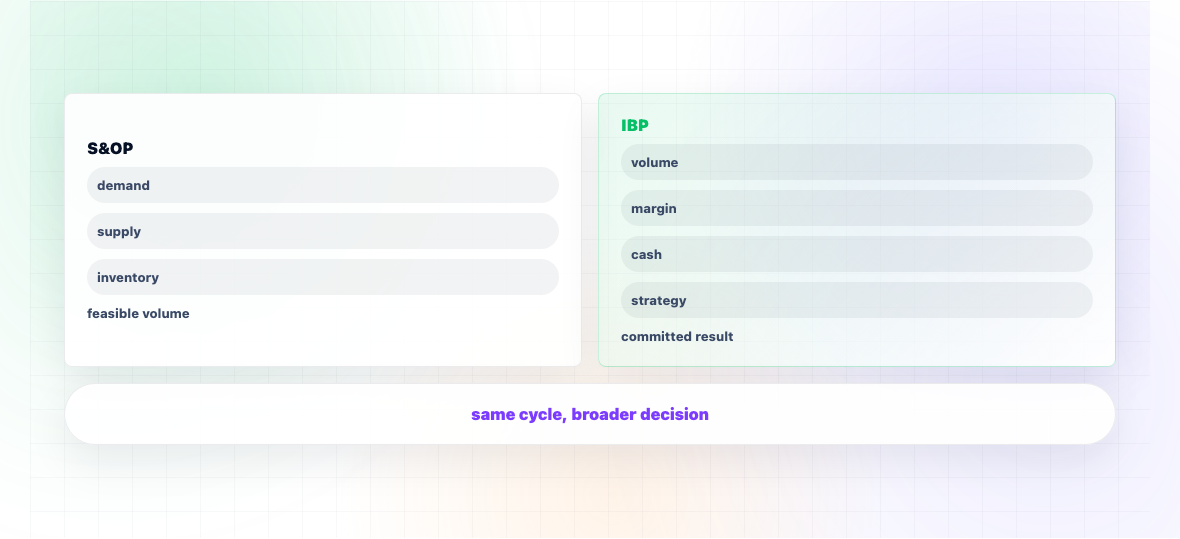
S&OP (Sales and Operations Planning) is a monthly process that balances demand and supply across a 12-24 month horizon. IBP (Integrated Business Planning) is the evolution of S&OP that adds financial reconciliation, scenario planning, and strategic alignment extending the same rhythm to cover the full P&L impact of operational decisions.
The two terms are often used interchangeably, and many "IBP" implementations are S&OP processes with a finance person added to the meeting. That is not the same thing. True IBP closes the loop between the operational plan, the financial plan, and the strategic plan, so the numbers in the boardroom match the numbers in the production schedule.
This page compares the two side-by-side on scope, participants, horizon, and outputs and explains the three signals that indicate a company is ready to move from S&OP to IBP.
Horizon supports the S&OP rhythm out of the box demand review, supply review, capacity reconciliation, exception-based executive view with the full audit trail of who changed what.
For companies running IBP, Horizon connects the operational plan to a financial model so volume changes flow into revenue, margin, and working capital projections automatically. A 5% lift in a high-margin SKU and a 5% lift in a low-margin SKU look the same in volume but produce very different P&L outcomes, and Horizon makes that visible in the same screen where the volume decision is made.
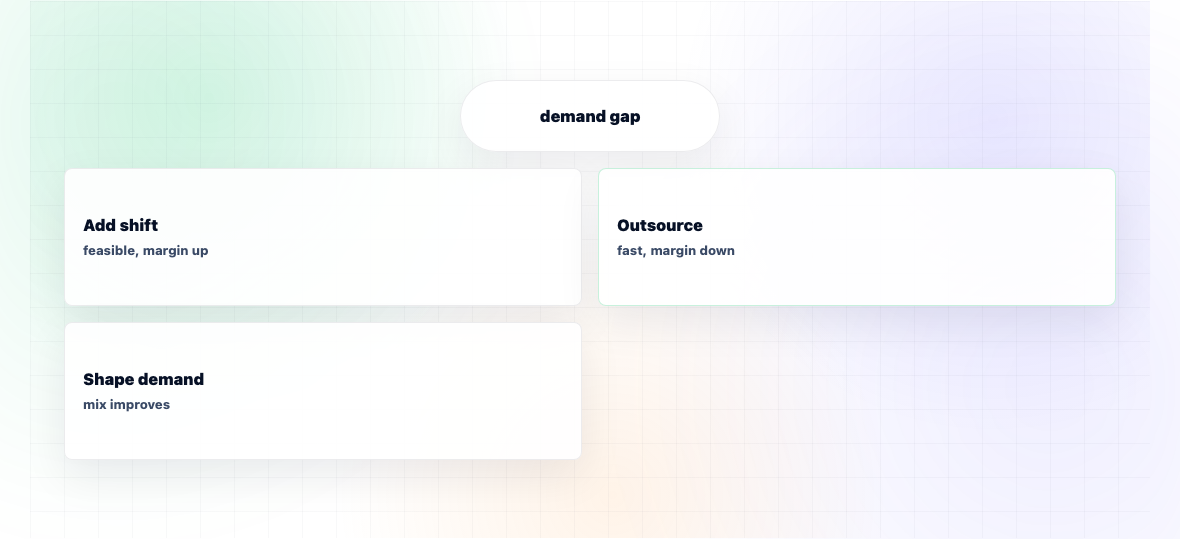
The scenario engine lets executives compare alternatives (e.g. "outsource overflow vs add a shift") on both feasibility and financial result before committing. This is the IBP capability most teams build as a spreadsheet alongside their planning tool Horizon brings it into the planning cycle directly.
See how Horizon connects the operational plan to the P&L
The distinction is not academic. It changes who shows up to the meeting, what gets decided, and what the board sees.
An S&OP process answers: can we make and sell the plan? The output is a feasible operational plan. An IBP process answers: can we make and sell the plan, and does it deliver the financial result we committed to? The output is a feasible operational plan that is reconciled to revenue, margin, working capital, and strategic targets.
The practical consequence: an S&OP process can produce a plan that ops thinks is great but finance discovers in month-end close has destroyed margin (because the plan over-promised low-margin SKUs to fill capacity). IBP catches that in the planning cycle, not in the close cycle. For companies whose plans regularly miss the financial target despite hitting the volume target, the gap is usually the lack of true IBP.
S&OP: Volume-based balancing of demand and supply. Inputs are unit forecasts and capacity. Output is a unit-based production and inventory plan.
IBP: Volume and value. Adds revenue, margin, working capital, and strategic initiatives. Output is a financially-reconciled plan that ties to the P&L.
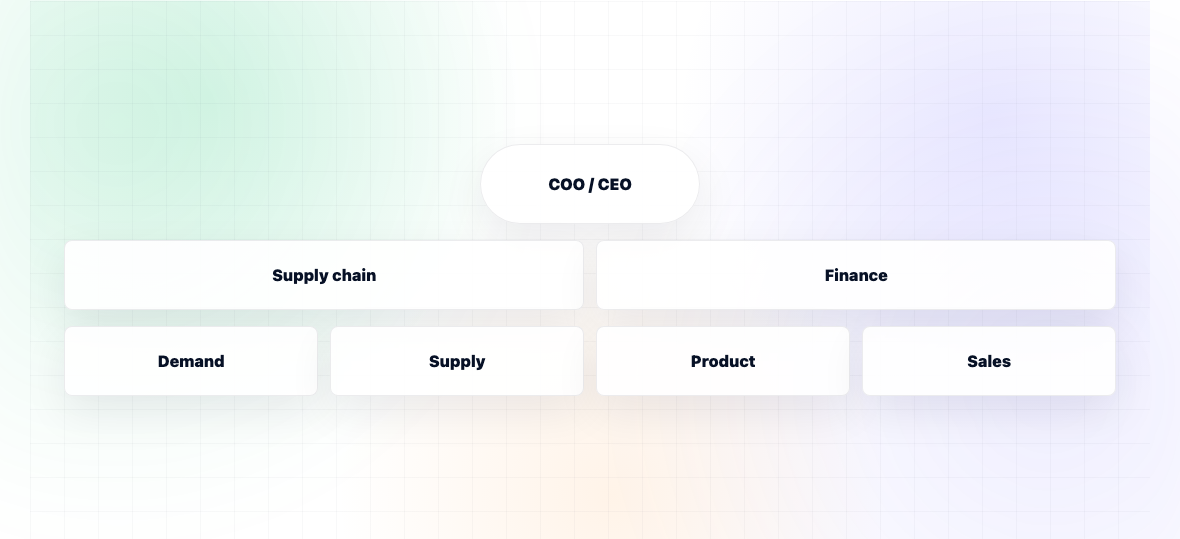
S&OP: Demand planning, supply planning, operations, sometimes sales. Typically run by a supply chain director.
IBP: All of the above plus finance (FP&A), marketing, product, and strategy. Run by a senior executive often the COO or CEO. Finance is a peer participant, not a guest.
S&OP: 12-24 months rolling, monthly buckets.
IBP: 24-36 months rolling, monthly near-term and quarterly long-term. Must reach far enough to include the next strategic horizon (new product launches, capacity investments, market entries).
S&OP: Usually one scenario, occasionally two (base and downside).
IBP: Multiple scenarios, evaluated on both operational feasibility and financial outcome. Strategic alternatives (e.g. "should we add capacity in Plant 2 or outsource?") are evaluated as part of the rhythm.
S&OP: Approved demand plan, supply plan, inventory plan. Production and procurement consume these.
IBP: All of the above, plus financial forecast updated to the operational plan, gap-to-target analysis with named owners, scenario recommendations to the executive team.
S&OP: Monthly, with a standard five-step flow (demand review → supply review → reconciliation → executive review → publish).
IBP: Same monthly rhythm, but the executive review is positioned as the company's primary operating cadence, not a supply chain meeting.
Three signals indicate readiness: