This guide is for a supply chain leader, CFO, or operations leader evaluating inventory optimization software. The buying decision usually starts with one of three triggers: working capital pressure (inventory is too high), service problems (chronic stockouts despite high inventory), or a recognition that rule-of-thumb policies have stopped scaling.
The inventory optimization category is broader than many buyers realize. Some tools are pure optimization engines that produce safety stock recommendations to be implemented elsewhere. Others are full platforms that include the operational execution of the policies. The distinction affects evaluation, implementation, and ROI substantially.
This page covers the seven capabilities that genuinely matter, the four red flags worth catching early, and realistic expectations for ROI and implementation.
Horizon's inventory optimization module covers all seven capabilities. MEIO uses stochastic service-level optimization with simulation-based methods, handling networks up to 30 stocking locations and 10,000 SKUs effectively. Lead time variability is derived from receipt history and used in safety stock calculations explicitly. Service level targets are configurable per SKU and per segment.
Non-normal demand distributions are handled, including specialized methods for intermittent demand (Croston, TSB) for SKUs with long zero-demand periods. Integration with the demand planning module is direct forecast accuracy improvements automatically reduce safety stock in the next cycle.
Operational execution is integrated through supply planning. Optimized reorder points and target inventory levels drive replenishment orders automatically. Policy refresh runs on a configurable cadence with exception flagging for SKUs whose policies have changed significantly.
Pre-built integrations exist for SAP S/4HANA, Oracle NetSuite, D365, and Infor. The full module typically deploys in 12-20 weeks for mid-market manufacturers.
The honest scope: Horizon's inventory optimization is built for manufacturers with 500-10,000 active SKUs and 2-30 stocking locations. Very large networks (50,000+ SKUs, 100+ locations) sometimes need specialized inventory tools that scale further. We'll be explicit about that fit in early conversations.
Inventory optimization typically has the strongest measurable ROI in the supply chain planning category. The reason: the working capital release is direct and immediate. A $500M manufacturer carrying $80M of inventory who achieves 20% reduction frees up $16M of cash within 6-12 months. Against software cost of perhaps $300K annual and $500K implementation, the ROI is unambiguous.
The second reason ROI is strong: inventory optimization improvements are typically additive rather than competing with other supply chain investments. Better demand forecasting compounds with inventory optimization. MEIO compounds with lead time reliability work. Each method makes the others more effective. This is different from many supply chain investments that show diminishing returns when combined.
The buying risk is choosing a tool that promises optimization but delivers only basic safety stock calculations. The capability range across vendors is wide, and the gap between "we have inventory optimization" and "we have MEIO with risk-pooling math" is large. Most of this guide focuses on distinguishing these levels during evaluation.
The defining capability that separates inventory optimization from basic safety stock. Verify the math is genuinely network-level optimization, not sequential single-echelon calculations dressed up with MEIO labels.
What to verify: Ask the vendor to explain how their math handles risk pooling at upstream nodes. Real MEIO will explain variance reduction across uncorrelated downstream demand and time-phased coverage between echelons. Vague answers indicate the math may be sequential single-echelon, not true MEIO.
Many companies hold safety stock primarily for lead time uncertainty, not demand uncertainty. The optimization math must include lead time variability as a first-class input, not treat lead times as constants.
What to verify: Show the vendor a SKU with known lead time variability (e.g., supplier with 6-week mean lead time but actual receipts ranging 4-9 weeks). Verify the safety stock calculation explicitly accounts for the variability and that the vendor can show the calculation decomposition.
Different SKUs deserve different service levels A SKUs may warrant 99%, C SKUs may run at 90%, regulatory-critical pharma SKUs may need 99.5%+. The tool must support per-SKU or per-segment service level targets, not a single global target.
What to verify: Configure three different service levels for three different SKU classes and verify the safety stock recommendations differ proportionally.
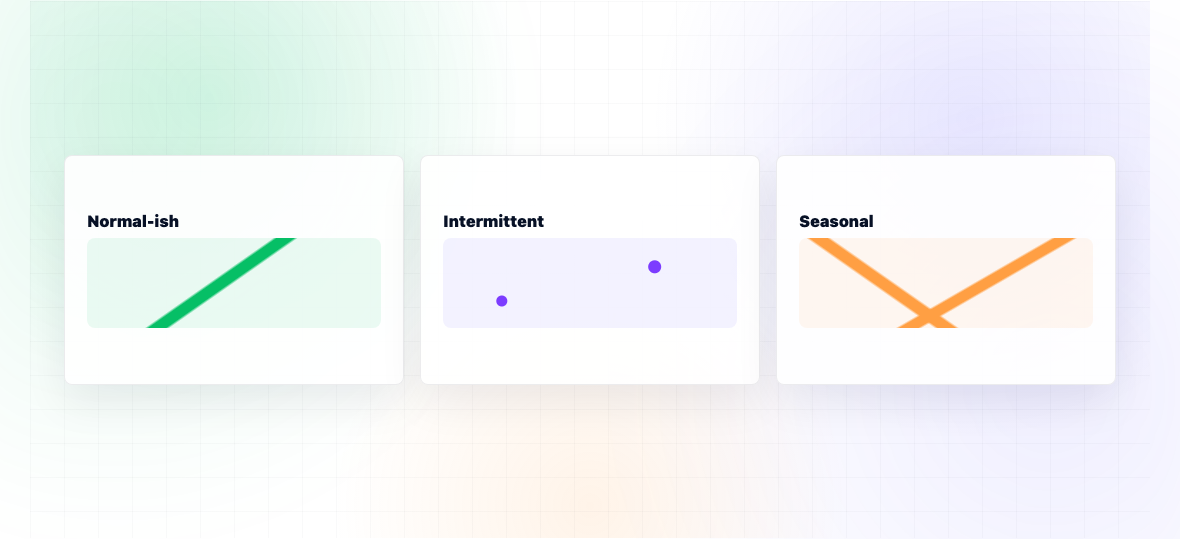
Standard safety stock math assumes demand follows a normal distribution. Real demand often doesn't intermittent demand, lumpy demand, demand with heavy seasonality. The tool should handle non-normal distributions appropriately, including specialized methods for intermittent demand (Croston, TSB).
What to verify: Test the tool against a representative intermittent-demand SKU. Standard safety stock formulas typically over-stock intermittent SKUs by 20-40%; tools with intermittent demand methods don't.
Inventory optimization consumes forecast accuracy metrics from demand planning. The two functions should share data accuracy improvements automatically translate to safety stock reductions in the next cycle. Standalone optimization tools that don't integrate well with demand planning produce static safety stock that doesn't track forecast improvement.
What to verify: Trace the data flow from demand planning to inventory optimization. Is forecast accuracy automatically consumed? Or does it require manual updates per cycle?
Pure optimization tools produce recommendations that someone else has to execute. Integrated platforms execute the optimization themselves generating replenishment orders, adjusting MRP parameters, publishing to ERP. The difference matters: optimization recommendations that don't execute don't release working capital.
What to verify: Trace the flow from optimization output to operational action. Does the tool produce reorder points that automatically drive ERP replenishment? Or are they advisory only?
Inventory optimization isn't a one-time event. Demand patterns change, lead times drift, service requirements evolve. The tool should support continuous re-optimization with policy refresh on a configurable cadence monthly for high-value SKUs, less frequent for tail.
What to verify: Verify the tool supports automated policy refresh on a configurable cadence. Tools that require manual re-running for each refresh tend to degrade as policies become stale.
Many vendors claim MEIO but use sequential single-echelon calculations across locations. Real MEIO involves stochastic service-level optimization with risk-pooling math. If the vendor can't explain the math, the capability is probably overclaimed.
Tools that don't handle lead time variability typically over-recommend safety stock by 10-20% because they conflate lead time uncertainty with demand uncertainty. Lead time variability handling is a hygiene factor in modern optimization tools.
Standalone optimization tools may produce good math but won't capture forecast accuracy improvements that should reduce safety stock over time. The integration is what compounds gains across functions.
Vendors who position inventory optimization as a "project" with a clear end date typically deliver one-time gains that erode over time. Real optimization is continuous, not project-based. Look for tools that support ongoing policy management, not just initial recommendation generation.
For a mid-market manufacturer (500-5,000 SKUs, multi-location):
The biggest delay risk is lead time data quality. Most companies have demand history but lack reliable lead time variability data because they've treated lead times as constants. Building this typically requires 4-6 weeks of work.