Kinaxis versus o9 is the comparison that emerges when enterprise buyers want AI-driven supply chain planning at scale. Both are credible enterprise platforms with strong AI positioning, but they take genuinely different architectural approaches: Kinaxis layers AI on top of concurrent planning architecture; o9 builds AI throughout via knowledge graph foundation.
The decision often depends on which architectural approach fits operational reality and data engineering maturity. This page covers the comparison honestly, with a brief note for mid-market buyers who shouldn't be in this evaluation in the first place.
Kinaxis vs o9 is enterprise-scale evaluation. Both platforms target $3B+ enterprises with mature data engineering and complex operations. Mid-market manufacturers ($100M-$3B revenue) typically don't have the relational complexity, data engineering capability, or scale to extract enterprise platform value — and TCO is disproportionate to mid-market scale.
For mid-market AI-driven planning, Horizon delivers ensemble forecasting with automatic per-SKU model selection, decision execution proposing specific actions, and integrated planning across demand, supply, inventory, and scheduling — at $700K-$1.5M three-year TCO and 6-9 month deployment.
If you're researching Kinaxis vs o9 but you're under $3B revenue, evaluating mid-market alternatives alongside enterprise platforms typically clarifies which scale fits your operations.
Both platforms deliver AI-driven planning, but how the AI integrates with the platform architecture matters operationally. Kinaxis's concurrent planning foundation maintains all planning views updating together; Maestro AI adds AI capabilities (demand sensing, supply variability prediction, scenario optimization) to this concurrent foundation. o9's knowledge graph foundation models supply chain entities and relationships explicitly; AI reasons across the graph natively rather than being added on top.
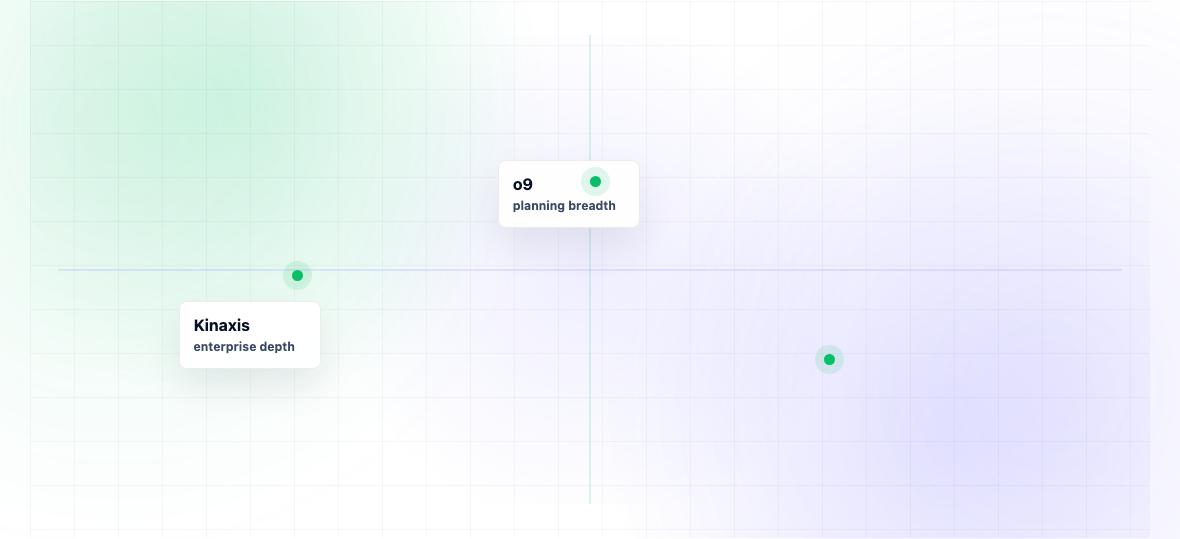
For operations with rapid scenario evaluation needs and concurrent planning value, Kinaxis often wins. For operations with rich relational data where understanding cross-entity effects matters, o9 often wins. The data engineering requirement differs significantly: o9 needs more.
Best fit: $3B+ multinational manufacturers with multi-ERP, multi-region operations. 2026 Gartner Magic Quadrant Leader. Strong reference base in automotive, electronics, aerospace, pharma, industrial.
Best fit: $3B+ global enterprises with rich relational supply chain data and mature data engineering capability. Customers' Choice in 2025 Gartner Peer Insights for Supply Chain Planning Solutions.
Concurrent planning architecture as foundation. Single in-memory engine maintains all planning views updating together. Maestro AI layered on top adds AI capabilities to concurrent planning foundation.
Knowledge graph architecture as foundation. Entities (products, customers, plants, suppliers) and relationships modeled explicitly. AI/ML embedded throughout, reasoning across the graph natively.
Benefits from data engineering capability but less dependent than o9. Concurrent architecture works on operational data without explicit graph construction.
Requires mature data engineering capability for knowledge graph. Companies without dedicated data engineering team typically extract 30-50% of platform value.
Automotive, electronics, aerospace, pharma, industrial. Broad multi-industry depth.
CPG, retail, complex manufacturing with rich product-customer-channel relationships.
Typical full deployment 12-18 months. RapidStart accelerators available.
Typical full deployment 12-24 months. Knowledge graph construction adds time.
Three-year TCO for $3B+ enterprise: $4-12M.
Three-year TCO for $3B+ enterprise: $5-15M+. Knowledge graph and data engineering investment contributes to upper range.
Neither platform fits well. Mid-market manufacturers ($100M-$3B) typically extract a fraction of either platform's value. Mid-market integrated alternatives (Horizon, Logility, RELEX) deliver AI-driven planning at scale-appropriate cost with faster deployment.