If you're researching Kinaxis versus o9, you're probably evaluating enterprise platforms with strong AI positioning. The two have genuinely different architectures: Kinaxis emphasizes concurrent planning with AI added through Maestro AI; o9 emphasizes modern architecture with knowledge graph approach. Both are credible enterprise choices and the decision often depends on which architectural approach fits your context.
We're including Horizon in this comparison for the same reason as our other three-way pages: a meaningful share of buyers researching Kinaxis vs o9 are actually mid-market manufacturers considering enterprise platforms because of analyst recommendations rather than scale fit. For genuine enterprise buyers, the comparison is Kinaxis vs o9 and Horizon is irrelevant. For mid-market buyers stuck in enterprise platform evaluation, knowing that mid-market alternatives exist saves evaluation time.
The framing throughout: what fits enterprise vs mid-market, and what fits concurrent architecture vs modern architecture?
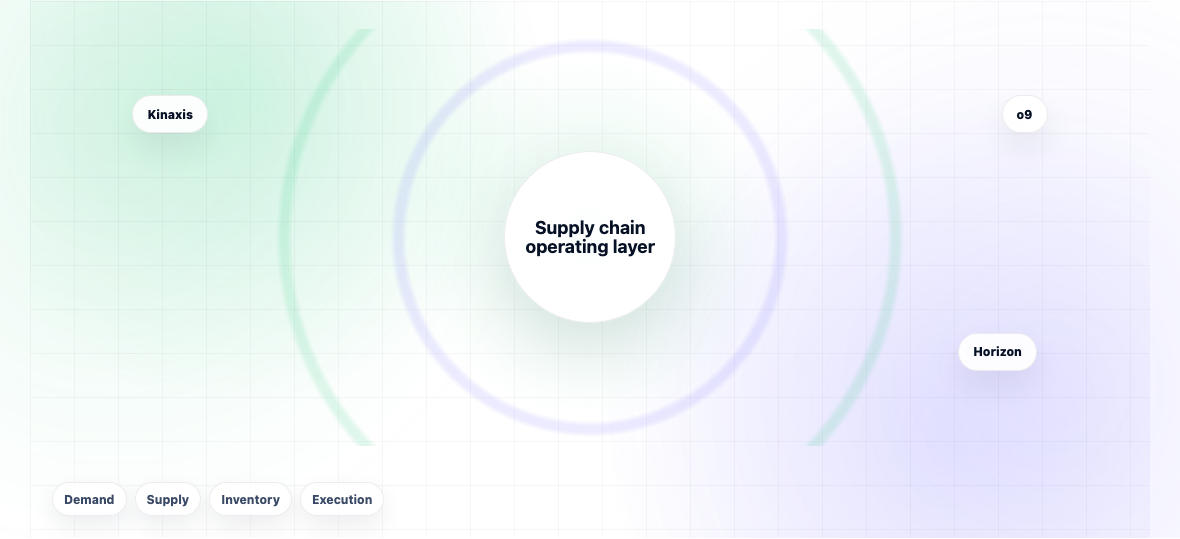
At enterprise scale, Horizon doesn't compete with Kinaxis or o9. Both enterprise platforms deliver capabilities (concurrent planning architecture, knowledge graph AI) that mid-market platforms can't match. Fortune 500 manufacturers should evaluate Kinaxis vs o9 based on which architectural approach fits their context better. Horizon is irrelevant to that decision.
Where Horizon competes effectively: mid-market manufacturers ($100M-$3B revenue) who are evaluating Kinaxis vs o9 because they appear on every analyst recommendation list. For these companies, the AI capability differential between Kinaxis Maestro AI and o9's knowledge graph approach matters less than the misfit of either platform to mid-market scale. Horizon delivers modern architecture sized for mid-market complexity at scale-appropriate cost.
The decision framework: if you're $3B+ revenue with multi-ERP, multi-region complexity, we'll recommend evaluating Kinaxis vs o9 based on whether concurrent planning or knowledge-graph AI fits your context better — we won't pursue your deal. If you're $100M-$3B mid-market, we'll show why Horizon typically fits better than either enterprise platform at your scale. The boundaries are clear enough that early conversations can clarify fit quickly.
The voice throughout: AI capability is real at all three platforms, but architectural approach and scale fit determine which AI delivers the most operational value for your situation. We're explicit about where Horizon doesn't fit.
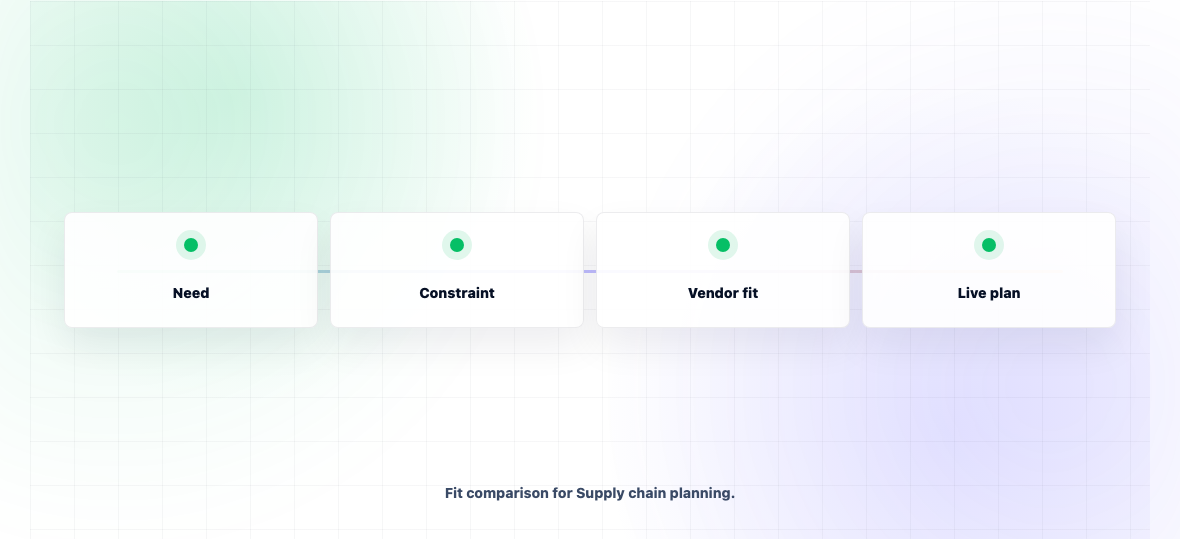
Kinaxis and o9 take different architectural approaches that drive different operational patterns. Kinaxis's concurrent planning architecture maintains all planning views in a single in-memory engine — when demand changes, supply and inventory views update together in real time. This is genuinely powerful for complex global operations where rapid scenario evaluation matters. o9's knowledge graph approach models supply chain entities (products, customers, plants, suppliers) and their relationships explicitly, with AI/ML embedded throughout. This is genuinely powerful for operations with rich relational complexity where understanding cross-entity effects matters.
Neither approach is universally better. The choice depends on which capability profile better fits your operational reality. Companies whose primary need is rapid concurrent re-planning across regions fit Kinaxis better. Companies whose primary need is AI-driven insight across complex product-customer-channel relationships fit o9 better.
For mid-market companies, both architectural approaches are sophisticated beyond what mid-market scale actually needs — the value of either approach scales with complexity. Mid-market platforms (Horizon) deliver similar planner experience at scale-appropriate cost.
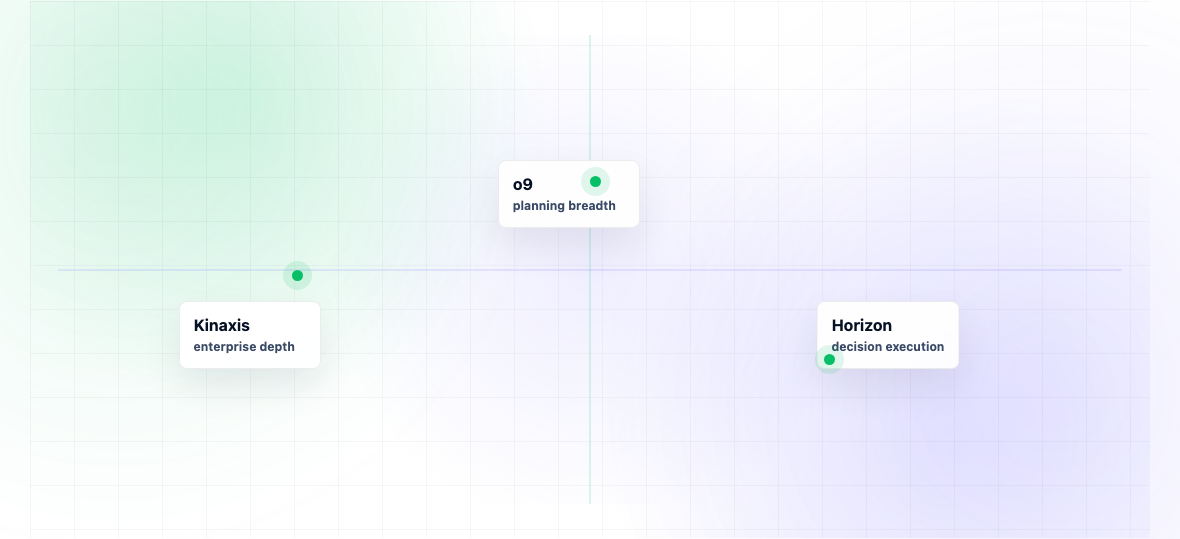
Best fit: large multinational manufacturers ($3B+ revenue) with complex multi-ERP, multi-region operations. Strong reference base in automotive, electronics, aerospace, pharma. Named a Leader in 2026 Gartner Magic Quadrant for both Discrete and Process industries.
Best fit: large global enterprises ($3B+ revenue) with rich data engineering capability and complex product-customer-channel relationships. The only vendor named a Customers' Choice in the 2025 Gartner Peer Insights Customers' Choice for Supply Chain Planning Solutions.
Best fit: mid-market manufacturers ($100M-$3B revenue), 1-10 plants, 500-5,000 active SKUs. Not built for global multinational complexity or 50,000+ SKU portfolios.
Concurrent planning architecture. Single in-memory engine maintains all planning views (demand, supply, inventory) updating together when changes happen. Maestro AI adds AI capabilities on top of the concurrent foundation. The architectural strength is rapid scenario evaluation across complex operations.
Knowledge graph architecture with embedded AI/ML throughout. Supply chain entities and relationships are modeled explicitly, allowing AI to understand cross-entity effects. The architectural strength is AI-driven insight across complex relational supply chains.
modern architecture sized for mid-market complexity. Ensemble forecasting with automatic per-SKU model selection. Decision execution layer proposes specific actions to planners. Configuration-driven deployment model.
AI capabilities added through Maestro AI suite. Strong in demand sensing, supply variability prediction, and scenario optimization. Effective at improving planning outcomes in complex operations.
AI embedded throughout the platform with ML for demand forecasting, supply variability, and cross-entity pattern recognition. Generally regarded as having deeper AI/ML embedding than Kinaxis. The knowledge graph foundation supports AI reasoning across entity relationships.
ensemble forecasting (Holt-Winters, ARIMA, Croston, gradient-boosted trees) with automatic per-SKU model selection. Decision execution layer that proposes specific operational actions to planners — different from analytical AI that produces insights for someone else to act on. NVIDIA Inception membership reflects investment in AI capability.
Typical full deployment 12-18 months. RapidStart accelerators compress single-area deployment to 6-9 months. Multi-region adds 6-12 months per region.
Typical full deployment 12-24 months. Knowledge graph construction and data engineering setup adds time compared to simpler architectures. Single-area deployment typically 9-12 months.
6-10 weeks per module. Full integrated platform (demand, supply, inventory, scheduling, IBP) typically live in 6-9 months total.
Three-year TCO for mid-market manufacturer: $2.5-5M. For Fortune 500 enterprises: $4-12M.
Three-year TCO for mid-market manufacturer: $3-6M. For Fortune 500 enterprises: $5-15M+. Knowledge graph setup and data engineering requirement contributes to upper end.
Three-year TCO for mid-market manufacturer: $700K-$1.5M. 50-70% lower than Kinaxis or o9.