If you're researching Logility versus ToolsGroup, you're evaluating mid-market supply chain planning approaches. Both serve mid-market manufacturers but optimize differently: Logility offers established integrated SCP across demand, supply, inventory, and S&OP; ToolsGroup offers probabilistic forecasting and inventory optimization as focused specialty. Horizon enters this comparison as a third mid-market option with modern integrated architecture and decision execution capability.
Unlike enterprise comparisons where Horizon doesn't compete, this is a genuine three-way peer evaluation at mid-market scale. The framing throughout: which mid-market approach fits which buyer profile.
Unlike enterprise comparisons, this is genuine mid-market peer evaluation. All three platforms serve mid-market manufacturers, with different positioning and architectural approaches. Honest framing:
Horizon vs Logility: both deliver integrated mid-market SCP. Differences: architectural modernity (Horizon cloud-native vs Logility established platform), deployment speed (Horizon 6-10 weeks per module vs Logility longer), AI approach (Horizon ensemble forecasting with decision execution vs Logility LEA workflow assistance), industry breadth (Horizon broader vs Logility CPG-strong). Logility wins for buyers prioritizing longest category presence.
Horizon vs ToolsGroup: different categories. ToolsGroup is probabilistic specialty; Horizon is integrated SCP with probabilistic methods included. For operations with heavy intermittent demand specialty needs and other planning systems mature, ToolsGroup wins. For operations wanting integrated SCP across functions, Horizon wins.
Logility vs ToolsGroup: integrated vs specialist. Different fundamental approach. Buyers evaluating both should clarify whether they want integrated SCP (Logility wins) or probabilistic specialty (ToolsGroup wins).
We'd encourage buyers to evaluate based on architectural preference and operational scope rather than vendor reputation alone. Each platform is credible for its target profile.
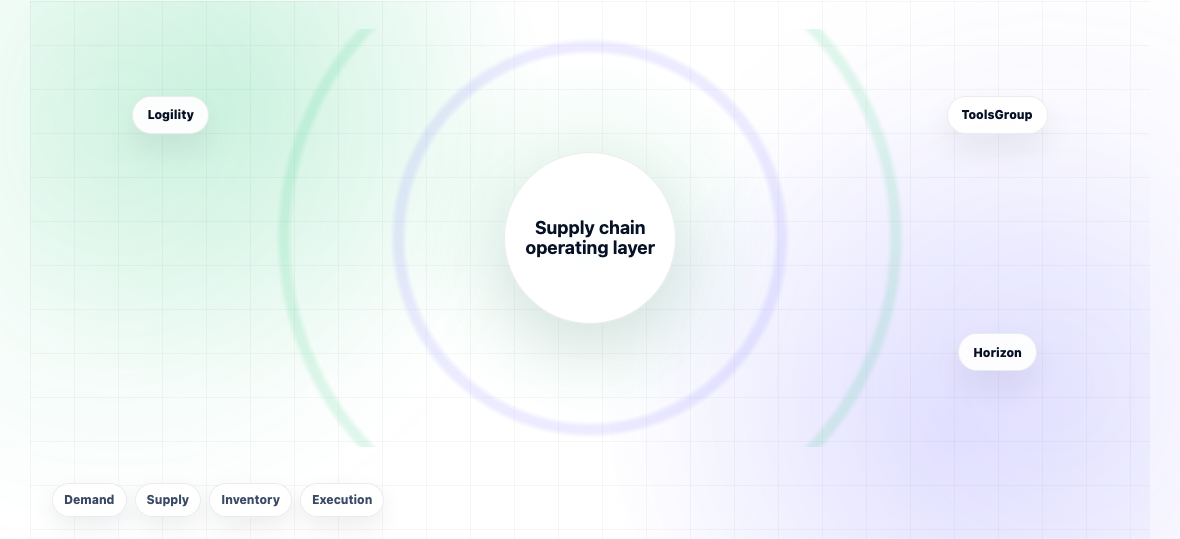
The most consequential mid-market SCP decision isn't enterprise vs mid-market — it's which mid-market approach fits best. The mid-market category includes integrated platforms (Logility, Horizon, RELEX, John Galt) and specialist platforms (ToolsGroup, Flowlity) with different architectural approaches. Picking the wrong approach within mid-market costs less operationally than picking enterprise-at-mid-market-scale, but still represents 5-7 year commitments.
The Logility vs ToolsGroup decision typically comes down to integrated vs specialist. Adding Horizon adds a third dimension: modern integrated architecture with decision execution. The alternatives below distinguish by which approach fits which buyer.

Best fit: mid-market manufacturers ($100M-$3B) wanting established integrated SCP with longest mid-market category presence. Strong in CPG, packaged food, consumer goods.
Best fit: mid-market and enterprise operations wanting probabilistic forecasting and inventory optimization specialty. Strong in operations with significant intermittent or lumpy demand (aftermarket, specialty parts, long-tail SKUs).
Best fit: mid-market manufacturers ($100M-$3B) wanting modern integrated SCP with decision execution. Broader industry coverage across discrete, process, CPG, industrial, distribution modes.
Established mid-market integrated SCP. AI through Logility Expert Advisor (LEA) as workflow assistance. Mature feature set across demand, supply, inventory, S&OP.
Probabilistic forecasting and inventory specialty. Deep mathematical depth in non-normal demand distributions, stochastic service-level optimization. Standalone tool integrated with other planning systems.
Modern integrated SCP across demand, supply, inventory, scheduling. Ensemble forecasting with automatic per-SKU model selection (includes probabilistic methods). Decision execution layer proposes specific actions to planners.
Integrated platform across demand, supply, inventory, S&OP. Less depth in scheduling than dedicated APS specialists.
Demand forecasting and inventory optimization. Does not include supply planning, scheduling, or S&OP — integration with other tools required for full SCP.
Integrated platform across demand, supply, inventory, scheduling, S&OP/IBP. Single workspace for full SCP scope.
Typical mid-market deployment 9-15 months. Module-by-module pattern.
Typical deployment 8-16 weeks for focused scope. Integration with other planning tools adds time.
6-10 weeks per module. Full integrated platform typically 6-9 months.
Three-year TCO for mid-market: $1-2M.
Three-year TCO for focused scope: $400K-$900K. Full SCP scope requires additional tools, adding $500K-$1.5M.
Three-year TCO for mid-market: $700K-$1.5M for full integrated SCP.