o9 Solutions is one of the strongest AI-driven enterprise supply chain platforms — the only vendor named Customers' Choice in the 2025 Gartner Peer Insights Customers' Choice for Supply Chain Planning Solutions. The knowledge graph architecture supports AI reasoning across complex product-customer-channel-supplier relationships in ways that older planning architectures don't match. For $3B+ global enterprises with rich relational supply chain data and mature data engineering capability, o9 often fits well.
o9 fits less well in several common cases: mid-market manufacturers ($100M-$2B) where o9's enterprise cost and 12-24 month deployment exceed reasonable proportion to scale, operations without mature data engineering capability who can't feed the knowledge graph properly, companies whose primary planning needs are operational depth rather than AI sophistication, and SAP-centric environments where SAP IBP's native integration delivers more practical value.
This page is for buyers in those categories. The framing isn't whether o9 is "good" — it's genuinely strong for the customers it fits. The question is whether you're one of those customers.
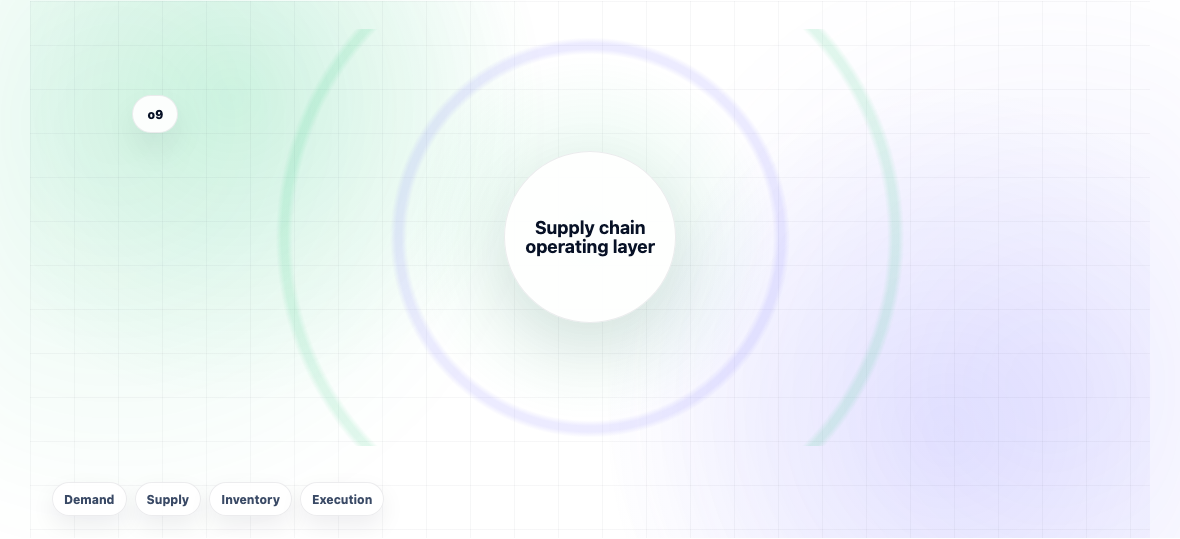
Horizon is positioned for mid-market manufacturers ($100M-$3B revenue) considering o9 because it appears on AI-focused analyst recommendations. For mid-market companies, Horizon often offers better fit on three dimensions: scale match, deployment timeline, and operational practicality.
Scale match: o9 is built for global enterprises with rich relational data and mature data engineering. Mid-market manufacturers typically have neither the relational complexity nor the data engineering capability to extract full o9 value. Horizon's ensemble forecasting and decision execution approach delivers AI value at mid-market scale without requiring equivalent data engineering investment.
Deployment timeline: o9 typically 12-24 months for full deployment due to knowledge graph construction and data engineering setup. Horizon's configuration-driven approach delivers 6-10 weeks per module.
Operational practicality: o9 produces analytical AI output that planners interpret and act on. Horizon's decision execution layer proposes specific actions for planners to approve, modify, or reject. The second approach is typically more valuable for mid-market planning teams without analyst capacity to translate insights into actions.
Where o9 still wins over Horizon: $3B+ global enterprises with mature data engineering capability, rich product-customer-channel-supplier relationships, and complex operations where knowledge graph reasoning delivers real value. For those buyers, we'd recommend o9 in early conversations rather than pursue mis-fit deals.
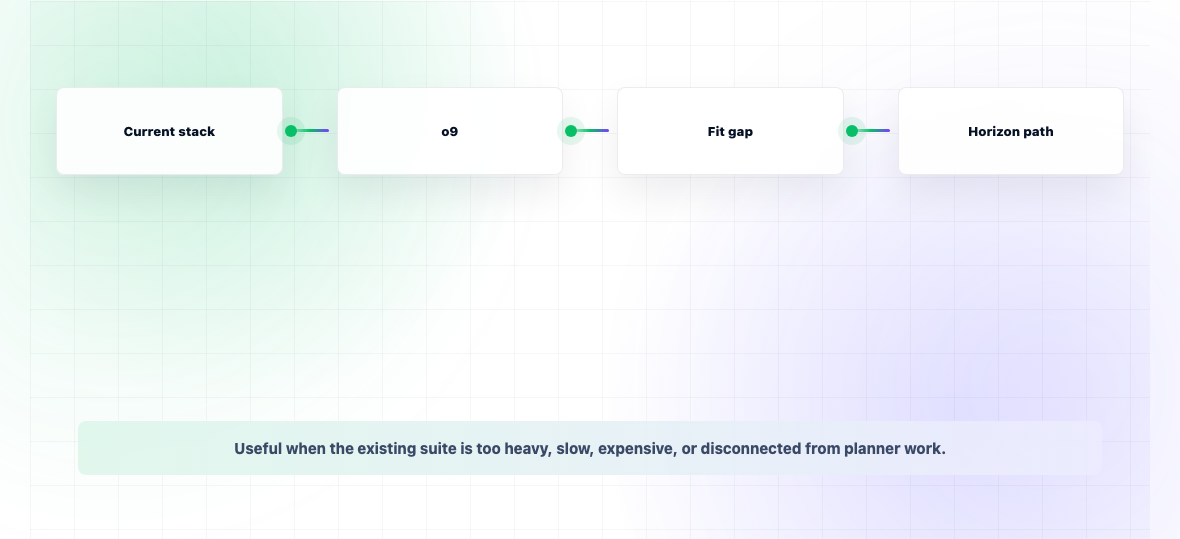
o9's knowledge graph architecture is genuinely powerful but requires significant data engineering investment to deliver its potential value. Companies with mature data engineering capability (data lakes, ETL pipelines, master data discipline, cross-system data quality programs) typically extract substantial value from o9. Companies without this capability typically use a smaller fraction of platform potential — often 30-50% of what o9 can theoretically do.
The implication: o9 alternatives evaluation often comes down to whether your organization has the data engineering capability to operationalize o9's knowledge graph approach. If yes, o9 often wins. If no, simpler architectures (Horizon's ensemble forecasting, Logility's integrated platform, Kinaxis's concurrent planning) often deliver more value because they don't require equivalent data engineering investment to operationalize. The alternatives below distinguish by which approach fits which organizational profile.
Why considered as o9 alternative: AI-driven planning at mid-market scale with configuration-driven deployment in 6-10 weeks per module. TCO typically 50-70% lower than equivalent o9 deployment.
Strengths versus o9: Mid-market-scaled licensing and deployment. Decision execution layer proposes specific actions rather than producing analytical output for planners to interpret. Doesn't require equivalent data engineering investment to deliver value.
When o9 still wins: $3B+ global enterprises with mature data engineering capability and rich relational data where knowledge graph reasoning delivers genuine operational advantage.
Mid-market integrated SCP with AI through Logility Expert Advisor. Lower data engineering requirement than o9.
Strong for mid-market CPG and retail-heavy operations needing AI-driven demand sensing.
Concurrent planning architecture delivers value without requiring knowledge graph data engineering investment. 2026 Gartner MQ Leader.
Native SAP integration for SAP-centric enterprises. Mature reference base.
Established CPG and retail-heavy enterprise capability without o9's data engineering requirement.
Native SAP integration that o9 can't match. Best for $3B+ SAP S/4HANA enterprises.
Process industry depth that often exceeds o9 for chemicals, pharma, food and beverage. Named highest in 2026 Gartner Magic Quadrant for Process Industries.
Better fit when planning is owned by finance with connected planning across non-supply-chain functions.
Probabilistic methods integrated with inventory optimization as focused capability.
Probabilistic AI-driven planning for mid-market.
Three structured questions clarify whether o9 or alternatives fit better. First: does your organization have mature data engineering capability to feed o9's knowledge graph? If not, you'll use a fraction of the platform value. Second: does your scale justify enterprise platform cost? Mid-market ($100M-$3B) typically gets better value from mid-market integrated platforms. Third: are your planning needs primarily operational depth or AI sophistication? Operational depth alternatives often deliver more practical value than knowledge graph AI for companies whose data isn't ready.