o9 versus Anaplan is the comparison that emerges when enterprises evaluate AI-driven planning and connected planning approaches. Both deliver enterprise-scale planning but optimize for fundamentally different things: o9 for AI-driven supply chain planning through knowledge graph architecture; Anaplan for finance-led connected planning across multiple functions through Hyperblock modeling engine.
The decision usually reveals organizational realities about planning ownership rather than just feature preferences. Supply-chain-led organizations typically gravitate toward o9 because the platform is built around supply chain operational depth. Finance-led organizations typically gravitate toward Anaplan because the platform fits connected planning across non-supply-chain functions.
o9 vs Anaplan is enterprise comparison. For mid-market manufacturers ($100M-$3B) with supply-chain-led planning, neither platform typically fits well. o9 is over-scaled and over-demanding on data engineering; Anaplan requires building supply chain operational logic from scratch.
Mid-market supply-chain-led alternatives that often fit better include Horizon (modern integrated supply-chain-native), Logility (established mid-market), and RELEX (retail/CPG-focused). These deliver supply chain operational depth at scale-appropriate cost. For mid-market companies with finance-led planning needs alongside supply chain, the complementary pattern (Anaplan for finance + mid-market integrated for supply chain) can work but adds complexity.
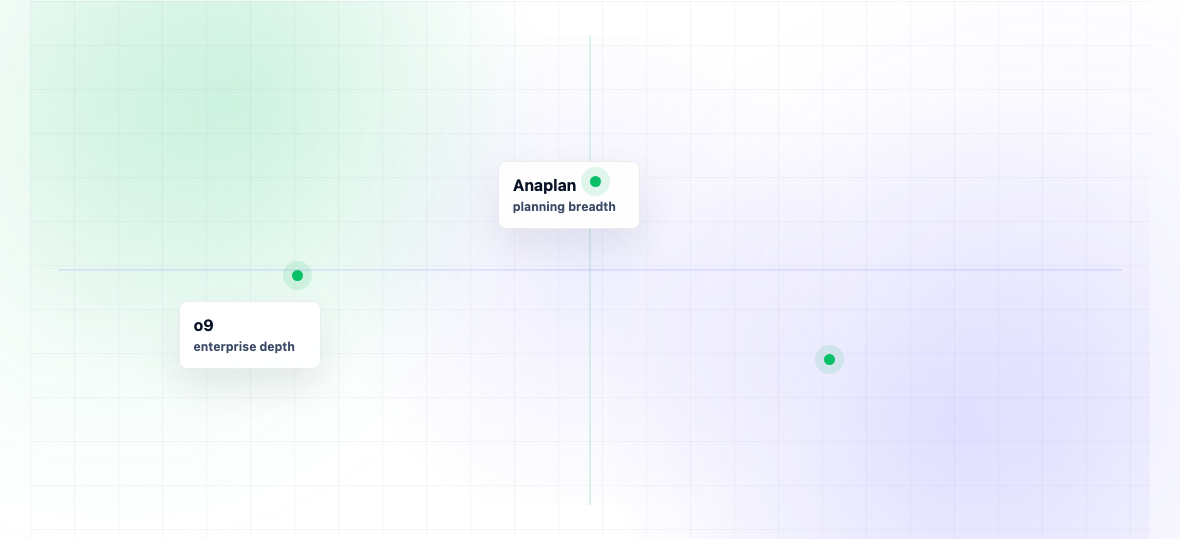
o9 and Anaplan don't compete on the same dimensions. o9 competes on supply chain operational depth with AI sophistication — knowledge graph reasoning, demand sensing, supply variability prediction, integrated planning across functions. Anaplan competes on modeling flexibility across functions — Hyperblock engine for real-time multi-dimensional modeling that supports finance, supply chain, sales, HR planning together.
For supply-chain-led organizations needing operational depth, o9 typically wins. For finance-led organizations needing connected planning across functions, Anaplan typically wins. Companies trying to use Anaplan for supply-chain-led operational planning typically struggle (modeling-first approach requires building supply chain logic from scratch). Companies trying to use o9 for finance-led connected planning typically struggle (supply-chain-native architecture doesn't optimize for connected modeling across non-supply-chain functions).
Best fit: $3B+ global enterprises with rich relational supply chain data, mature data engineering capability, and supply-chain-led planning. Customers' Choice in 2025 Gartner Peer Insights.
Best fit: finance-led planning organizations across enterprise and upper mid-market. Companies where finance owns planning rhythm and connected planning across functions delivers more value than supply chain operational depth.
Knowledge graph architecture with AI/ML embedded throughout. Supply chain entities and relationships modeled explicitly. Native supply chain operational depth — demand sensing, supply variability prediction, inventory optimization, scheduling.
Hyperblock calculation engine for real-time multi-dimensional modeling. Modeling-first architecture — customers build planning structures matching their operating model. Supply chain operational logic typically modeled by customer rather than provided natively.
High supply chain operational depth (native demand/supply/inventory/scheduling capability). Lower modeling flexibility across non-supply-chain functions.
High modeling flexibility across functions. Lower supply chain operational depth (requires modeling).
Designed for supply-chain-led planning. Best when supply chain owns operational planning.
Designed for finance-led connected planning. Best when finance owns S&OP/IBP rhythm and planning extends across functions.
Requires mature data engineering for knowledge graph. Companies without dedicated data engineering extract 30-50% of value.
Less data engineering dependent. Modeling-first approach works on data accessible to planners.
Three-year TCO for $3B+ enterprise: $5-15M+.
Three-year TCO for $3B+ enterprise: $3-10M depending on connected planning scope.
Some large enterprises run both: Anaplan for finance-led connected planning, supply-chain-native platform (o9, SAP IBP, Kinaxis) for supply-chain-led operational planning. Works when governance is set up properly. For mid-market, typically over-engineered.