o9 versus SAP IBP is the comparison enterprise buyers face when evaluating modern AI-driven planning against established SAP-centric planning. Both target $3B+ enterprises but optimize for different things: o9 for AI-driven supply chain planning through knowledge graph architecture; SAP IBP for native SAP ecosystem integration with mature enterprise SCP.
The decision typically depends on SAP ecosystem investment and AI architecture preference. SAP-centric enterprises with mature S/4HANA deployment often find SAP IBP's native integration delivers more value than o9's AI sophistication. Enterprises prioritizing AI-driven planning with mature data engineering capability often find o9's knowledge graph approach delivers value SAP IBP's AI extensions can't match.
o9 vs SAP IBP is enterprise-scale evaluation. Both target $3B+ enterprises with TCO in $5-15M+ range. Mid-market manufacturers ($100M-$3B revenue) typically don't have the relational complexity (o9) or SAP ecosystem depth (SAP IBP) to extract enterprise platform value.
Mid-market integrated alternatives that often fit better: Horizon (modern integrated SCP with ensemble forecasting and decision execution at $700K-$1.5M three-year TCO), Logility (established mid-market with LEA AI), RELEX (retail/CPG-focused). These deliver supply chain planning at scale-appropriate cost with faster deployment.
If you're researching o9 vs SAP IBP but your scale is mid-market, consider whether enterprise complexity genuinely matches your operations before committing to enterprise platforms.
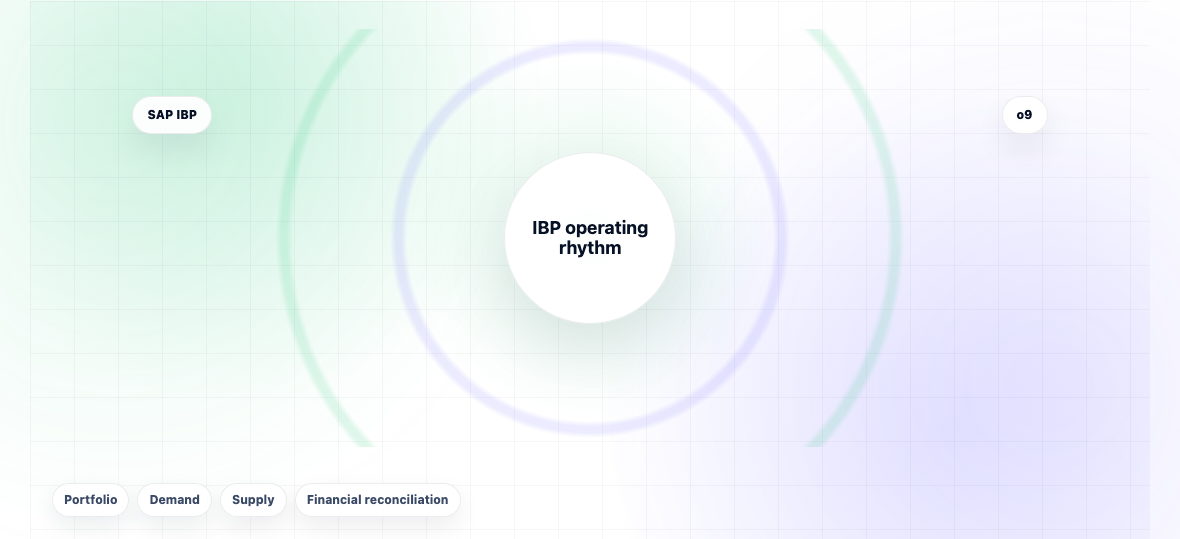
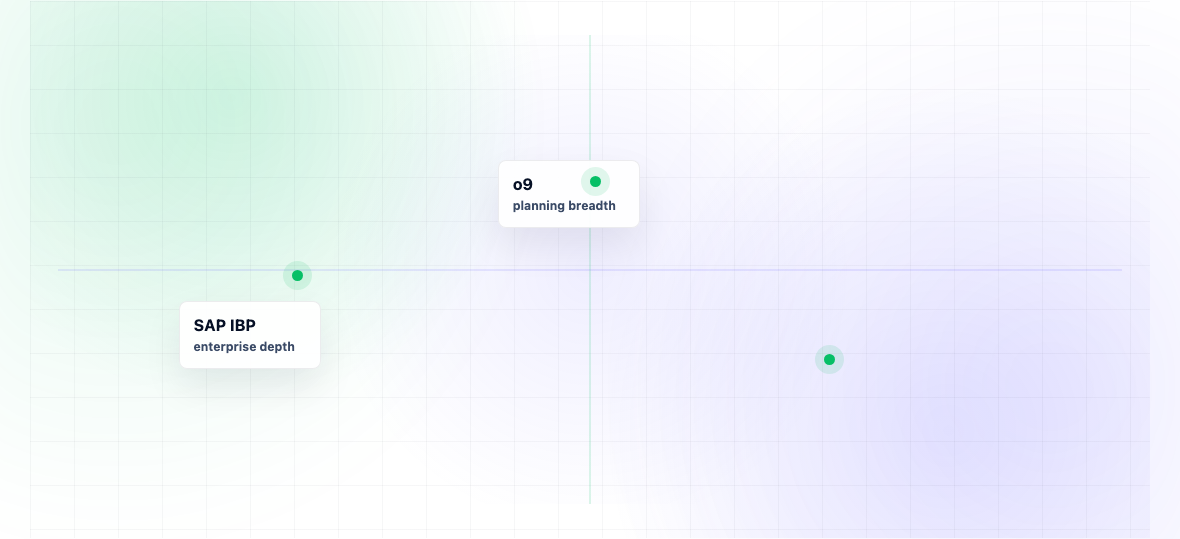
The biggest factor in o9 vs SAP IBP decisions is SAP ecosystem investment depth. Companies with mature S/4HANA, deep SAP financial systems integration, and broader SAP application footprint extract substantially more value from SAP IBP's native integration. The second factor is data engineering maturity: o9's knowledge graph requires mature data engineering to operationalize; SAP IBP's integration depth substitutes SAP ecosystem maturity for general data engineering.
The trade-off: SAP IBP optimizes for SAP integration; o9 optimizes for AI sophistication and modern architecture. Companies have to evaluate which dimension matters more — and recognize that the right choice often correlates with existing technology ecosystem rather than architectural preference alone.
Best fit: $3B+ global enterprises with rich relational supply chain data, mature data engineering capability, and AI-driven planning as strategic priority. Customers' Choice in 2025 Gartner Peer Insights.
Best fit: $3B+ SAP-centric enterprises running SAP S/4HANA with deep SAP ecosystem investment. Strong in pharma, chemicals, CPG, life sciences.
Knowledge graph architecture with AI/ML embedded throughout. Supply chain entities and relationships modeled explicitly, supporting AI reasoning across the graph.
Established enterprise SCP architecture with native SAP ecosystem integration. Mature financial integration through SAP FI/CO. AI capabilities added over time but not architecturally embedded the way o9's knowledge graph supports.
ERP-agnostic with mature integration patterns. SAP integration available but not native depth.
Native integration with SAP S/4HANA, SAP ECC, SAP financial systems, and broader SAP applications.
AI embedded throughout via knowledge graph foundation. ML for demand sensing, supply variability prediction, cross-entity pattern recognition.
AI capabilities added across modules. Less architecturally AI-driven than o9's knowledge graph approach.
Requires mature data engineering for knowledge graph. Companies without dedicated data engineering typically extract 30-50% of value.
Data engineering requirement focused on SAP integration depth rather than knowledge graph. SAP-centric companies fit this naturally.
Typical full deployment 12-24 months. Knowledge graph construction adds time.
Typical full deployment 12-24 months. Single module 6-9 months.
Three-year TCO for $3B+ enterprise: $5-15M+.
Three-year TCO for $3B+ enterprise: $5-15M+.
Both platforms over-scaled for mid-market. Mid-market integrated alternatives (Horizon, Logility, RELEX) deliver similar functional scope at 50-70% lower TCO.