If you're researching o9 versus SAP IBP, you're probably evaluating enterprise platforms for supply chain planning. Most three-way comparisons from vendors are self-serving, but the case for including Horizon here is genuine: a meaningful share of buyers researching o9 versus SAP IBP are actually mid-market manufacturers ($100M-$2B) considering enterprise platforms because they appeared on analyst recommendations — not because enterprise scale fits.
For those buyers, Horizon as a mid-market alternative is useful information. For buyers who are actually enterprise scale ($3B+ revenue, mature data engineering capability), both o9 and SAP IBP are better choices than Horizon, and this comparison should help you choose between them based on AI architecture preference and SAP ecosystem investment.
The framing throughout: when does o9 fit, when does SAP IBP fit, and when does neither fit because you're actually mid-market?
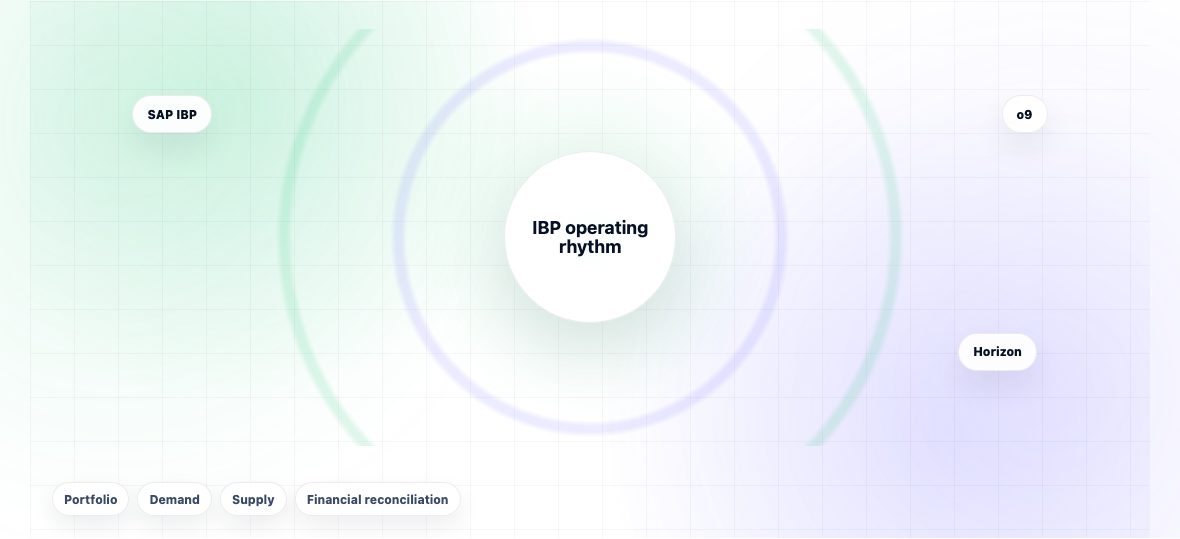
Horizon doesn't compete with o9 or SAP IBP at enterprise scale. Fortune 500 enterprises with $3B+ revenue, mature data engineering, and SAP ecosystem investment are better served by o9 (for AI/knowledge graph) or SAP IBP (for SAP-centric environments) than by Horizon. We're explicit about this.
Where Horizon competes effectively: mid-market manufacturers ($100M-$3B revenue) considering o9 or SAP IBP because they appeared on enterprise platform recommendations. For these companies, o9's knowledge graph approach typically delivers less value than at enterprise scale (insufficient relational complexity to exploit) and SAP IBP's enterprise scale is disproportionate to mid-market needs. Horizon delivers similar functional scope at scale-appropriate cost with faster deployment.
The decision framework: $3B+ with mature data engineering and AI priority → o9 fits, we don't pursue. $3B+ SAP-centric with S/4HANA → SAP IBP fits, we don't pursue. $100M-$3B mid-market → we'll show why Horizon typically fits better than enterprise platforms at your scale.
o9 and SAP IBP are both enterprise SCP leaders but optimize for different priorities. o9's strength is AI-driven planning through knowledge graph architecture — entities and relationships are modeled explicitly, allowing AI to reason across product-customer-channel-supplier dimensions. SAP IBP's strength is native SAP ecosystem integration with mature reference base across pharma, chemicals, and CPG industries.
For companies prioritizing modern AI architecture and willing to invest in data engineering to feed knowledge graph reasoning, o9 typically wins. For SAP-centric enterprises running S/4HANA with deep SAP financial ecosystem investment, SAP IBP typically wins through native integration. Both are credible enterprise choices for buyers in their target profiles.
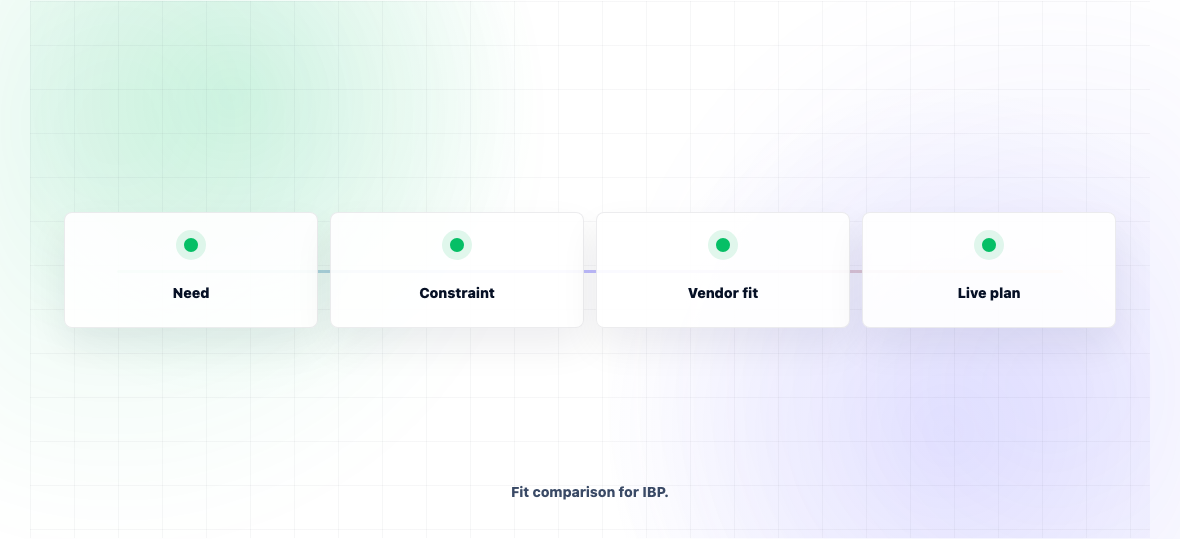
Best fit: $3B+ global enterprises with rich relational supply chain data and mature data engineering capability. Customers' Choice in 2025 Gartner Peer Insights for Supply Chain Planning Solutions.
Best fit: $3B+ SAP-centric enterprises running SAP S/4HANA with deep SAP ecosystem investment across ERP, financial systems, and adjacent platforms. Particularly strong in pharma, chemicals, CPG.
Best fit: mid-market manufacturers $100M-$3B revenue, 1-10 plants, 500-5,000 SKUs. Single platform across demand, supply, inventory, scheduling, IBP.
Knowledge graph architecture with AI/ML embedded throughout. Supply chain entities (products, customers, plants, suppliers) and relationships modeled explicitly, supporting AI reasoning across the graph.
Established planning architecture with deep SAP ecosystem integration. Strong financial integration, demand sensing, inventory optimization within SAP context. AI capabilities added over time.
Modern integrated planning sized for mid-market complexity. Ensemble forecasting with automatic per-SKU model selection. Decision execution layer proposes specific actions across the supply chain.
Requires mature data engineering capability to feed knowledge graph properly. Companies without dedicated data engineering team typically extract 30-50% of platform value.
Data engineering requirement focused on SAP integration depth rather than knowledge graph. Companies with mature SAP ecosystem fit this naturally.
Configuration-driven approach. Standard data integration patterns (ERP, point solutions) without knowledge graph data engineering requirement.
Typical full deployment 12-24 months. Knowledge graph construction and data engineering setup contributes significant time.
Typical full deployment 12-24 months. Single module deployment typically 6-9 months.
6-10 weeks per module. Full integrated platform typically live in 6-9 months.
Three-year TCO for mid-market: $3-6M. For Fortune 500: $5-15M+. Knowledge graph and data engineering investment contributes to upper range.
Three-year TCO for mid-market: $2-4M. For Fortune 500: $5-15M+.
Three-year TCO for mid-market: $700K-$1.5M. 50-70% lower than o9 or SAP IBP at mid-market scale.