Reducing inventory without causing stockouts is mathematically possible inventory and service levels are related, but they're not on a fixed 1-to-1 trade-off. Companies can reduce inventory and improve service simultaneously by addressing the structural causes of both excess and stockouts, which usually overlap. The same SKUs that cause stockouts often hold excess inventory at the wrong time; the same SKUs with chronic excess often face occasional stockouts.
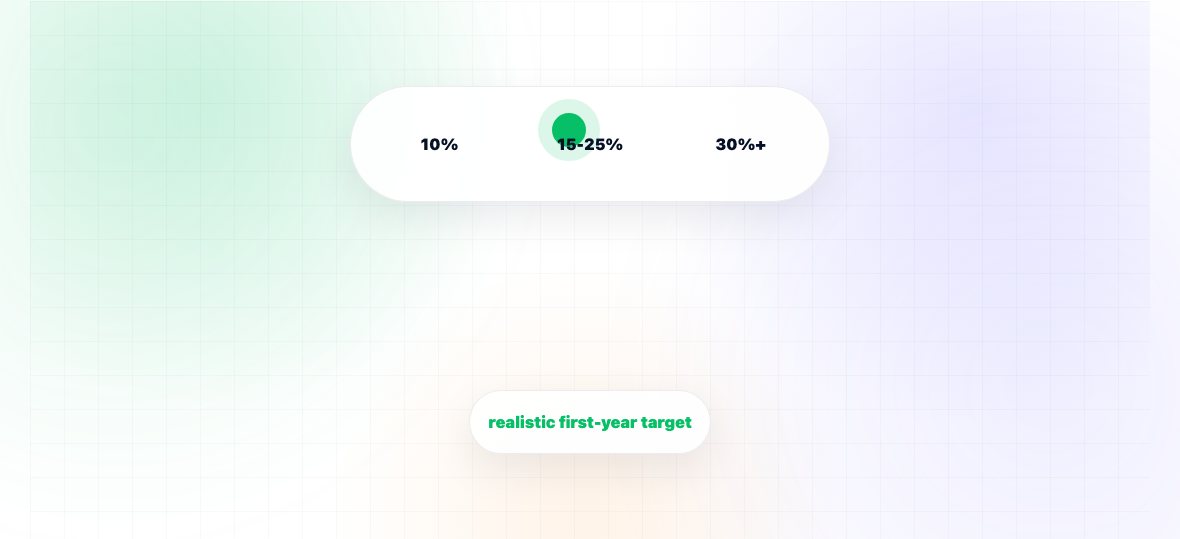
This page covers six specific methods that, in our experience, deliver real working capital release without service degradation. They're ordered roughly by impact and by sequence earlier methods unlock the later ones. A realistic expectation: companies starting from rule-of-thumb inventory policies typically see 15-25% inventory reduction over 12-18 months while maintaining or improving service. The methods compound; no single method delivers the full gain.
Horizon's inventory module supports each of the six methods. SKU segmentation runs automatically using configurable ABC/XYZ classification with per-segment policy templates. Differential policies (different service levels, different safety stock formulas, different review cadences per segment) execute without manual reconfiguration as SKUs change segments.
Forecast accuracy improvements from the demand planning module flow directly into safety stock calculations accuracy gains automatically translate to inventory reductions in the next cycle. MEIO runs across multi-location networks, with risk pooling math at upstream nodes.
Lead time variability is computed from historical receipt data and used in safety stock calculations. Companies with unreliable lead times see this in their inventory math Horizon surfaces which suppliers contribute most to safety stock through lead time variability, which informs supplier conversations.
For postponement and SKU rationalization, Horizon supports both. Postponement models can be configured at the network level (e.g., hold undifferentiated inventory at the central DC, differentiate at regional DCs). SKU rationalization analysis surfaces low-contribution SKUs that may be candidates for elimination.
Policy discipline is supported through monthly variance reporting actual vs target inventory per SKU, with exception flagging when variances exceed thresholds. Without policy discipline, optimization gains erode. With it, gains compound.
The honest expectation: deploying Horizon doesn't automatically deliver all six methods on day one. Methods 1-3 (segmentation, forecast accuracy, MEIO) typically deliver within the first 6-9 months. Methods 4-6 (lead time, postponement, discipline) take longer because they involve process and organizational change, not just analytical change.
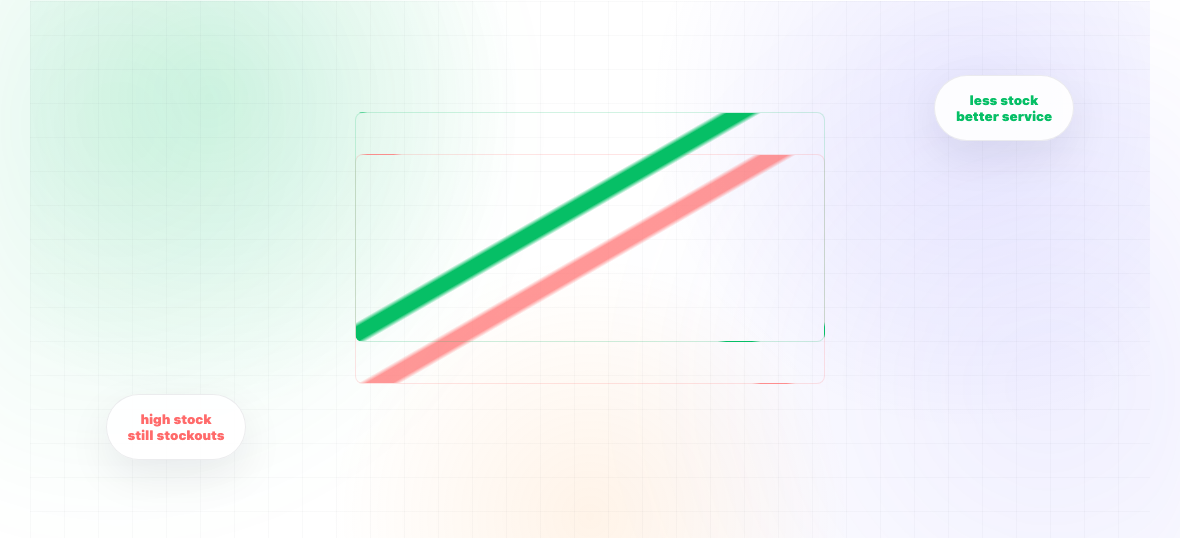
Most inventory discussions frame the choice as "lower inventory or better service pick one." This is true if everything else is held constant. But inventory and service are both downstream consequences of upstream conditions: forecast accuracy, network design, lead time reliability, SKU portfolio complexity. Changing those upstream conditions changes the trade-off curve itself companies can move to a curve where both inventory and service improve simultaneously.
The companies that achieve simultaneous improvement aren't doing magic. They're systematically addressing the structural conditions that produce both excess and stockouts. Often the same SKU is excess for 9 months and stockout for 2 months in a year meaning the average inventory is high while occasional stockouts still happen. Fixing the structural cause (typically forecast bias, wrong segmentation, or single-echelon thinking) reduces both the excess and the stockouts simultaneously.
The methods below are the structural interventions that move companies onto a better trade-off curve. Each method addresses a specific cause of inefficient inventory; combined, they typically deliver the 15-25% reduction with improved service that companies often consider impossible.

Apply different inventory policies to different SKU segments rather than uniform policies across the portfolio. A SKUs (top revenue contributors) get high service targets and tight policies. C SKUs (long tail) get efficient policies that may accept occasional stockouts in exchange for low average inventory.
The mechanism: most companies hold the same buffer (in weeks of cover) for every SKU. This over-stocks low-volume SKUs (where holding 6 weeks of cover for a slow mover is excessive) and may under-stock high-volume SKUs (where 6 weeks may not be enough variability protection). Differentiated policies reduce both excess on slow movers and stockouts on fast movers.
Typical impact: 10-15% inventory reduction on the tail, modest service improvement on top SKUs.
Better forecasts mean lower required safety stock at the same service level. The safety stock formula scales directly with demand standard deviation every percentage point of accuracy improvement allows a proportional safety stock reduction.
Worked example: SKU with mean demand 1,000/week, MAPE 25%. Standard deviation roughly 250. Safety stock at 95% service ≈ 1.65 × 250 × √(3 weeks lead time) = 715 units. Improve MAPE to 18%. New std dev roughly 180. New safety stock = 1.65 × 180 × √3 = 514 units. Safety stock drops 28% at the same service level, just from accuracy improvement.
Typical impact: 5-15% inventory reduction from forecast accuracy gains in the first year.
For multi-location networks, MEIO exploits risk pooling at upstream nodes to reduce total network inventory. Demand variability across multiple locations is partially uncorrelated, so the total inventory needed across the network is less than the sum of independent location-level calculations.
Typical impact: 15-25% network inventory reduction in multi-DC operations.
Safety stock scales with the square root of lead time. Reducing lead time directly reduces required safety stock. Reducing lead time variability matters even more many companies hold safety stock primarily to protect against unreliable supplier lead times rather than demand variability.
Worked example: SKU with lead time 6 weeks ± 2 weeks variability. Safety stock includes a substantial buffer for lead time uncertainty. Stabilize the lead time to 6 weeks ± 0.5 weeks (through supplier agreements, monitoring, or alternative sourcing). Safety stock for lead time variability drops dramatically. Common result: 10-20% safety stock reduction from lead time reliability alone.
Typical impact: 10-15% inventory reduction in companies where lead time variability had been a major contributor.
Hold inventory in less-differentiated form as long as possible, then differentiate close to demand. The classic example: hold base product, customize for specific markets at the DC rather than at the plant. Inventory carried in undifferentiated form is more flexible it can serve any market and benefits from risk pooling across markets.
SKU rationalization complements postponement. Reducing the number of SKUs (eliminating slow movers, consolidating variants) reduces the total inventory pool. Companies often discover that 20-30% of SKUs contribute <2% of revenue and can be rationalized.
Typical impact: 8-15% inventory reduction, varies by business model.
The methods above produce optimized inventory levels. Maintaining them requires operational discipline: actually executing against the policies, refreshing policies as conditions change, monitoring the gap between policy and actual inventory.
The pattern in many companies: inventory levels drift up over time even after optimization, because operational decisions (build-aheads, opportunistic buys, "just in case" overrides) accumulate. Without discipline, the gains from one-time optimization erode.
The mechanism: monthly tracking of actual vs target inventory per SKU, with exception management for SKUs significantly off target. Continuous refinement of policies as demand and lead time patterns change.
Typical impact: Preserves the gains from other methods. Without policy discipline, 30-50% of one-time gains typically erode within 18 months.
Companies starting from rule-of-thumb inventory typically sequence the methods this way: