SAP IBP is the default supply chain planning choice for SAP S/4HANA customers, particularly large enterprises with significant SAP investment across ERP, financial systems, and adjacent platforms. For that profile, IBP often is the right answer — native integration depth, established reference base in pharma/chemicals/CPG, and mature workflow templates for S&OP and IBP rhythms make it a strong fit despite the implementation cost and timeline.
SAP IBP fits less well in several common cases: companies that aren't on S/4HANA and don't plan to migrate, mid-market manufacturers ($100M-$3B) for whom the implementation timeline (12-24 months) and TCO ($1M+ annually) don't match their scale, companies wanting modern architecture rather than the slower SAP innovation cadence, and companies whose primary need is operational depth rather than financial integration. This page is for buyers in those categories who are looking for alternatives.
The honest framing: this isn't about whether SAP IBP is "good" or "bad" — it's about whether it fits your specific operational and IT context. The alternatives below are evaluated on the same basis.
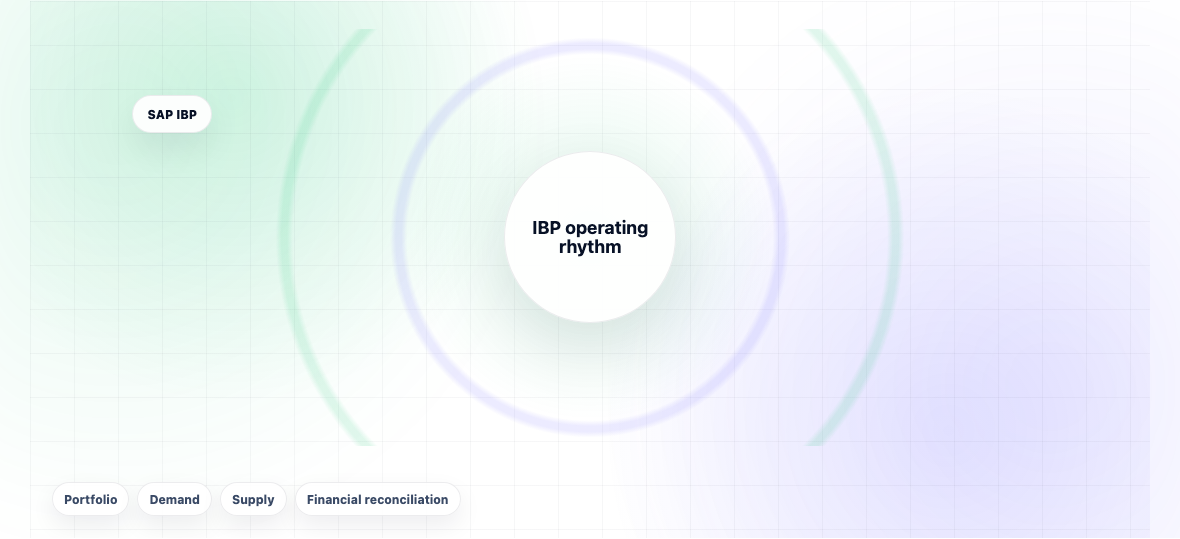
Horizon is positioned for mid-market manufacturers ($100M-$3B revenue) who are looking at SAP IBP either because they're SAP ERP customers or because IBP appears on every analyst shortlist. For these companies, Horizon often offers better fit on three dimensions: scale match, deployment timeline, and modern architecture.
Scale match: SAP IBP is built for enterprises that use the full breadth of the platform. Mid-market manufacturers typically use 30-40% of IBP's capability, which means the cost-to-value ratio is poor. Horizon is built specifically for the mid-market scale — feature breadth matches what mid-market planning teams actually need.
Deployment timeline: SAP IBP deployments typically run 12-24 months. Horizon deploys in 6-10 weeks per module — demand planning, supply planning, inventory optimization, scheduling, and IBP can be live in 6-9 months total. For companies where executive sponsorship is time-bounded (the new COO has 18 months to show results), Horizon's timeline matches the sponsorship horizon.
modern architecture: SAP IBP has added AI capabilities over time but the core architecture is older. Horizon's forecasting uses ensemble methods with automatic per-SKU model selection from the ground up. Decision execution proposes specific actions to planners — different from SAP IBP's report-and-let-planners-decide approach.
Where SAP IBP still wins over Horizon: top-20 global enterprises with deep SAP financial integration requirements, companies whose planning needs extend significantly beyond mid-market complexity, and operations whose SAP ecosystem investment makes IBP's native integration uniquely valuable. For those companies, IBP is often the right answer — and we'll say so explicitly in early conversations rather than pursue mis-fit deals.
SAP IBP implementations typically run $2-7M total cost over the first three years (license, implementation, integration, internal team, ongoing consulting). For a mid-market manufacturer where that represents 5-15% of supply chain operating budget, the platform decision deserves real evaluation rather than defaulting to whatever the SAP account team recommends.
The most common pattern in misfit SAP IBP deployments: mid-market companies that bought IBP because they were SAP customers, then spent 18-24 months in implementation, ended up using 30-40% of the platform capability, and would have been better served by a mid-market integrated platform at one-third the TCO with faster deployment. This is not SAP's fault — it's a misfit between platform scale and company scale. Evaluating alternatives identifies whether the mismatch applies to your situation.
The platforms below are categorized by the type of buyer they typically serve better than SAP IBP. Identify which category fits your situation, then evaluate 2-3 platforms within that category.
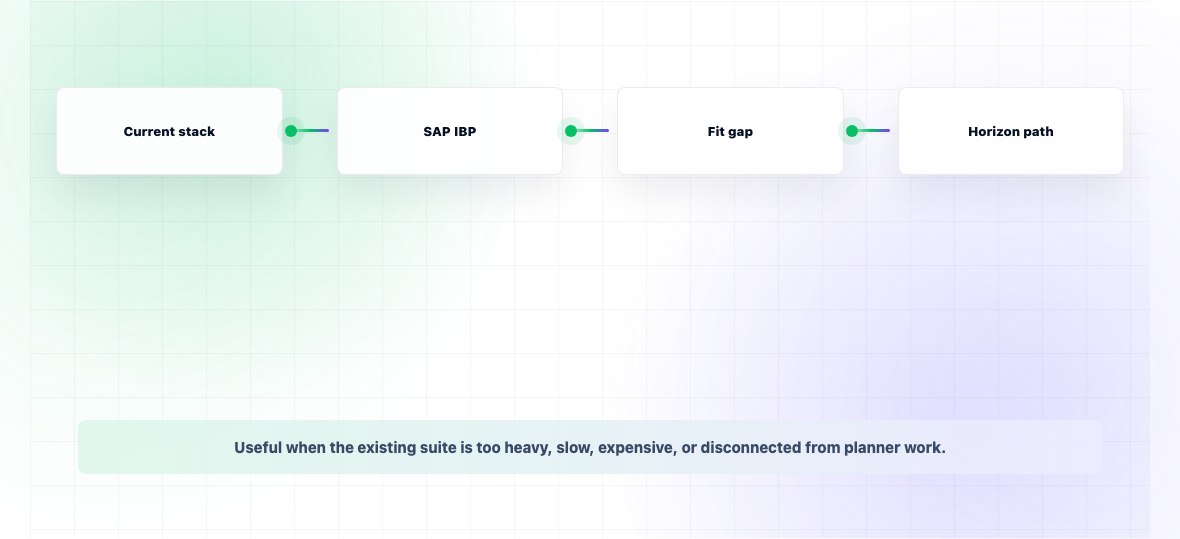
This is the most common category of buyers looking at SAP IBP alternatives. The companies typically have SAP ECC or S/4HANA but are not large enough to justify enterprise IBP implementation cost and timeline.
Why considered as SAP IBP alternative: Integrated platform covering demand, supply, inventory, scheduling, and IBP in one workspace at mid-market scale. Native financial integration supports IBP rhythm without enterprise complexity. Deployment in 6-10 weeks per module versus 12-24 months. TCO typically 50-70% lower than equivalent SAP IBP deployment.
Strengths versus SAP IBP: Faster deployment. modern architecture with automatic per-SKU model selection and decision execution layer. Integration with SAP ERP (both ECC and S/4HANA) is straightforward — Horizon doesn't require migration to S/4HANA. Configuration-driven rather than custom-developed.
When SAP IBP still wins: Companies with seven-figure planning budget, mature SAP ecosystem across financial systems, and a clear path to global multinational complexity.
Why considered as SAP IBP alternative: Concurrent planning architecture for companies wanting enterprise-class capability without SAP lock-in.
Strengths versus SAP IBP: Concurrent calculation across demand-supply-inventory faster than IBP's batch-style updates. Less coupled to SAP ecosystem.
When SAP IBP still wins: Companies with deep SAP financial integration requirements.
Why considered as SAP IBP alternative: modern architecture for companies wanting modern ML/AI approach.
Strengths versus SAP IBP: Knowledge graph approach and deeper AI/ML embedding. More flexible data model.
When SAP IBP still wins: Companies where SAP integration depth matters more than AI capability.
ensemble forecasting with automatic per-SKU model selection, decision execution layer that proposes specific actions to planners. NVIDIA Inception membership reflects the AI investment.
Enterprise AI architecture with knowledge graph approach. Best fit for large enterprises with mature data engineering.
Probabilistic AI-driven planning. Best as a focused capability rather than a full SAP IBP replacement.
Native fit for Oracle ERP customers. Named a Leader in 2026 Gartner Magic Quadrant.
ERP-agnostic, particularly strong in retail-heavy operations.
ERP-agnostic, with mature integration patterns across SAP, Oracle, Microsoft Dynamics, and others.
ERP-agnostic for mid-market. Mature integration patterns with NetSuite, SAP, Microsoft Dynamics, Oracle, and custom ERPs.
Process-industry depth that's often better than SAP IBP for chemicals, pharma, food and beverage operations. Named highest in 2026 Gartner Magic Quadrant for Process Industries.
Better fit when IBP is owned by finance rather than supply chain. Best as a planning layer over operational tools.
Unified planning across finance and operations. Best when corporate performance management is the primary need.
Three structured questions help identify whether SAP IBP or an alternative fits better. First: would you implement SAP IBP if you weren't already an SAP ERP customer? If the answer is "probably not," the SAP ERP integration is the primary driver — and alternatives with mature SAP integration may serve nearly as well. Second: what percentage of SAP IBP's capability will you actually use? If realistic estimate is under 50%, you're likely over-buying. Third: how much value do you place on faster deployment? Mid-market companies that need to deliver value within 6-9 months often find alternatives compelling because SAP IBP's 12-24 month timeline pushes value realization beyond the typical executive sponsorship window.