SAP IBP versus Blue Yonder is the comparison that emerges when CPG and retail-heavy enterprises evaluate enterprise platforms. Both serve large CPG operations effectively but optimize for different things: SAP IBP for native SAP ecosystem integration; Blue Yonder for CPG-specific depth and execution platform integration.
The decision typically depends on SAP ecosystem investment depth and CPG specialization needs. SAP-centric CPG enterprises with mature SAP investment often find SAP IBP delivers value through native integration that Blue Yonder's ERP-agnostic approach can't match. CPG enterprises with mature retail relationships and trade promotion management needs often find Blue Yonder's industry-specific depth more valuable than SAP integration breadth.
SAP IBP and Blue Yonder both target $3B+ enterprises. For mid-market CPG manufacturers ($100M-$3B revenue), both platforms are typically over-scaled — TCO and implementation timelines disproportionate to mid-market scale.
Mid-market CPG alternatives that often fit better: RELEX (strong retail-heavy CPG focus, particularly European), Horizon (broad CPG plus other industries, decision execution layer, faster deployment), Logility (established mid-market CPG with longest category presence). Three-year TCO for mid-market integrated SCP typically $700K-$2M.
For genuine enterprise buyers, this comparison helps clarify SAP ecosystem investment versus CPG industry specialization as the primary decision factor.
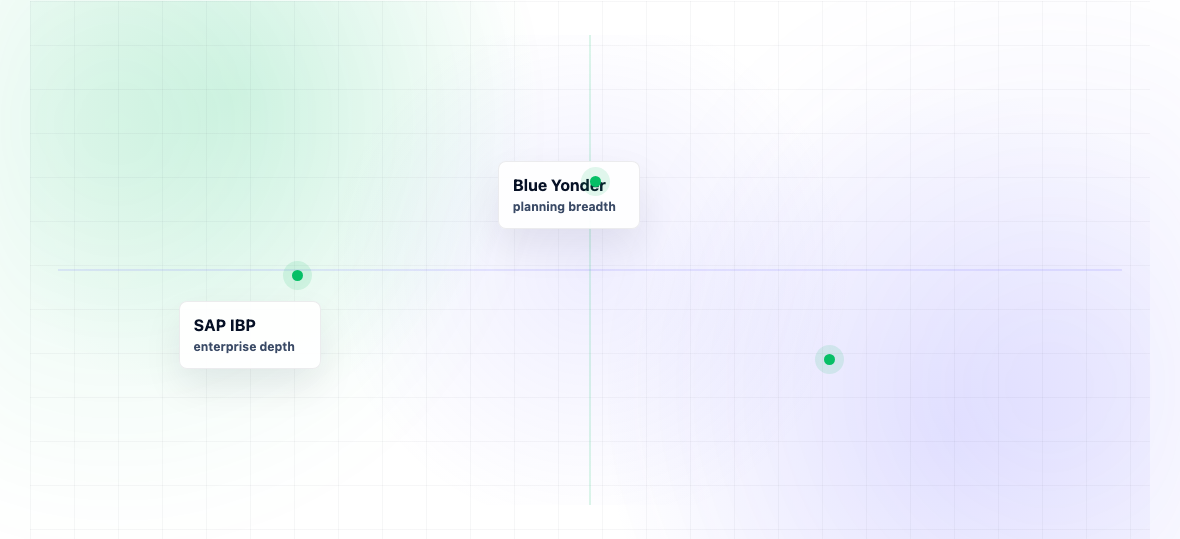
For SAP-centric CPG enterprises, both factors come into play. SAP IBP delivers native financial integration, master data integration, and ecosystem-wide consistency. Blue Yonder delivers retail point-of-sale integration, trade promotion management, store-level replenishment, and execution platform integration that SAP IBP doesn't match natively.
The trade-off: SAP IBP optimizes for SAP integration breadth; Blue Yonder optimizes for CPG industry specialization. Companies have to evaluate which dimension matters more for their operations, and recognize that neither platform fully delivers the other's strengths.
Best fit: $3B+ SAP-centric enterprises running SAP S/4HANA with deep SAP ecosystem investment. Strong in pharma, chemicals, CPG, life sciences.
Best fit: $3B+ CPG, packaged food, beverage, and retail-heavy manufacturers with significant retail channel exposure. 2026 Gartner Magic Quadrant Leader.
Native SAP integration as primary differentiator. Mature enterprise SCP within SAP context. Strong financial integration through SAP FI/CO.
Luminate platform with CPG/retail-specific capabilities — retail-grade demand sensing, trade promotion management, retail point-of-sale integration, execution platform integration.
Native integration with SAP S/4HANA, SAP ECC, SAP financial systems, SAP CRM. Non-SAP integration possible but adds complexity.
ERP-agnostic. Works with SAP, Oracle, Microsoft Dynamics, custom ERPs. SAP integration available but not as deep as IBP's native approach.
CPG capability covers demand planning, supply planning, inventory optimization, S&OP/IBP. Trade promotion integration possible through SAP CRM. Retail-specific depth limited compared to Blue Yonder.
Deep CPG capability: trade promotion management, retail point-of-sale integration, store-level replenishment, retail execution coordination. Established CPG reference base.
Typical full deployment 12-24 months. SAP integration work can extend timeline for complex environments.
Typical full deployment 12-18 months. Single module 6-9 months.
Three-year TCO for $3B+ enterprise: $5-15M+.
Three-year TCO for $3B+ enterprise: $5-15M+.
Both platforms typically over-scaled for mid-market. Mid-market alternatives (Horizon, RELEX, Logility) deliver similar functional scope at 50-70% lower TCO.