SAP IBP versus Kinaxis is the most common enterprise supply chain planning comparison. Both are 2026 Gartner Magic Quadrant Leaders, both serve Fortune 500 manufacturers, both deliver integrated demand-supply-inventory planning at enterprise scale. The decision between them often takes 6-12 months of evaluation and represents $2-15M+ in three-year TCO commitments.
The two platforms optimize for different priorities: SAP IBP optimizes for native SAP ecosystem integration; Kinaxis optimizes for concurrent planning architecture across multi-ERP, multi-region operations. The right choice depends primarily on SAP ecosystem investment and architectural preference.
This page covers the comparison honestly with one additional note: a meaningful share of buyers researching this comparison are actually mid-market manufacturers considering enterprise platforms because they appeared on analyst recommendations. If you're under $3B revenue, neither SAP IBP nor Kinaxis may be the right fit — we'll cover that briefly at the end.
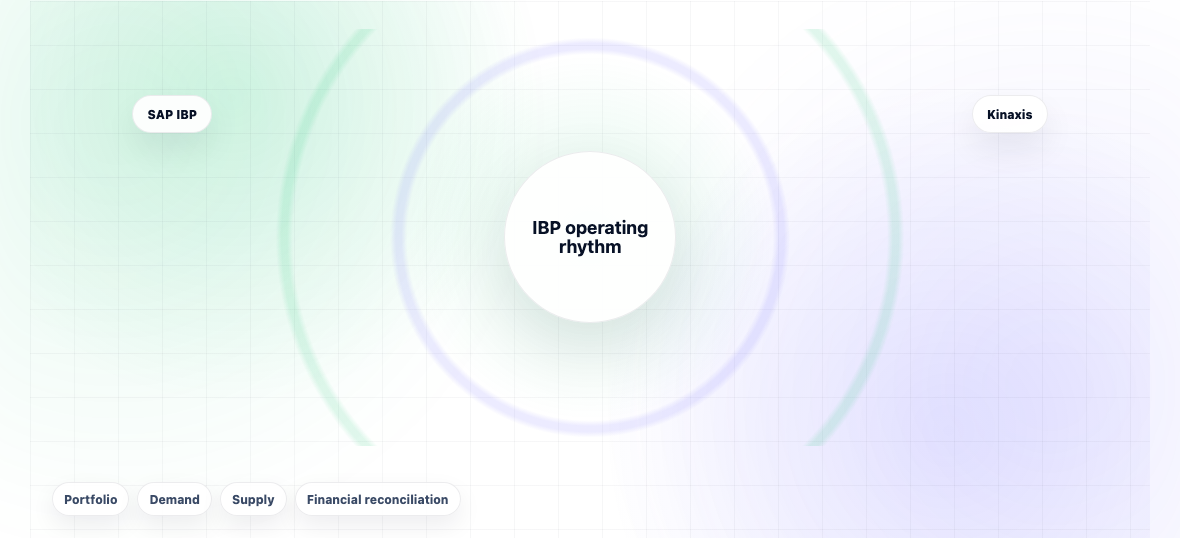
This comparison is primarily for $3B+ enterprises where SAP IBP and Kinaxis genuinely compete. For mid-market manufacturers ($100M-$3B revenue), both platforms are typically over-scaled — TCO and implementation timelines disproportionate to operational complexity.
Horizon serves mid-market manufacturers ($100M-$3B, 1-10 plants, 500-5,000 SKUs) with integrated SCP at scale-appropriate cost. Configuration-driven deployment in 6-10 weeks per module. Three-year TCO typically 50-70% lower than SAP IBP or Kinaxis at mid-market scale.
If you're researching SAP IBP vs Kinaxis but your actual scale is mid-market, we'd encourage evaluating mid-market alternatives alongside enterprise platforms. For genuine enterprise buyers, this comparison should help you choose between SAP IBP and Kinaxis based on SAP ecosystem investment and architectural preference.

The most consequential factor in SAP IBP vs Kinaxis decisions is depth of SAP ecosystem investment. Companies with mature S/4HANA deployment, deep SAP financial systems integration, and broader SAP application footprint typically extract substantially more value from SAP IBP's native integration than from Kinaxis's ERP-agnostic approach. Companies without that ecosystem depth typically extract similar value from either platform, with the choice coming down to architectural preference.
The second factor: operational complexity. Multi-ERP, multi-region operations benefit from Kinaxis's concurrent planning architecture. Single-ERP, regionally-focused operations benefit less from concurrent planning depth. This shifts the value calculation between platforms substantially.
Best fit: $3B+ SAP-centric enterprises running SAP S/4HANA with deep SAP ecosystem investment across ERP, financial systems (SAP FI/CO), CRM (SAP C/4HANA), and adjacent applications. Particularly strong in pharma, chemicals, CPG.
Best fit: $3B+ multinational manufacturers with multi-ERP, multi-region operations across automotive, electronics, aerospace, pharma, industrial. Concurrent planning architecture delivers value at global complexity.
Established enterprise SCP architecture with native SAP integration depth. Strong financial integration through SAP FI/CO, demand sensing, inventory optimization within SAP context. AI capabilities added over time.
Concurrent planning architecture. Single in-memory engine maintains all planning views (demand, supply, inventory) updating together in real time when changes happen. ERP-agnostic. Maestro AI layered on concurrent foundation.
Native integration with SAP S/4HANA, SAP ECC (legacy), and SAP applications. Non-SAP integration possible but adds complexity. Most value when SAP ecosystem dominates.
ERP-agnostic with mature integration patterns across SAP, Oracle, Microsoft Dynamics, NetSuite, and custom ERPs. Equal effort across ERP types.
Pharma, chemicals, CPG, life sciences. Strong mature reference base in regulated process industries.
Automotive, electronics, aerospace, pharma, industrial. Broad multi-industry reference base.
Typical full deployment 12-24 months. Single module deployment typically 6-9 months.
Typical full deployment 12-18 months. RapidStart accelerators can compress single-area deployment to 6 months.
Three-year TCO for $3B+ enterprise: $5-15M+. License typically $700K-$2M annually.
Three-year TCO for $3B+ enterprise: $4-12M. License typically $600K-$1.5M annually.
Companies under $3B revenue evaluating SAP IBP vs Kinaxis often find both platforms over-scaled for their needs. Mid-market manufacturers ($100M-$3B) typically use 30-40% of either platform's capability, paying enterprise pricing for capability they don't deploy. Mid-market integrated platforms (Horizon, Logility, RELEX) deliver similar functional scope at scale-appropriate cost with faster deployment. For the full picture across every major platform, including o9 and Anaplan, see our Best IBP Software 2026 breakdown by buying structure.