If you're researching SAP IBP versus Kinaxis, you're probably evaluating enterprise supply chain planning platforms. Most three-way comparison content from vendors is self-serving, but there's a genuine case for including ourselves here: a meaningful share of buyers researching SAP IBP versus Kinaxis are actually mid-market manufacturers ($100M-$3B revenue) considering enterprise platforms because they're the names that came up in research — not because enterprise scale genuinely fits.
For those buyers, Horizon as a mid-market alternative is genuinely useful information. For buyers who are actually enterprise scale ($3B+ revenue, multi-ERP, global operations), SAP IBP and Kinaxis are both better choices than Horizon, and this comparison should help you choose between them.
The framing throughout: when does SAP IBP fit, when does Kinaxis fit, and when does neither fit because you're actually mid-market and would be better served elsewhere?
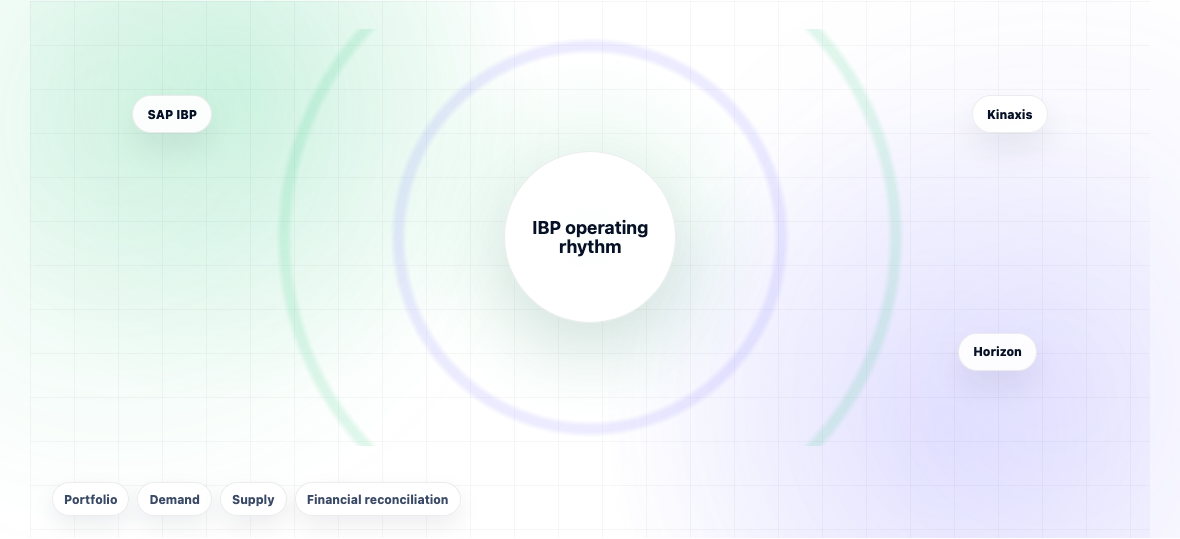
Horizon doesn't compete with SAP IBP or Kinaxis at enterprise scale. We're explicit about that: Fortune 500 global manufacturers with multi-ERP environments and seven-figure planning budgets are better served by SAP IBP or Kinaxis depending on their context. Mid-market companies that try to use SAP IBP or Kinaxis often end up using 30-40% of the platform capability at enterprise pricing — that's the mismatch this comparison is meant to surface.
Where Horizon competes effectively: mid-market manufacturers ($100M-$3B revenue) who are looking at SAP IBP or Kinaxis because they appear on every analyst recommendation list. For these companies, Horizon delivers similar functional scope (demand, supply, inventory, scheduling, IBP integrated) at scale-appropriate cost, faster deployment, and modern architecture.
The decision framework we use in early conversations: if you're $3B+ revenue with multi-ERP, multi-region complexity, we'll recommend SAP IBP or Kinaxis based on which fits your context better and won't pursue your deal. If you're $100M-$3B mid-market with 1-10 plants and 500-5,000 SKUs, we'll show you why Horizon typically fits better than enterprise platforms at your scale. If you're between those profiles (e.g., $2-4B revenue with growing complexity), we'll be honest about which platform is genuinely the better long-term fit even if it means recommending against ourselves.
The voice throughout: this isn't about whether SAP IBP or Kinaxis is "good" — they're both clearly good for the customers they fit. The question is whether you're one of those customers, or whether mid-market scale would be better served by mid-market-built platforms.
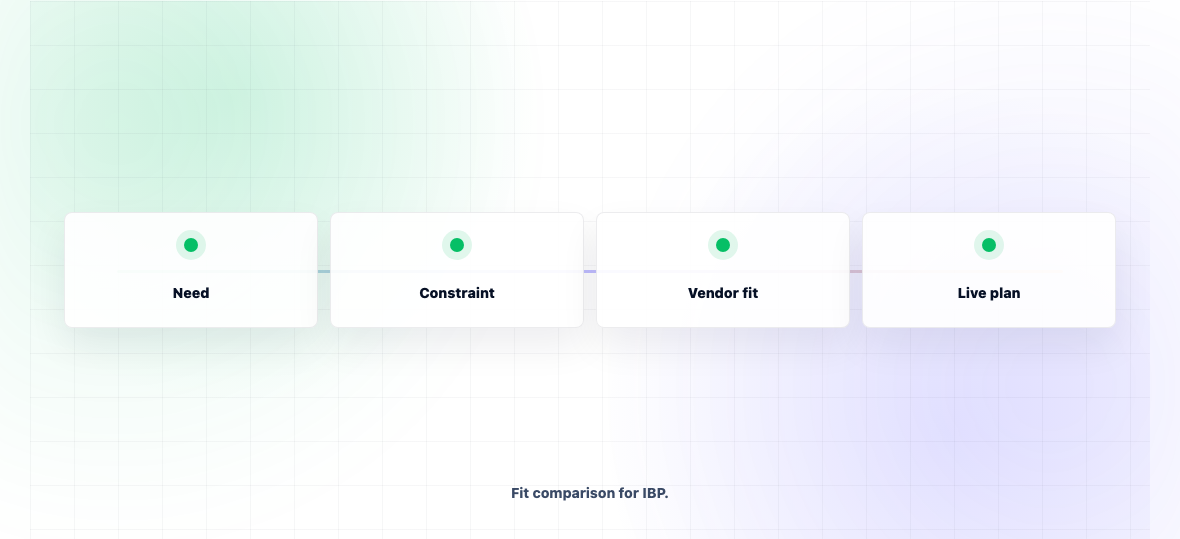
SAP IBP and Kinaxis are both significant platform commitments — typically $2-7M total cost over three years, 12-18+ month implementations, and 5-10 year operational commitments once deployed. Making the wrong choice between them isn't just budget waste — the operational disruption from migrating later costs multiples of the original implementation.
The other reason stakes are high: SAP IBP and Kinaxis target similar buyers but optimize for different things. SAP IBP optimizes for native SAP ecosystem integration and depth in pharma, chemicals, and CPG. Kinaxis optimizes for concurrent planning architecture across complex global operations. Buyers who don't recognize this distinction early often get to month 6 of evaluation before realizing one platform genuinely fits their context and the other doesn't.
For mid-market buyers stuck in this comparison because of analyst recommendations, the stakes are different again: spending 6 months evaluating two enterprise platforms when neither fits your scale is opportunity cost that compounds.

Best fit: large multinational manufacturers ($3B+ revenue) running SAP S/4HANA, particularly in pharma, chemicals, CPG, and consumer products. The native SAP ecosystem integration is the primary value driver — companies without significant SAP investment typically get less differential value from IBP.
Best fit: large multinational manufacturers ($3B+ revenue) with complex multi-ERP environments, particularly in automotive, electronics, aerospace, pharma. Concurrent planning architecture delivers most value when operations span multiple regions, multiple ERPs, and need real-time scenario evaluation. Named a Leader in 2026 Gartner Magic Quadrant for both Discrete and Process industries.
Best fit: mid-market manufacturers ($100M-$3B revenue), 1-10 plants, 500-5,000 active SKUs. Single platform across demand, supply, inventory, scheduling, and IBP. Not built for global multinational complexity or 50,000+ SKU portfolios.
Typical full deployment 12-24 months. Single module deployments (e.g., demand planning only) typically 6-9 months. Process maturation often takes another 12-24 months on top of platform deployment.
Typical full deployment 12-18 months. RapidStart accelerators can compress single-area deployment to 6 months for less complex operations. Multi-region deployments add 6-12 months per region.
6-10 weeks per module. Full integrated platform (demand, supply, inventory, scheduling, IBP) typically live in 6-9 months total. Configuration-driven rather than custom-developed.
Three-year TCO for a mid-market manufacturer: $2-4M (license $400-700K annually, implementation $700K-$1.5M, integration $300-500K, internal team, ongoing consulting). For Fortune 500 enterprises, $5-15M+ three-year TCO is common.
Three-year TCO for a mid-market manufacturer: $2.5-5M (similar structure). For Fortune 500 enterprises, $4-12M three-year TCO is common.
Three-year TCO for a mid-market manufacturer: $700K-$1.5M for the same functional scope — 50-70% lower than SAP IBP or Kinaxis.
Established planning architecture with AI capabilities added over time. Strong in financial integration, demand sensing, and inventory optimization within the SAP ecosystem. AI is configurable but not the foundational architecture.
Concurrent planning architecture is the differentiator — all planning views update together in real time when changes happen. Maestro AI adds AI capabilities to the concurrent planning foundation. Strong in scenario analysis and rapid re-planning.
modern architecture from the ground up. Ensemble forecasting with automatic per-SKU model selection. Decision execution layer proposes specific actions to planners rather than only producing reports. NVIDIA Inception membership reflects AI investment.
Mature depth in demand planning, supply planning, inventory optimization, S&OP, IBP. Strong financial integration. Pharma and chemicals industry depth particularly mature.
Mature depth across demand, supply, inventory, and scheduling. Strong concurrent planning capability. Automotive, electronics, and aerospace industry depth particularly mature.
Functional depth at mid-market scale across demand, supply, inventory, scheduling, distribution, and IBP. Feature breadth matches what mid-market planning teams actually use — typically 80-90% of platform capability deployed and used versus 30-40% typical for enterprise platforms used by mid-market.
Weighing more than these three? Our Best IBP Software 2026 guide compares the full IBP field — SAP IBP, Kinaxis, o9, Anaplan, and Horizon — by organizational structure rather than feature checklists.