Slimstock (Slim4) is one of the strongest distribution-focused supply chain platforms, particularly in European markets. Established distribution reference base across industrial distribution, MRO, electronics distribution, and wholesale. Strong replenishment workflow design. Native lead time variability handling. Inventory and demand planning integrated for distribution-specific patterns. For pure distribution and wholesale operations, Slimstock often delivers the strongest fit available.
Slimstock fits less well in several common cases: manufacturer-distributors who need integrated planning across both manufacturing and distribution operations, companies with significant manufacturing components requiring BOMs and routings, operations whose needs extend beyond distribution into broader supply chain planning, and US-heavy distribution operations where Slimstock's European reference base is less relevant.
This page is for buyers in those categories. Slimstock is genuinely strong for pure distribution — the question is whether pure distribution is what you actually do, or whether your operations include manufacturing or extended planning needs.

Horizon is positioned for mid-market manufacturer-distributors ($100M-$3B revenue) with operations spanning both distribution and manufacturing. The honest framing: for pure distribution operations, Slimstock often fits better than Horizon — the distribution-specific depth is genuinely deeper, and Horizon's manufacturing capabilities aren't relevant. We'd recommend Slimstock for pure distribution buyers.
Where Horizon fits better than Slimstock: operations with significant manufacturing components alongside distribution (light assembly, kitting, configure-to-order, value-added services, aftermarket parts manufacturing), companies needing integrated planning across both functions (so demand and supply for manufactured items coordinates with distribution planning), and mid-market operations with broader supply chain planning needs (S&OP/IBP rhythm, capacity planning, customer-specific B2B planning) beyond distribution-focused capability.
For both manufacturer-distributors and operations where the distinction is unclear, we'd encourage evaluation on actual operational scope rather than relying on company label. Companies that describe themselves as "distributors" but have 20%+ of revenue from any modification, assembly, or manufacturing typically benefit more from integrated platforms (Horizon) than from pure distribution specialists (Slimstock). Companies that describe themselves as distributors with truly no modification typically fit pure distribution specialists better.
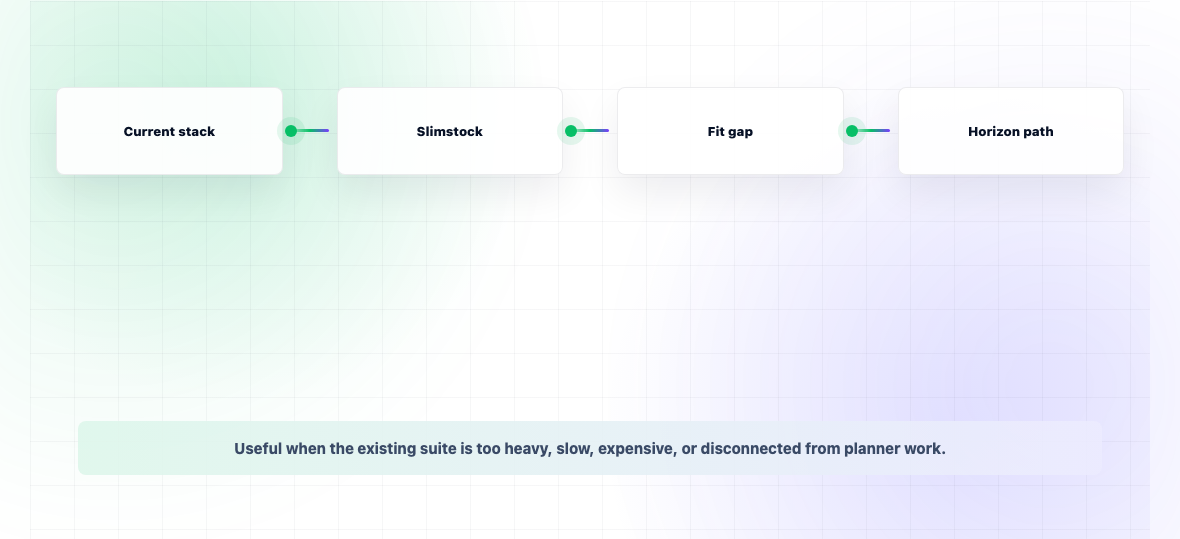
Slimstock's design center is pure distribution — buying, holding, and selling products without modification. The platform's depth in replenishment, lead time variability, and inventory-focused planning serves this pattern well. Companies whose operations match pure distribution typically get strong fit from Slimstock.
The challenge: many operations labeled "distribution" actually include manufacturing components — light assembly, kitting, configure-to-order, value-added services, or aftermarket parts manufacturing alongside pure distribution. For these manufacturer-distributors, pure distribution platforms struggle with the manufacturing side (BOMs, routings, finite capacity, multi-stage propagation). The alternatives below distinguish between pure distribution buyers (where Slimstock often wins) and manufacturer-distributor buyers (where integrated platforms typically fit better).
Why considered as Slimstock alternative: Integrated planning across distribution and manufacturing for mid-market operations $100M-$3B. Multi-echelon inventory with lead time variability handling (comparable to Slimstock for distribution) plus manufacturing capabilities (BOMs, routings, finite capacity scheduling) that Slimstock lacks.
Strengths versus Slimstock: Integrated manufacturing and distribution planning. Decision execution layer proposes specific actions across both manufacturing and distribution functions. Customer-specific demand modeling for B2B operations spanning multiple business lines.
When Slimstock still wins: Pure distribution operations without manufacturing components. Companies whose primary need is distribution-specific replenishment depth.
Mid-market integrated SCP with distribution and manufacturing capability.
Strong for distribution operations with retail channel exposure.
Distribution-focused mid-market alternative with strong US reference base. Often better US fit than Slimstock's European-heavy base.
Smaller distributor focus with combined demand and inventory.
SMB distribution and manufacturing replacing Excel for the first time. Different scale than Slimstock.
SMB cloud-based replenishment.
Enterprise distribution within SAP S/4HANA environments.
Enterprise distribution with strong execution integration.
Oracle ERP customers with enterprise distribution needs.
Probabilistic forecasting and inventory specialty. Different focus than Slimstock's distribution-workflow emphasis.
Three structured questions clarify whether Slimstock or alternatives fit better. First: are you a pure distributor or a manufacturer-distributor? Pure distribution often fits Slimstock or other distribution specialists best; manufacturer-distributors typically fit integrated platforms better. Second: what's your geographic concentration? Slimstock is strongest in European markets; US-heavy operations may get more from US-focused alternatives. Third: what's your scale? SMB distributors fit lighter specialists (Netstock, EazyStock); mid-market distributors fit Slimstock or integrated platforms; enterprise distribution fits SAP IBP, Blue Yonder, or Oracle.