Sales and Operations Planning (S&OP) and Integrated Business Planning (IBP) are cross-functional rhythms aligning demand, supply, inventory, financial, and strategic decisions. This guide covers the concepts that matter most for understanding modern S&OP/IBP practice.
The line between S&OP and IBP has blurred substantially. The concepts below apply to both, with notes where there are meaningful distinctions.
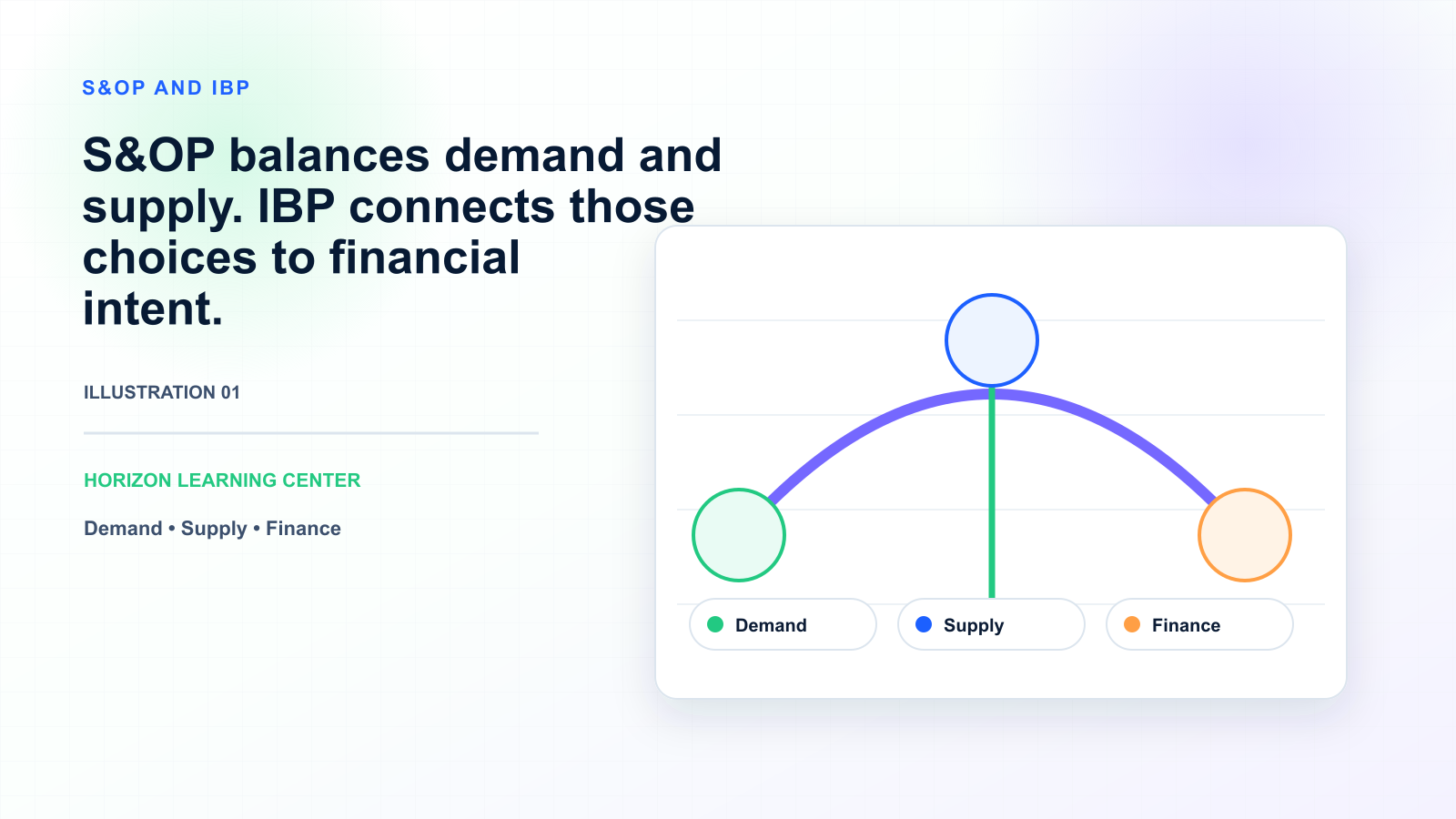
Mature S&OP/IBP applies these concepts together. The monthly rhythm with demand, supply, and executive reviews establishes governance structure. Financial reconciliation translates operational metrics to executive decision language. Scenario planning supports risk-aware decision-making. Decision execution tracking connects meeting decisions to operational follow-through. Governance clarity puts decisions at appropriate levels with appropriate authority.
Platforms support S&OP/IBP but don't deliver it. The organizational work — executive engagement, governance discipline, sustained commitment — is the real source of effectiveness. Horizon supports supply-chain-led S&OP/IBP at mid-market scale ($100M-$3B revenue) with integrated demand, supply, inventory, financial reconciliation, scenario planning, and decision execution tracking. Where Horizon doesn't optimize for: finance-led IBP with broader connected planning scope (Anaplan typically fits better), or enterprise IBP with complex multi-region governance (Kinaxis, SAP IBP, o9 typically fit better).
S&OP/IBP effectiveness depends on understanding these concepts. The difference between rhythms that drive decisions and rhythms that become status reporting traces to which concepts are applied well. Companies that understand S&OP/IBP as a software output rather than as organizational capability typically struggle to realize value — the concepts below describe the organizational dimensions that matter.
Cross-functional monthly planning process aligning demand, supply, inventory, and operational decisions. Originated in supply chain function in the 1980s. Traditional structure: demand review, supply review, pre-S&OP, executive S&OP meeting. Originally supply-chain-led with operational focus.
Evolution of S&OP including financial reconciliation, scenario planning, and broader cross-functional governance. Often finance-led or cross-functional. Includes the operational reviews of S&OP plus financial integration and strategic alignment.
By 2026, the distinction is increasingly academic. Most mature operations run rhythms with IBP characteristics whether labeled S&OP or IBP. The substantive shift: financial reconciliation, scenario planning, and cross-functional governance have become expected elements rather than IBP-specific additions. Pure S&OP without these elements is rare among $500M+ organizations.
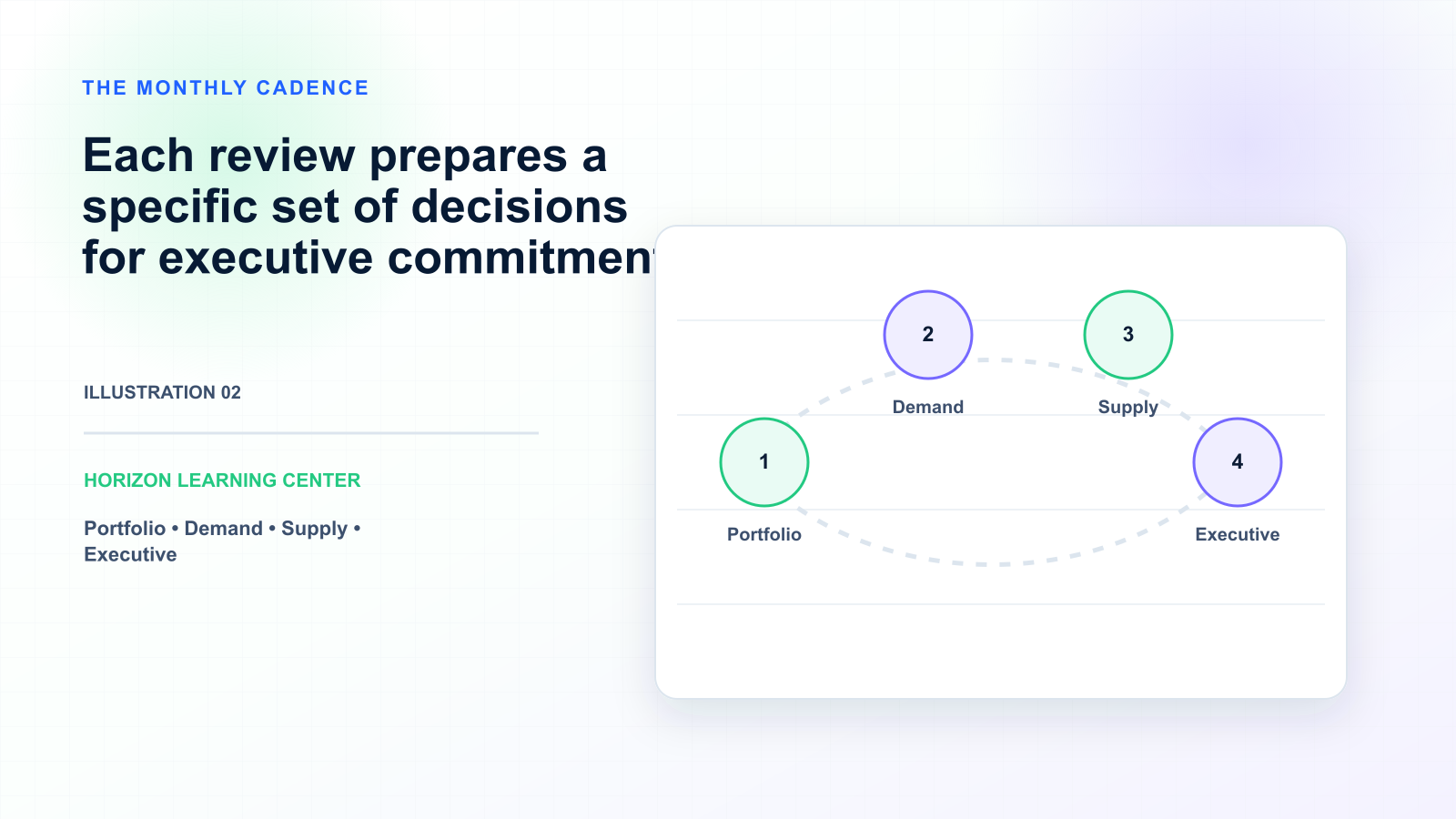
Demand Review: Reviews demand forecast, demand changes, demand-side risks and opportunities. Typically owned by demand planning function with sales input. Output: agreed demand forecast for the planning horizon.
Supply Review: Reviews supply plan against demand, capacity constraints, supply-side risks and opportunities. Typically owned by supply planning function with operations input. Output: agreed supply plan, identified gaps requiring resolution.
Pre-S&OP / Pre-IBP: Cross-functional reconciliation of demand and supply, scenario evaluation, decision preparation. Output: aligned recommendations and decisions for executive review.
Executive S&OP / Executive IBP: Senior leadership review and decision-making. Strategic operational decisions get made. Output: committed plan with resource commitments.
Monthly remains the standard governance rhythm for strategic operational decisions. Supplements: weekly reviews for high-volatility periods, daily briefings during disruptions, exception-triggered reviews for specific events. The honest guidance: supplementary cycles should be shorter and more focused than monthly meetings, not reproductions of monthly format.
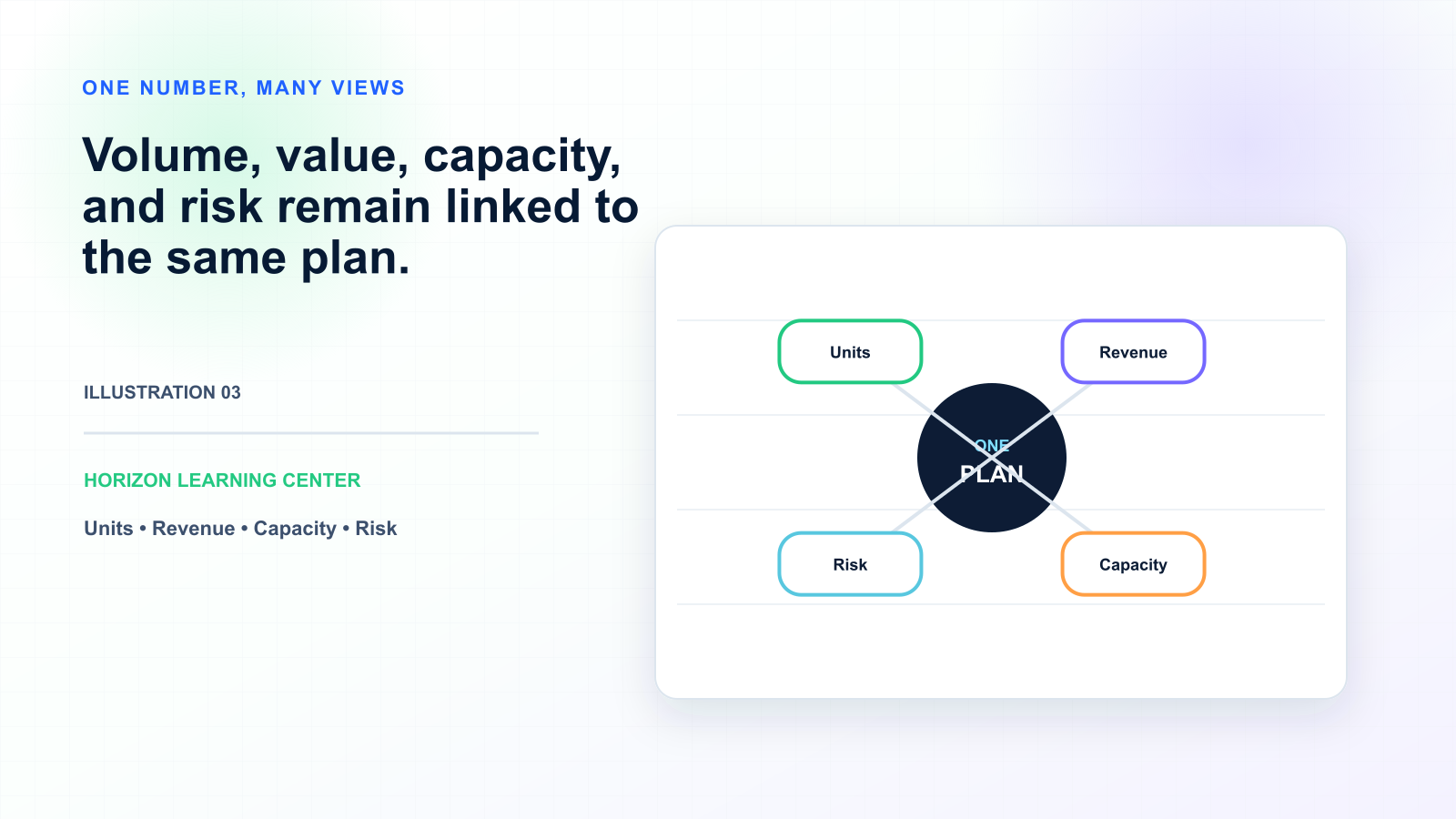
Translates volume plans into financial impact: volume × margin = revenue, inventory levels × carrying cost rate = carrying cost impact, capacity changes = capital impact. Connects operational decisions to financial outcomes executives evaluate.
Executive engagement increasingly requires financial framing. Supply-chain-only S&OP that focuses on operational metrics (units, capacity, fill rate) increasingly struggles to maintain executive attention because executives operate in financial language. Financial reconciliation translates operational outputs to executive decision language.
Operational metrics flow through to financial metrics via standard formulas: forecasted volumes × standard margins = projected revenue, inventory plans × carrying cost rate = projected carrying cost, capacity changes × capital cost = capital implications. Variance from financial plan gets surfaced for decision-making. Scenarios show financial implications under different assumptions.
Evaluates multiple potential futures (base case, upside, downside, specific stress tests) to support risk-aware decision-making. Each scenario shows operational implications and financial impact.
Single-point forecasts increasingly insufficient for executive discussion. Macro volatility makes point forecasts feel incomplete. Executive teams increasingly understand probabilistic thinking. Scenario planning supports risk-based decision making rather than commitment to false precision.
Base case: Most likely outcome based on current expectations. Foundation for committed plans.
Upside case: Favorable conditions — stronger demand, better availability, lower costs. Identifies upside management opportunities.
Downside case: Adverse conditions — weaker demand, supply disruptions, higher costs. Identifies risk mitigation requirements.
Stress tests: Specific event scenarios — loss of major customer, supplier failure, demand surge, regulatory change. Tests resilience under specific risks.
Senior leadership review and decision-making on strategic operational matters. Should drive decisions, not just review status. Output: committed plan with resource commitments and accountability.
Effective executive S&OP/IBP requires attendees with decision authority for their function — not delegates. Typical attendees: CEO or COO (depending on chair), CFO, VP Sales, VP Operations, VP Supply Chain, sometimes VP Marketing or VP HR depending on scope. Delegate attendance signals declining commitment and predicts rhythm decline.
Effective executive S&OP/IBP: makes decisions, surfaces escalations needing executive attention, addresses specific risks/opportunities with operational implications. Status-reporting executive S&OP/IBP: reviews dashboards, hears presentations, defers decisions to later meetings or to functional teams. The signs of decline: increasing presentation polish, decreasing decision count, attendance shifting to delegates.
Focused on demand. Reviews demand forecast quality (FVA, accuracy, bias), demand changes (new customers, lost customers, market shifts), demand-side risks and opportunities. Output: agreed demand forecast supporting downstream planning.
Focused on supply feasibility. Reviews supply plan against demand, capacity constraints, supplier performance, identified gaps. Output: supply plan and identified resolution requirements.
Sometimes integrated with supply review, sometimes separate. Specifically addresses capacity feasibility: where capacity constrains demand fulfillment, what capacity decisions are needed (add capacity, defer demand, shift production). Output: capacity decisions or escalations.
Typically COO or VP Supply Chain for supply-chain-led S&OP. CFO or CEO for finance-led IBP. The chair sets agenda priorities and decision authority. Chair selection often reflects organizational priorities — supply-chain-led emphasizes operational excellence; finance-led emphasizes financial integration.
Different decisions belong at different levels. Operational decisions (planning recommendations within authorized policy) at functional planning level. Tactical decisions (significant deviations from plan, capacity flex within authorized envelope) at S&OP/IBP demand or supply review. Strategic decisions (significant capacity changes, customer commitments, plan revisions) at executive S&OP/IBP. Decisions appearing at wrong level signal governance issues.
Mature S&OP/IBP tracks decisions through to execution: identified, owner assigned, deadline set, status tracked, completion confirmed. Without execution tracking, decisions get made in meetings but don't reliably translate to operational results. Modern platforms increasingly support this; traditional approaches sometimes track decisions in meeting minutes that get lost.
Most common failure: implementation succeeds initially, then drifts toward status reporting over 12-18 months. Executive engagement declines, delegates replace executives, decisions migrate outside the rhythm. The pattern is structural — addressing it requires explicit recommitment, not just better execution of current design.
Supply-chain-only S&OP without financial reconciliation increasingly loses executive attention. Executive language is financial; operational-only meetings don't speak it. The fix: integrate financial reconciliation as core agenda item.
Meetings where attendees lack decision authority can't make decisions. Whether through wrong attendance (delegates instead of executives) or unclear governance (who decides what), decision authority gaps prevent S&OP/IBP from driving decisions.
Following S&OP/IBP rhythm mechanically without substantive change to operational decisions. Companies sometimes implement S&OP "for the discipline" without expecting decisions to change as a result. Without changing decisions, the value-add is minimal — and over time, attendees recognize this and disengage.