Supply chain planning has accumulated specialized terminology over decades of practice. This glossary covers the terms that appear most frequently in platform evaluations, vendor conversations, and operational discussions. Each entry provides concise definition plus practical context — what the term means in operational reality, not just textbook definition.
For deeper treatment of specific topic areas, see the thematic concept articles on demand planning, supply planning, production scheduling, and S&OP/IBP linked throughout.
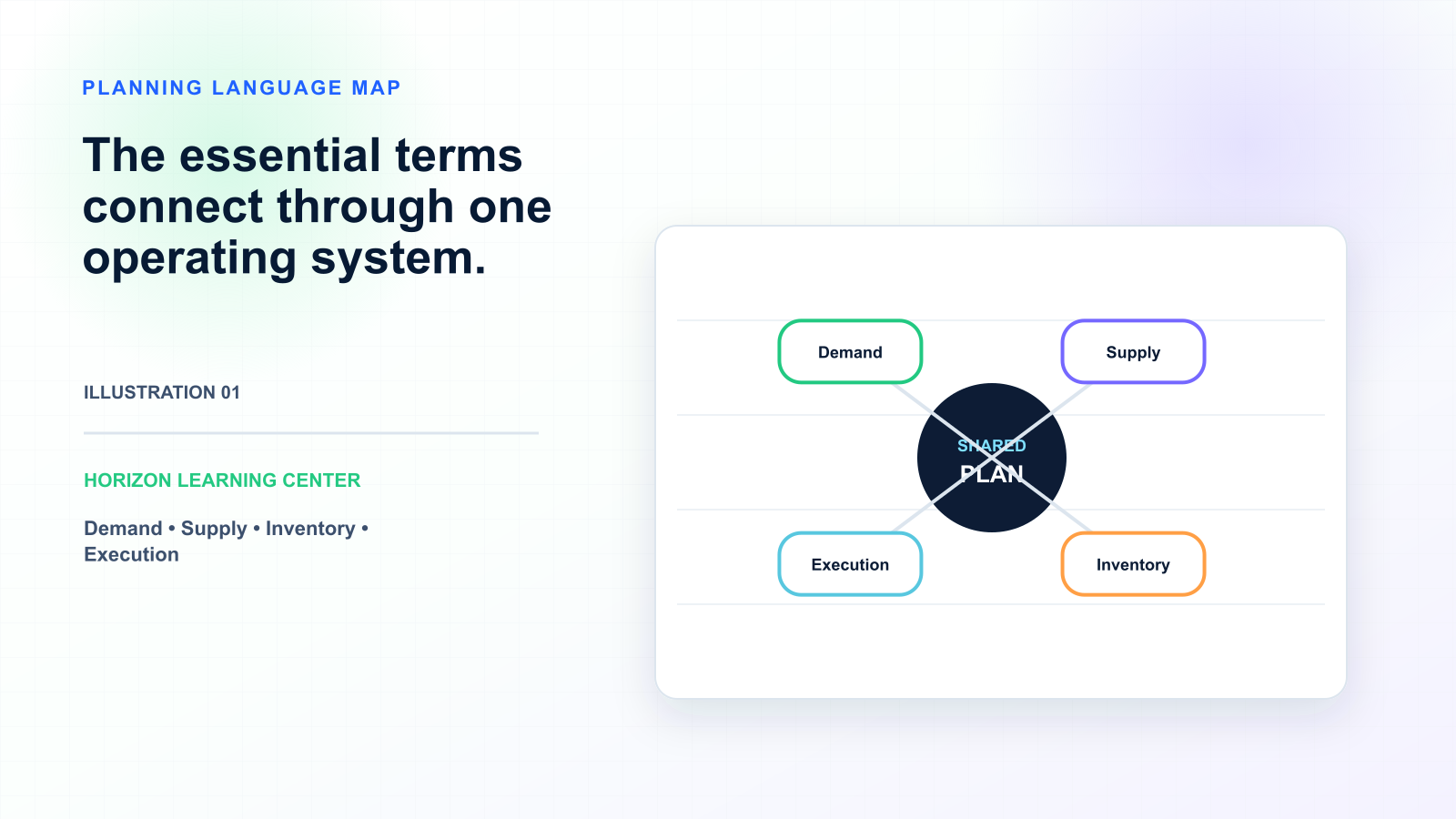
Each term in this glossary maps to operational reality. The deeper treatments in our thematic concept articles (demand planning, supply planning, production scheduling, S&OP/IBP) explain how these concepts work together in mature supply chain planning practice. Platform evaluations benefit from terminology clarity — vendor positioning gets misunderstood when terms have different meanings to different parties.
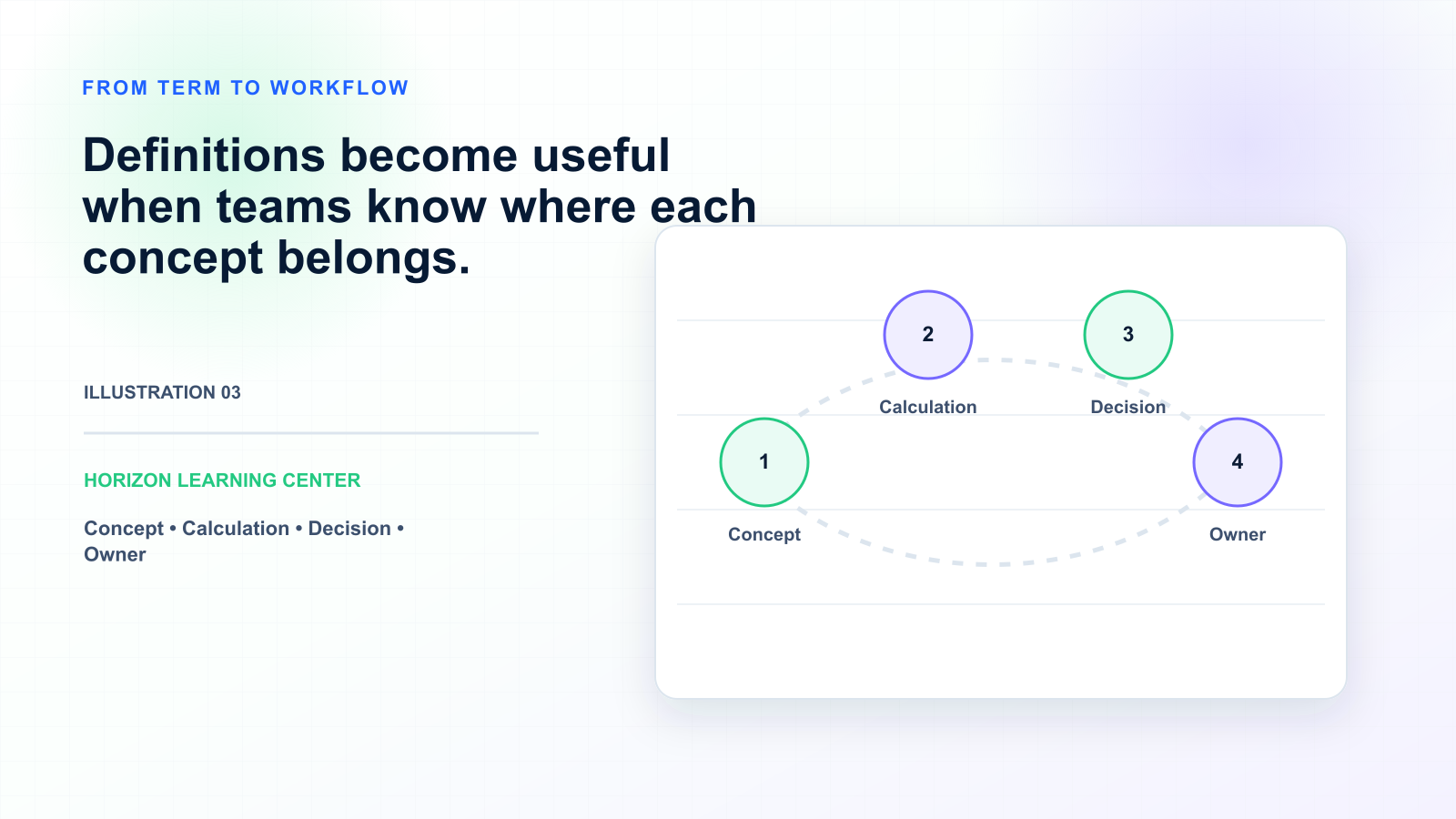
Supply chain planning conversations often suffer from terminology confusion. Vendors use the same terms with different meanings. Consultants use industry-specific jargon. Internal teams develop company-specific vocabulary. The result: meetings where participants think they're discussing the same thing but aren't, and platform evaluations where vendor positioning gets misunderstood.
This glossary provides standard definitions to reduce terminology confusion. The definitions reflect mainstream industry usage rather than any specific vendor's positioning.
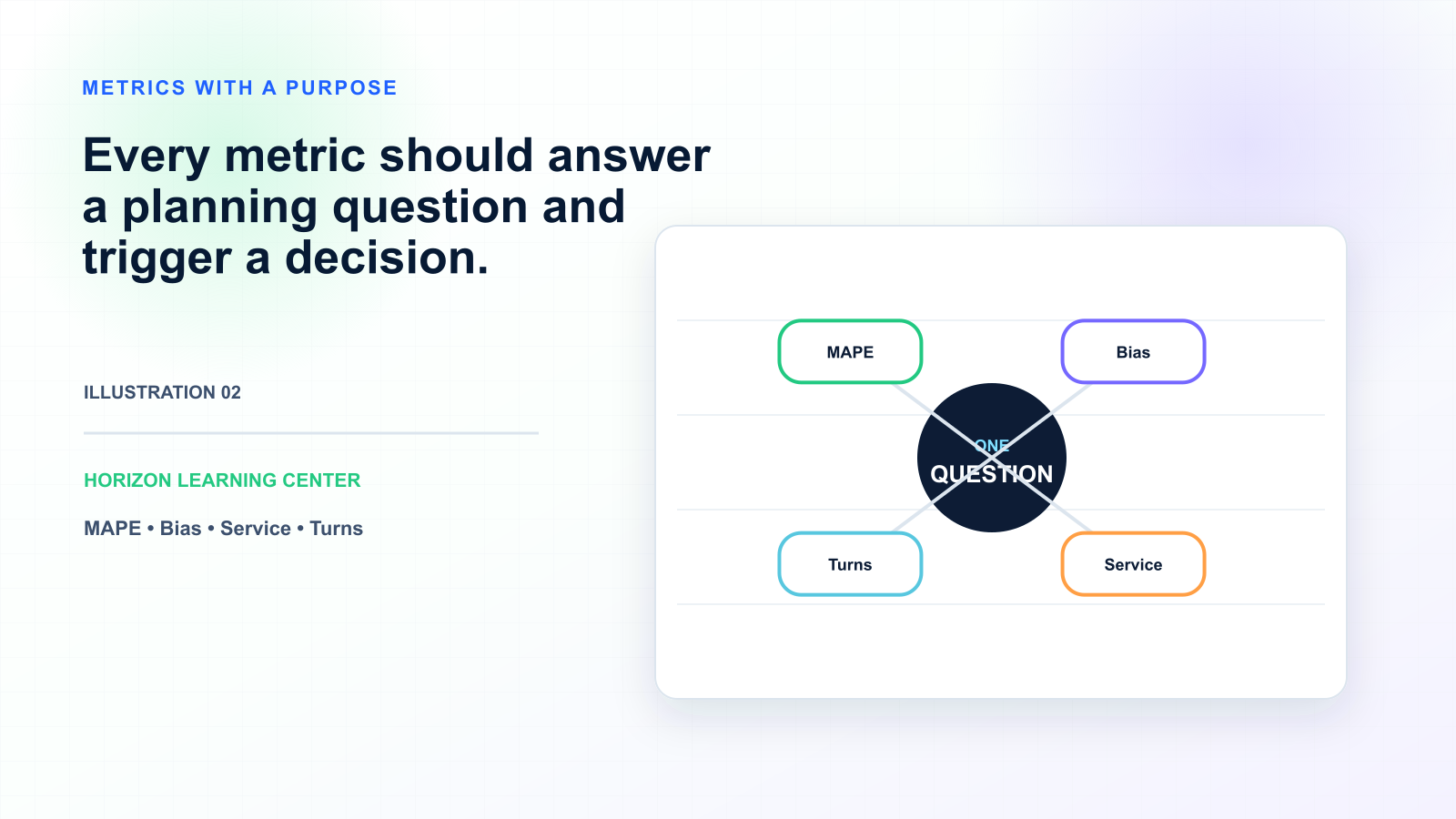
Demand Planning: The process of forecasting customer demand to drive operational decisions (production, inventory, capacity). Includes statistical/ML forecasting, planner overlays, demand sensing, and forecast governance.
Demand Sensing: Using short-cycle market signals (point-of-sale data, recent orders, market intelligence) to refine near-term forecasts. Most valuable for retail-heavy CPG and fast-cycle products.
Forecast Accuracy: Measure of how closely forecasts match actuals. Common metrics: MAPE (Mean Absolute Percentage Error), WMAPE (Weighted MAPE), MAD (Mean Absolute Deviation), RMSE (Root Mean Square Error). See Demand Planning Concepts Explained.
Forecast Bias: Systematic over- or under-forecasting. Differs from accuracy — total accuracy can look acceptable while bias is significant. Tracking signal monitors cumulative bias over time.
Forecast Value Added (FVA): Methodology measuring whether each step in the forecasting process (statistical baseline, ML overlay, planner adjustment, S&OP consensus) adds accuracy or adds noise. Helps identify which overlays are valuable and which subtract value.
Ensemble Forecasting: Combining multiple forecasting methods (statistical and ML) with automatic per-SKU model selection. See How Ensemble Forecasting Works.
MAPE / WMAPE: Mean Absolute Percentage Error / Weighted MAPE. MAPE averages absolute percentage errors across SKUs. WMAPE weights by volume or value, giving high-value SKUs more influence on the metric.
Statistical Forecasting: Forecasting methods based on time-series statistics (exponential smoothing, ARIMA, Holt-Winters, Croston). Distinguished from ML methods that learn patterns from data more flexibly.
Causal Forecasting: Forecasting that incorporates external factors (price, promotion, weather, economic indicators) beyond pure time-series patterns.
Croston's Method: Statistical method for intermittent demand (slow-moving SKUs with sporadic orders). Separates demand into magnitude and inter-arrival time.
Forecast Horizon: How far into the future forecasts extend. Common horizons: weekly for 0-3 months, monthly for 3-18 months, quarterly for 18+ months. Horizon should match decision horizon.
Forecast Lag: Time gap between when forecast is made and when forecasted period occurs. Forecast made in January for May has 4-month lag. Accuracy typically declines with lag length.
NPI (New Product Introduction): Forecasting and planning for new products without historical demand. Methods include analog-based, lifecycle curve, and structured judgment.
EOL (End of Life): Planning for products being phased out. Includes managing remaining demand, run-out timing, and substitution planning.
Promotional Uplift Modeling: Separating baseline demand from promotional uplift to forecast each accurately. Promotional history tagging is foundational.
Outlier Detection: Identifying historical data points that don't represent normal demand (e.g., one-time large orders, system errors) to prevent them from skewing forecasts.
Seasonality: Repeated patterns within a year (e.g., summer cooling, winter heating). Modeled in seasonal forecasting methods (Holt-Winters seasonal, SARIMA).
Trend: Underlying directional movement in demand over time (growth, decline). Distinguished from seasonality (cyclical) and random variability.
Supply Planning: Translating demand forecasts into feasible production and procurement plans considering capacity, materials, and lead time constraints.
MRP (Material Requirements Planning): Calculation of material requirements based on demand, BOMs (Bill of Materials), and inventory positions. Traditional MRP assumes infinite capacity.
MPS (Master Production Schedule): Top-level production plan specifying what will be produced when, typically at end-item level.
Safety Stock: Inventory held above expected demand to buffer against forecast error and supply variability. See Supply Planning Concepts Explained.
Service Level: Target probability of meeting demand from stock without stockout. Common targets: 95-98% for A-class SKUs, 90-95% for B-class, 85-90% for C-class.
MEIO (Multi-Echelon Inventory Optimization): Inventory optimization considering all locations together (manufacturing buffer, distribution centers, satellite warehouses) rather than each location independently.
Lead Time: Time from order placement to receipt. Includes supplier lead time, transportation time, and processing time. Variability in lead time affects safety stock requirements.
Lead Time Variability: Standard deviation of actual lead times versus quoted lead times. Often substantial in real supply chains and significantly affects safety stock math.
Reorder Point (ROP): Inventory level triggering a replenishment order. Calculated based on expected demand during lead time plus safety stock.
Economic Order Quantity (EOQ): Order quantity minimizing total cost of ordering plus carrying cost. Theoretical foundation more than operational practice in modern supply chains.
Bullwhip Effect: Amplification of demand variability moving upstream through supply chain (retailer to distributor to manufacturer to supplier). Driven by order batching, demand signal interpretation, lead time changes.
Available-to-Promise (ATP): Available inventory plus scheduled receipts not yet committed to existing orders. Used to commit delivery dates to new orders.
Capable-to-Promise (CTP): Like ATP but also considers production capacity availability. Used when current inventory and scheduled receipts can't meet demand but additional production is feasible.
Finite Capacity Planning: Planning that respects actual capacity constraints rather than assuming infinite capacity (standard MRP assumption).
Production Scheduling: Detailed sequencing of work orders on specific resources (machines, lines, work centers) over short horizons (typically days to weeks).
APS (Advanced Planning and Scheduling): Software systems performing finite capacity scheduling with constraints like sequence-dependent setups, resource capabilities, material availability.
Sequence-Dependent Setup: Setup/changeover time depends on what was running before. Critical in chemicals, food, pharma where changeovers require cleaning and qualification.
Campaign Planning: Grouping similar products into production campaigns to minimize changeovers. Common in process industries with shared equipment.
Changeover: Time and cost of switching production from one product to another. Includes cleaning, setup, qualification, sometimes regulatory documentation.
Drum-Buffer-Rope: Theory of Constraints scheduling approach. The constraint (bottleneck) is the drum, buffer protects it from upstream variability, rope ties production releases to drum capacity.
Bottleneck: Resource constraining overall throughput. Identifying and managing bottlenecks is central to Theory of Constraints. See Production Scheduling Concepts Explained.
OEE (Overall Equipment Effectiveness): Measure of equipment productivity combining availability, performance, and quality. Standard manufacturing metric.
S&OP (Sales and Operations Planning): Cross-functional monthly planning process aligning demand, supply, inventory, and operational decisions. Originated in supply chain function.
IBP (Integrated Business Planning): Evolution of S&OP including financial reconciliation, scenario planning, and broader cross-functional governance. Often finance-led or cross-functional.
Demand Review: S&OP/IBP meeting reviewing demand forecast, demand changes, and demand-side risks/opportunities.
Supply Review: S&OP/IBP meeting reviewing supply plan, capacity constraints, and supply-side risks/opportunities.
Capacity Reconciliation: Process of validating supply plan feasibility against capacity, identifying capacity gaps and resolution options.
Financial Reconciliation: Translating volume plans to financial impact (revenue, margin, working capital) for executive review and decision-making.
Executive S&OP: Executive-level meeting where strategic operational decisions get made. Should drive decisions, not just review status. See S&OP and IBP Concepts Explained.
Scenario Planning: Evaluating multiple potential futures (base case, upside, downside, stress tests) to support risk-aware decision-making.
FVA (Forecast Value Added): See demand planning section. Often discussed in S&OP/IBP context as accountability mechanism for forecast quality.
SKU (Stock-Keeping Unit): Unique product identifier at the level inventory is managed. Granularity varies by company.
BOM (Bill of Materials): List of components and quantities required to manufacture a product.
OTIF (On-Time In-Full): Service level metric measuring percentage of customer orders delivered on time and complete.
ERP (Enterprise Resource Planning): Transactional system of record for orders, inventory, financial transactions, etc. Foundation for planning systems but separate from them.
WMS (Warehouse Management System): Execution system for warehouse operations (receiving, putaway, picking, shipping). Separate from planning systems.
TMS (Transportation Management System): Execution system for transportation (carrier selection, routing, tracking). Separate from planning systems.
SCP (Supply Chain Planning): Umbrella term covering demand planning, supply planning, inventory optimization, scheduling, and S&OP/IBP.