Demand planning has been one of the most active areas of SCP investment over the past three years. The trends we describe below are based on observed customer behavior and platform capability development through 2025 — not analyst projections about what should be happening.
The headline: demand planning practice in 2026 looks meaningfully different from 2023, but not in the ways most analysts predicted. AI capability is real but more selective than positioning suggests. Some traditional capabilities (ensemble forecasting, FVA tracking, demand sensing) matured significantly. Other promised capabilities haven't delivered the dramatic improvements vendor positioning suggested.
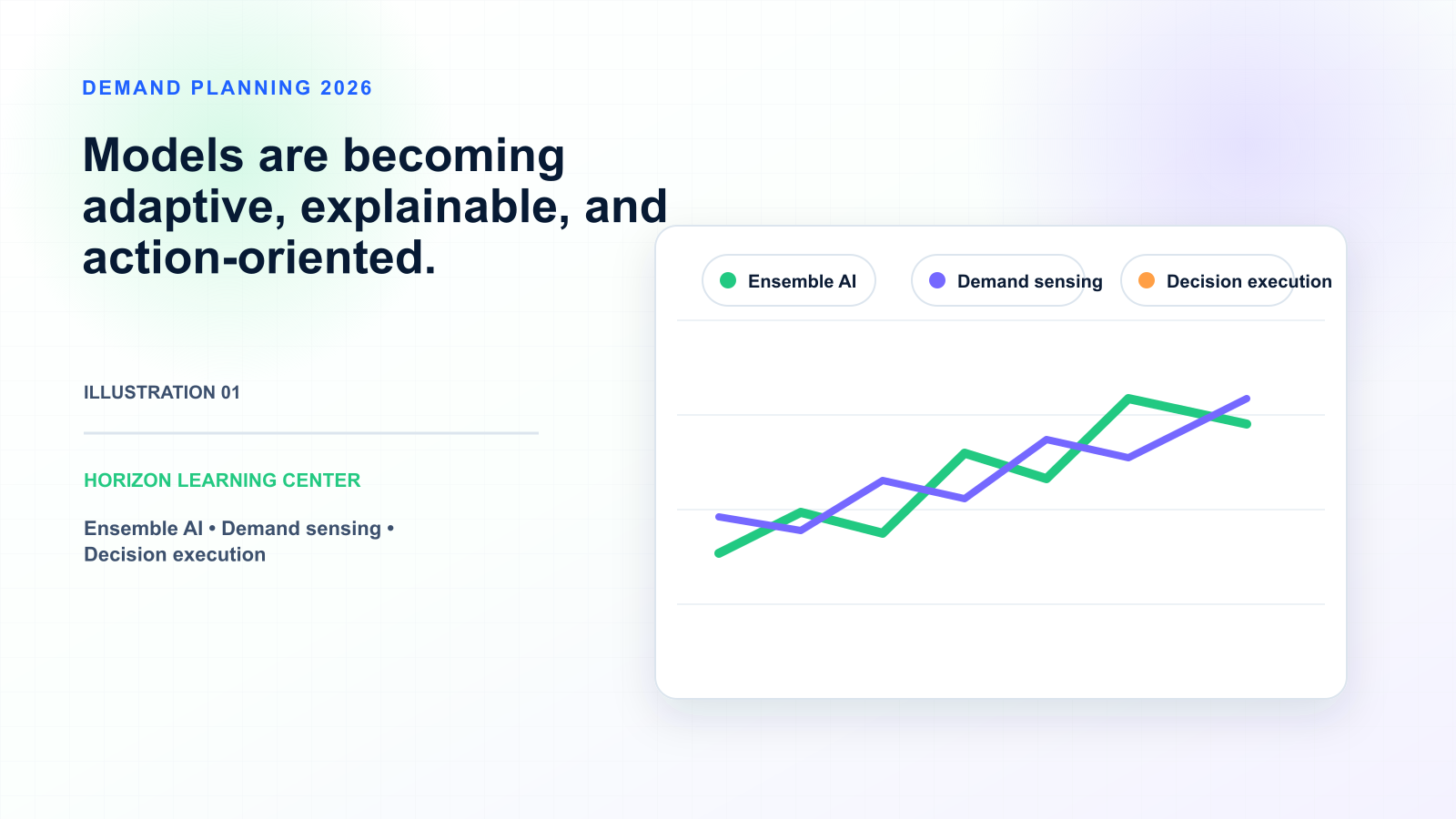
Horizon participates in several of the trends described: ensemble forecasting with automatic per-SKU model selection, integrated FVA tracking, decision execution proposing specific actions based on forecast changes, ML methods integrated with statistical methods rather than replacing them. The platform fits mid-market manufacturers ($100M-$3B revenue) wanting these capabilities at scale-appropriate cost.
What Horizon doesn't optimize for: retail-grade demand sensing (Blue Yonder, RELEX excel here), enterprise knowledge graph reasoning (o9), concurrent planning across global complexity (Kinaxis). For these specific needs, the platforms named above typically fit better than Horizon.
Companies making demand planning platform decisions or extending existing platforms benefit from understanding the actual capability landscape, not vendor positioning. The patterns below help buyers identify which capabilities are mature (worth investing in), which are still maturing (worth evaluating carefully), and which are largely marketing positioning (worth discounting in evaluation).
Three years ago, ensemble forecasting (combining multiple statistical and ML methods with automatic per-SKU model selection) was a differentiator among demand planning platforms. By 2026, it's table stakes for serious platforms — modern mid-market platforms (Horizon, Flowlity, RELEX) and enterprise platforms (Kinaxis, o9, SAP IBP) all offer some version. The differentiation has shifted to implementation depth: how many methods, how automatic the selection, how transparent the model choices to planners, how well the platform handles model selection edge cases.
What this means operationally: buyers evaluating demand planning platforms should expect ensemble capability and probe its specifics rather than be impressed by it. The question isn't "do you have ensemble forecasting" — it's "how many methods does your ensemble include, how are they selected, and what do you do when none fit?"
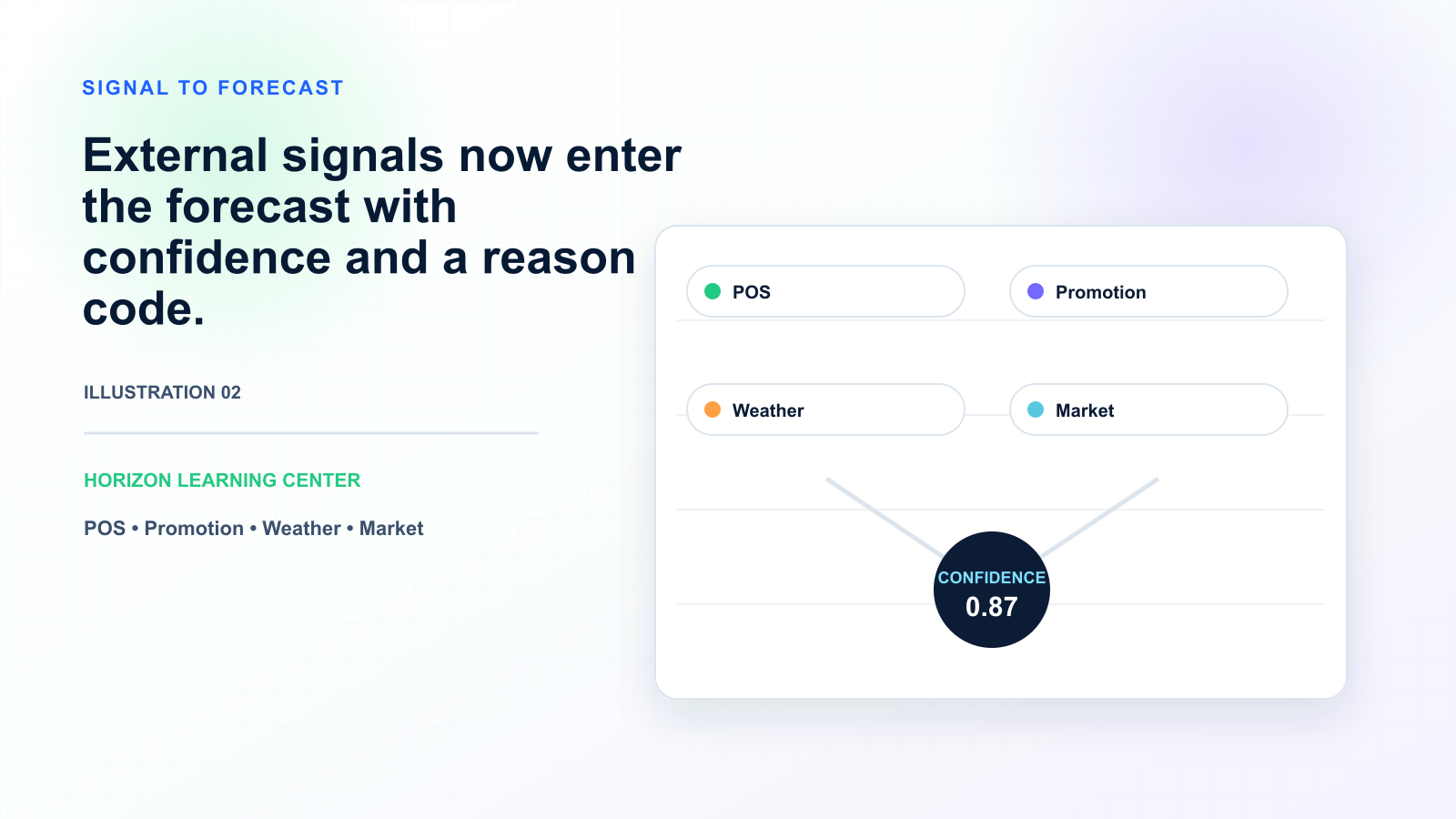
Demand sensing — using short-cycle data (POS, orders, market signals) to refine near-term forecasts — has been positioned as a major capability since 2018. The 2026 reality is more nuanced: demand sensing delivers measurable value for specific operational patterns (CPG with retail point-of-sale data, fast-cycle products, promotional periods) and limited value for others (slow-moving items, B2B with monthly order patterns, deep capital equipment).
The platforms with strongest demand sensing capability: Blue Yonder (deep retail integration), RELEX (retail-specific demand sensing), o9 (knowledge graph reasoning). For mid-market operations without significant retail channel, demand sensing capability matters less than basic forecasting accuracy and decision execution.
2022-2023 vendor positioning often suggested ML methods would replace statistical methods. The 2026 reality: ML methods integrated alongside statistical methods in ensemble approaches. Statistical methods (exponential smoothing, Holt-Winters, ARIMA, Croston) remain valuable for specific patterns. ML methods (gradient boosting, neural networks, Prophet variations) deliver value for other patterns. Per-SKU automatic model selection picks appropriately — sometimes ML, sometimes statistical, sometimes ensemble combinations.
What this means: buyers should be skeptical of platforms positioning pure ML approaches as universally superior. The mature pattern combines methods rather than replacing one with the other.
FVA — measuring whether planner overlays add accuracy or add noise — was a niche practice in 2018. By 2026, it's standard across mature demand planning operations. The change happened gradually as platforms made FVA easier to track and as planners accepted that overlay value is variable rather than uniformly positive.
The maturity has implications for platform evaluation: platforms without native FVA capability are increasingly behind. Manual FVA tracking in Excel works but is friction-heavy. Platforms with embedded FVA workflows (Horizon, Logility, Kinaxis, SAP IBP) deliver this more cleanly.
NPI forecasting (forecasting products without history) remained challenging through 2024. Analog-based methods (find similar products, apply their patterns), ML methods with cold-start techniques, and structured judgment frameworks all matured through 2025-2026. None solved NPI completely — products without history are inherently uncertain — but the gap between best-practice NPI forecasting and unstructured approaches widened.
For companies launching products frequently (CPG, consumer electronics, medical devices), NPI forecasting capability now matters more in platform evaluation than it did in 2023.
Traditional demand planning produced forecasts that other functions interpreted. The 2026 trend: demand planning increasingly proposes specific actions based on forecast changes — adjust this safety stock, expedite this PO, reallocate this capacity, communicate this change to this supplier. The shift connects demand planning to broader supply chain action rather than treating it as a standalone forecasting exercise.
The platforms strongest in this shift: modern mid-market platforms (Horizon's decision execution layer, Flowlity's action focus) and select enterprise platforms (Kinaxis Maestro AI, o9 cross-function reasoning).
Average industry forecast accuracy improved modestly. Despite ensemble forecasting maturity, ML integration, and demand sensing, average forecast accuracy across the industry moved 1-3 percentage points overall. Significant accuracy gains concentrated in companies with strong data foundations and analytical capability. Companies expecting platforms to deliver dramatic accuracy improvement without addressing data quality were disappointed.
Data quality remained the dominant constraint. The single most under-discussed factor in demand planning outcomes: master data quality, history cleanliness, and integration data reliability. Platforms can only forecast what data shows. Companies with messy data extracted limited value from sophisticated platforms.